When Peepabun Was More Than a Name on Google Maps
Once a thriving centre of Christian revivalism, Peepabun was known for its annual camp meetings in the early 1900s.
Turn north off Dufferin Road 109 onto East Luther Sideroad 21-22, and you’ll encounter a landscape of pancake-flat, carefully tended farm fields and, in the distance, giant wind turbines. What you won’t find is any hint that Peepabun was once a thriving centre of Christian revivalism.
That’s not surprising. Even in its heyday, Peepabun — its curious-sounding name is said to derive from an Anishinaabe word meaning “dawn of day” or “turn of the day” — was a widely scattered farming community. Its nucleus, if there was one, may have been the post office, which closed in 1912.
But for a time, at least, annual camp meetings, a popular evangelical tradition that had spread north from the United States, focused widespread attention on the community. The photo shows some of the congregants, decked out in Sunday-go-to-meeting finery, at a Peepabun camp meeting in 1905.
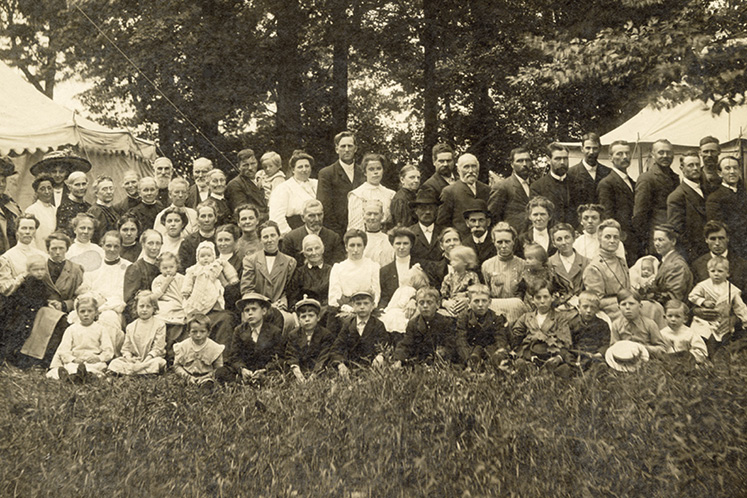
The Peepabun meetings, which began in about 1898, took place every summer on a local farm and attracted the faithful from as far away as the northern U.S. Camping out, the visitors attended outdoor services several times a day over the course of about 10 days.
A church, Victory Chapel, was built, but most camp services were held outdoors in a “brush arbour.” The arbour was assembled by collecting long, green — and therefore flexible — poles and planting them in two parallel lines about 30 feet apart. The tops of the poles were bent toward each other and lashed together to create an arched frame that was covered in evergreen boughs.
Inside, wooden benches provided seating, sawdust covered the ground, and a platform was built for the singers and the preachers, usually visiting ministers and missionaries.


By the 1930s, however, enthusiasm for camp meetings was fading, and the Peepabun meetings died out. Victory Chapel was eventually torn down, the Peepabun post office had long since closed, and in the 1960s, the community’s Presbyterian church met the same fate as Victory Chapel.
Today, Peepabun’s halcyon days are largely forgotten. But its name, said to be the only Indigenous place name in Dufferin County, endures, even if only on Google Maps.
Related Stories

The Little Engine That Could
Steam locomotives like the James McKay helped shape and build our communities in the early 1900s.

Now, That’s a Snow Fort!
The historic Globe Hotel in Erin was the backdrop for many key moments in the town’s growth, until the landmark burned down in 1945.

The Old Fire “Excape” at Shelburne’s Old School on the Hill
Shelburne’s old ‘school on the hill’, built without fire escapes, added in two evacuation slides which students gladly used during fire drills.

Jolting Along the Gravel Road
Back when it took four hours to travel 30km from Erin to Guelph by stagecoach, a bumpy ride was a guarantee.