Meet the Maker: Darlene Hostrawser
This Mono weaver draws inspiration from her rural surroundings to create her refined handwoven blankets and textiles.
The digital world vanishes at the threshold of Darlene Hostrawser’s weaving studio, tucked into the lower level of the Mono home she shares with her partner, Steve Crocker. This is an analog zone, replete with soft yarns in a rainbow of natural colours, a library of pattern books and, of course, woven blankets, scarves, kitchen textiles and wall hangings.
“I try to limit my exposure to social media, as I don’t want to be influenced by popular trends or styles,” says Hostrawser.
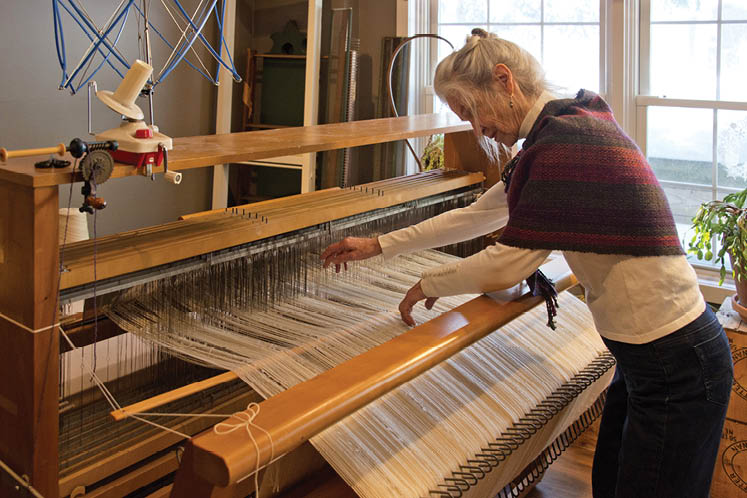
The vibe is cozy, tactile and traditional. A spinning wheel is not simply decorative – Hostrawser often spins her own yarn and teaches spinning to others. Two Leclerc floor looms, one 45 inches wide and the other 60 inches, dominate the space. A warping board holds yarn ready to be loaded onto a loom. Light spills in through the windows, with trees and fields filling the vista. Hostrawser finds this setting essential to her creative inspiration, especially at dawn, her favourite time to be outside.
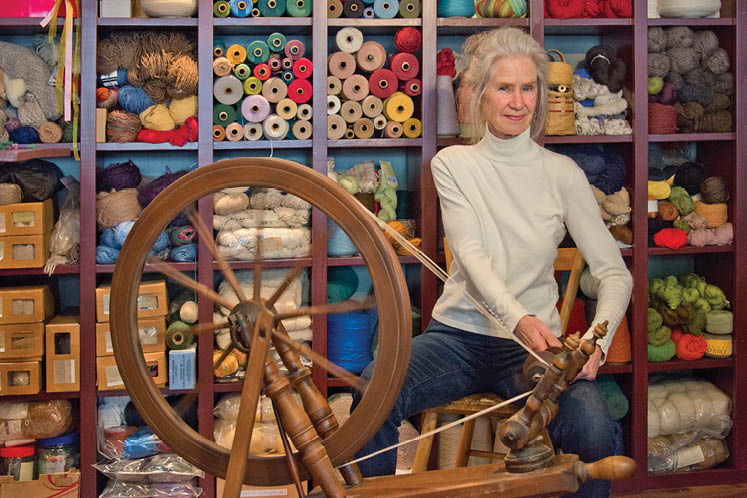
Her process starts with yarn, usually purchased from nearby Camilla Valley Farm Weavers’ Supply, which stocks not only yarn, but also looms and loom parts.
Blankets, her most popular item, also provide her with the greatest creative satisfaction because the larger size opens a plethora of design possibilities. She also enjoys imagining a blanket’s end use, as it’s an item people will often enjoy for years or decades.
After deciding on a pattern, Hostrawser warps the loom, the first step in the weaving process. The warp forms the lengthwise foundation of a woven piece, and she starts by rolling pre-measured warp threads onto the cylindrical warp beam at the rear of the loom.
The ends of the warp threads are temporarily suspended in place, ready to be threaded, one at a time, through the heddles of each harness needed to create the chosen pattern. The number of harnesses – she may use as many as eight – depends on the pattern. Then each warp thread is passed through the reed, which keeps the threads aligned and evenly spaced.
The final step is crucial. She ties the threads to the apron attached to the front beam, which rolls to keep the piece snugly wrapped as it lengthens. The tension of the warp threads must be uniform, and Hostrawser’s experience helps her judge when the feel is just right.


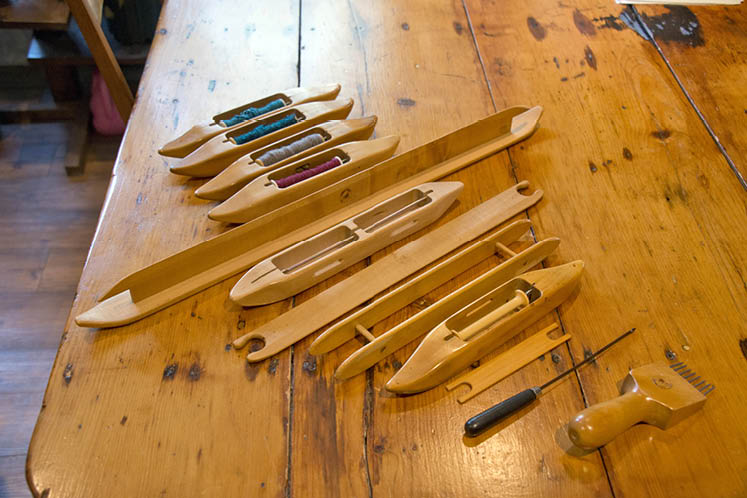
Pressing on the treadles lifts specific harnesses to create the shed, the space for the shuttles containing bobbins of the coloured yarns that form the weft, the crosswise threads that are woven over and under the warp threads. Seated at the front of the loom, Hostrawser guides a shuttle through the shed and draws the beater bar forward to secure each row. This sequence repeats, back and forth, row upon row, until a piece is finished.
“Weaving may look meditative – and it is – but it is also a very physical and active process,” she says. “It can also be quite time-consuming. It often takes me a few days to get into the rhythm of the piece, and then I might weave for weeks to complete it.”
Hostrawser’s desire to create with textiles began as she was growing up on the family’s East Garafraxa farm, the same farm where, today, her brother, Daryl, who has represented Canada five times at the World Ploughing Championship, continues to hone his considerable ploughing skills. She was encouraged by her mother, aunts and neighbourhood women, who were skilled in knitting, crocheting and quilting, and who enthusiastically shared their knowledge.
After high school, Hostrawser majored in weaving at the Sheridan College School of Craft and Design, then completed an 18-month apprenticeship with Edna Blackburn, who helped revive interest in spinning and weaving, at the Albion Hills Farm School in Caledon. Blackburn raised Corriedale sheep, a breed known for its exceptional wool, and Hostrawser learned about spinning and natural dyeing, in addition to helping teach students.
She also learned multi-harness weaving from Susan Jarmain, an internationally known weaver, and studied incorporating artful approaches while attending the Atlin Centre for the Arts in northern B.C. for two summers.
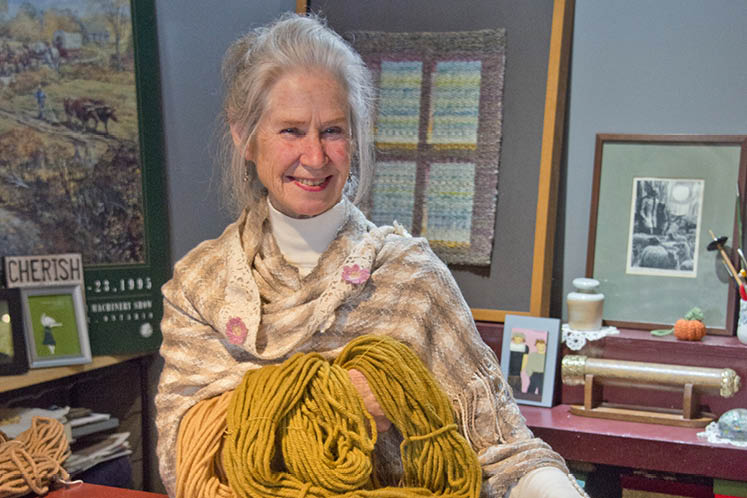
Decades later, Hostrawser continues to teach in the community, helps local weavers set up their looms and introduces kids at Westminster United Church to the wonders of wool.
Nature pops up often in Hostrawser’s weaving. For Headwaters Arts’ annual Tapestry of Art and Music show last spring, for example, her entry included strips of woven birch bark. Her work also features regularly at the Museum of Dufferin’s annual juried Holiday Treasures Craft Market.
Hostrawser’s clients purchase from shows like these or directly from the studio. She relies largely on word of mouth, as she is not a huge fan of digital promotion, though she does maintain a presence on Instagram at handwoven_cloth_culture.
Timelessness is a key theme of her work. Her favourite piece is the blanket she wove for her newborn son – an open double weave with mohair and merino in soft, vibrant pastels. “I still feel the joy of that little miracle whenever I have it wrapped around me.” Her son, daughter-in-law, and grandchildren live nearby, and she is grateful that family members can support one another and that she can watch the kids grow.
Hostrawser’s view of community extends to art. A retired social worker who worked for 30 years in Dufferin and Caledon, she understands the importance of community support and respect. “I think about those values a lot and integrate them into my artistic philosophy.”
She likens various yarns to the various characters and qualities encountered in life. “When I weave, I create an interwoven fabric, just like a community,” she says. “Yarns, and people, too, interact uniquely with one another. Everything responds to how we are treated, in weaving and in life.”
Related Stories

Meet the Maker: Leslie Knight
With a rug hook and strips of wool fabric, this Caledon textile artist captures the beauty of nature.
Meet the Maker: Johana Cordero
For this weaver, the warp and weft of life is much more than a metaphor.