Newt Love
Newts fall in love too but, as in human affairs, persistence, gentle wooing and perhaps a splash of cologne can help win the day.
Birds do it, bees do it
Even educated fleas do it
Let’s do it, let’s fall in love
In Cole Porter’s classic, popularized by the incomparable Ella Fitzgerald, all manner of critters fall in love. Not only birds, bees and fleas, but “romantic sponges and Cape Cod clams” too. And here in Headwaters newts do as well, in passionate liaisons in local ponds.
Many species of animals are sexually dimorphic, meaning that males and females look different. In some, males are generally larger and more powerful. That includes us. In other animals, the ladies assume the more dominant physical roles. Turtle females, for example, are often much larger than their male suitors.
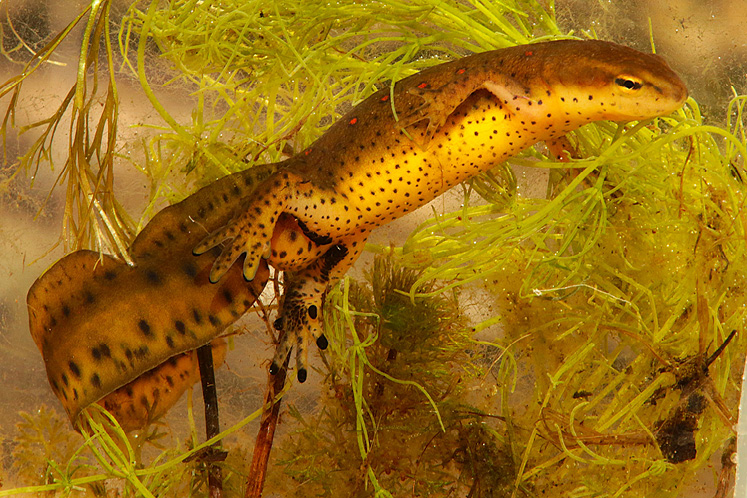
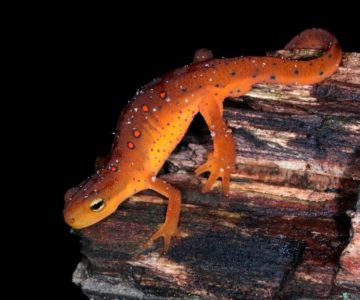
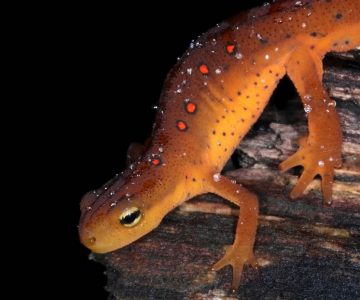
In the newts’ world the males differ from females in several ways. Though usually bigger than their mates, the most obvious difference between male and female newts is tail size. Male newts sport flamboyant finlike tails that are much larger than female tails.
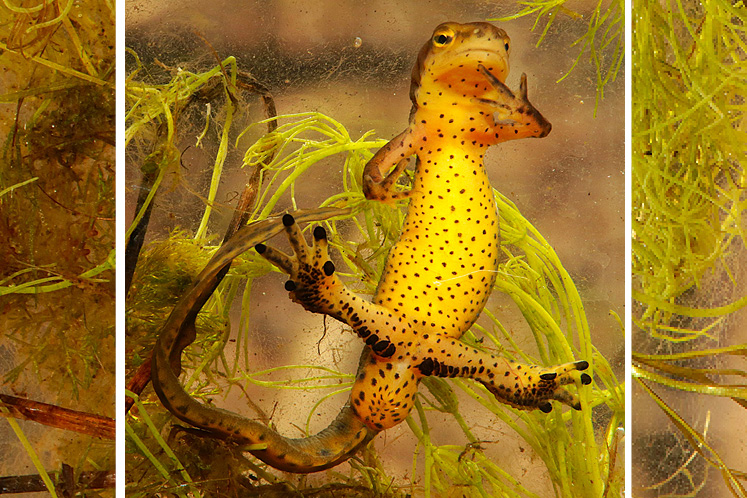
And male newts have back legs that evoke Popeye’s forearms. They use these powerful legs to encircle female necks and hug them tightly during courtship. Rough black pads on male toes also help grip the females.
But to properly woo female newts, the males must do more than demonstrate their brawn. They also need to seduce females with their specialized newt cologne. They waft this intoxicating scent towards the snouts of females, by waving those extravagant tails.
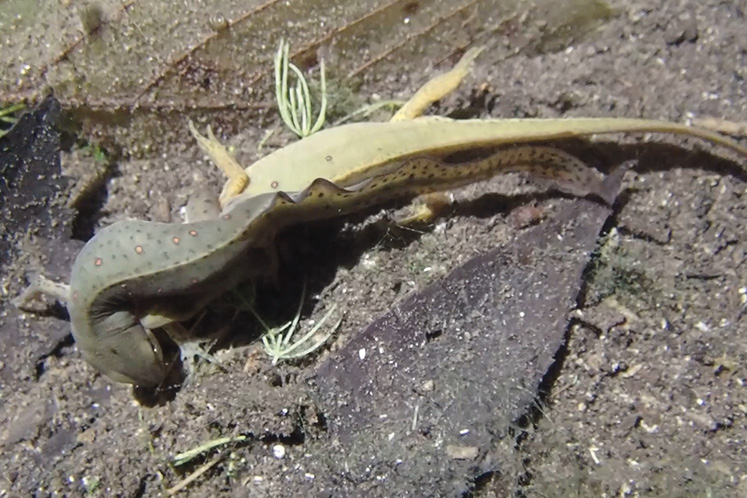
The rigorously scientific among us might prefer the term “pheromone” instead of cologne, but whatever you call this seductive fragrance, it appears to be an essential part of newt love. Only after hours of inhaling a male’s scent, will a female be sufficiently aroused to lay eggs.
So, newts fall in love too but, as in human affairs, persistence, gentle wooing and perhaps a splash of cologne or perfume can help win the day.
Related Stories
Adapting to Survive
Animals use camouflage, poison and deception to live another day.
Hopping and Walkin’ in the Rain
This is the time of year to get out after dark and explore… especially as the rain falls.