
Fixing What’s Broke
Reducing waste by giving new life to broken household items is the mantra of ecoCaledon’s popular Repair Cafés.
Among the synonyms for “broken” are faulty, defective, malfunctioning, inoperative, in disrepair, shot, snapped, smashed, torn, rent, kaput and the delightfully puzzling on the fritz.
Just who Fritz is, or was, remains uncertain. What is certain was that the goofy, foot-tall doll my late mother knitted decades ago had seen better days.
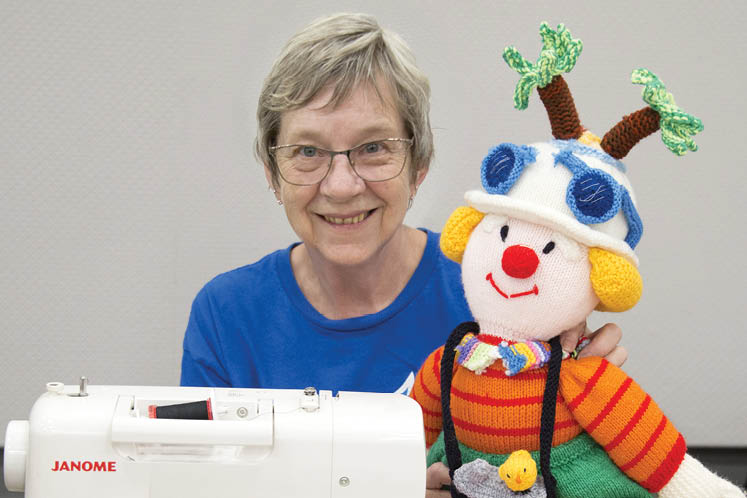
A multicoloured “traveller” character, he sports lurid knitted shorts, sunglasses and a hat sprouting palm trees, and bears a knitted camera (with little birdy), a duck-headed brolly and a never-ending “V” of a smile sewn on in red wool. But time, inattention, kids and misadventure had seen the scarf of Tony the Traveller badly worn, his grip on his umbrella torn and his portmanteau in need of a darn.
On a crisp fall Saturday at the Caledon East Community Complex, “Tony” finds himself in the lap and under the studied gaze of Chris Millar, a “sewist”– the current term for sewer or someone who sews, I learned. She is one of a group of volunteer fixers occupying tables at a Repair Café organized by ecoCaledon, a non-profit group promoting environmental policies and waste reduction. Lining the walls of a big, bright auditorium are a dozen or more tables, functioning as workspaces for the volunteers surrounded by fix-it paraphernalia and an aura of decades of knowledge of their craft.
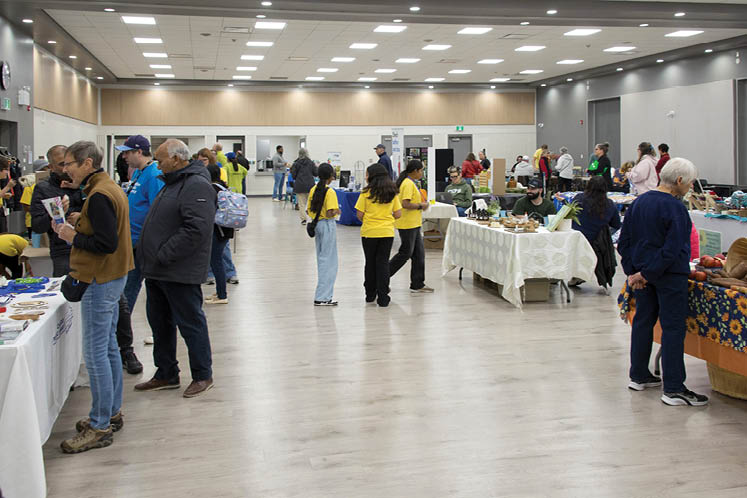
They await a steady stream of broken things to be fixed, free of charge, for whomever shows up. Those with newly repaired items go home happy and their erstwhile “junk” avoids becoming landfill. Fix. Win. Win. With the added win of pleasant encounters with neighbours, fixers, fixees and amiable gawkers wishing to learn.
An electronics whiz
By nature and by geography, Polish-born and -raised Bolton resident “Kaz” Osuchowski (he immigrated to Canada in 1990) is a fixer with a strong DIY philosophy. “I spent half my life in a socialist/communist system, and you had to fix things,” he says. “You fixed things with your hands and with your head. I was fixing my motorbike, my TV, many other things in Poland. Basic skills were required to help yourself.”
Osuchowski moved well beyond the basics. Electronics became a vocation. Educated in industrial electronics and automation, and semi-retired at 76 after a long career, he says that the work remains a joy and has inspired him to volunteer his services at every Repair Café here since they began in 2021. His work of the moment is an old, broken blender that is now more of a paperweight.
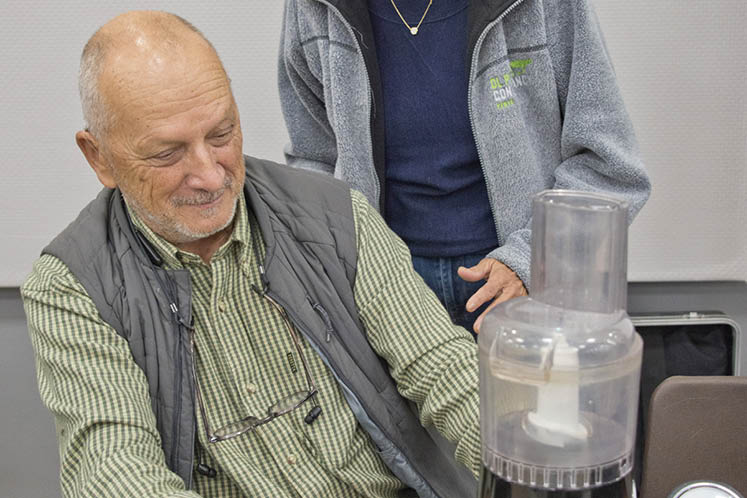
Osuchowski holds and manoeuvres the device with a knowing touch, quickly dismantling and eyeing it with decades of much higher expertise and experience. The problem is analyzed – when he points it out, it is obvious even to the mechanically clueless, like me – and he quickly and expertly sets things right with a bit of wire, solder and a smile.
With a pleasant whir of confirmation, the blender has been fixed, the customer is happy, the landfill is denied and the real benefits of what ecoCaledon and others dub the circular economy are manifest. The term refers to a philosophy and practice whereby products are kept in circulation through repair, reuse and recycling, thereby reducing needless waste and consumption.
Like riding a bike
Inderpal Singh has a long beard, a shy daughter and a five-speed kid’s bicycle that is acting funny. He is huddled in a conference with volunteer bicycle fixer David Elich, whose mother, Sandy, is his “repair crew.”
The bicycle rests upside down on a stand. It seems the gears keep derailing. Elich, concentrating, spins the wheels methodically seeking … a solution. The wheels spin and spin, quietly, almost hypnotically, while he shifts the gears. It may look like science but “it is 95 per cent feel,” he says. “Sometimes it’s an art. I go by eye, by sound. I feel it.”
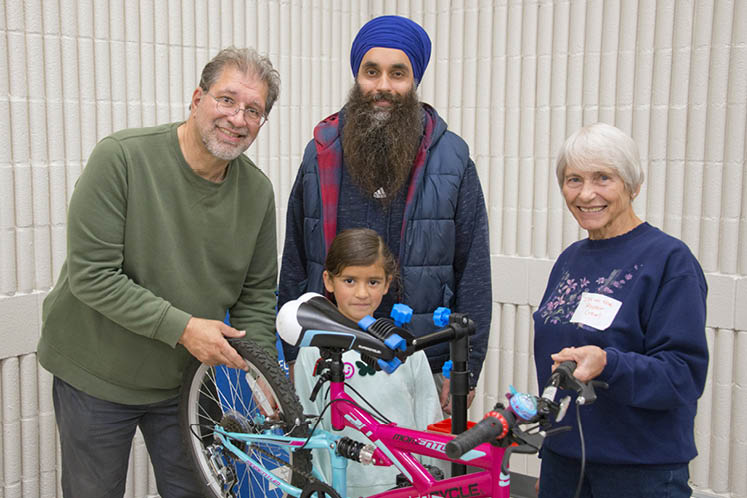
In this case, the repair involves correcting innocent human error. Singh’s young daughter, Kirpa, has been shifting the gears of her first bicycle too quickly and “beyond the capacity of the bike,” says Elich. “It happens. We’re all kids.” He instructs dad and daughter about how to do things correctly so the small fist of gears will remain co-operative in future.
Singh heard of the Repair Café through a Facebook group. An IT-based health-care consultant, he works mostly from home in Caledon East. He has some proven DIY skills, as he calls them, and claims “70 per cent success trying to drywall my basement.” But they don’t come naturally.
“This,” he smiles, waving at the upturned bike, “would take me a whole lot of research. I’d spend 10 minutes to find the right video person on YouTube who can explain it well, then there is the actual doing it. It would take me hours to do what David is going to do in five minutes.”
In a society in which people are increasingly working remotely, eschewing the interpersonal and hands-on of anything save a keyboard, might the face-to-face humanity of repairs and repairpersons be a small and pleasant correcting force?
Singh believes so. “Personal skills are still important,” he says. “The fixers had great smiles on their faces as soon as we came in, answered my questions, were willing to help. And they are volunteers! As someone working from home, I crave these environments. I look forward to things like this. I may have to break more things just to get back!” Surprised to learn that all repairs at the event are free, he chose to make a donation to ecoCaledon.
The sharpest knife
Busiest fixer of all, over in a corner but far from overlooked, is Peter Gosciola, a Repair Café regular doing here voluntarily what he does for a living at his business, iSharp Knives, in Brampton.
Dressed as sombrely as Johnny Cash, all in black, Gosciola sits enveloped in the sound of his grinding wheels, engrossed in putting frighteningly sharp edges on a murderous collection of waiting knives, scissors, shears, clippers and cleavers. His are seemingly easy (they are not) and quick fixes. The rhythmic and sparking to and fro of blades on a grinding wheel are delicate and deliberate, and he takes the time needed.
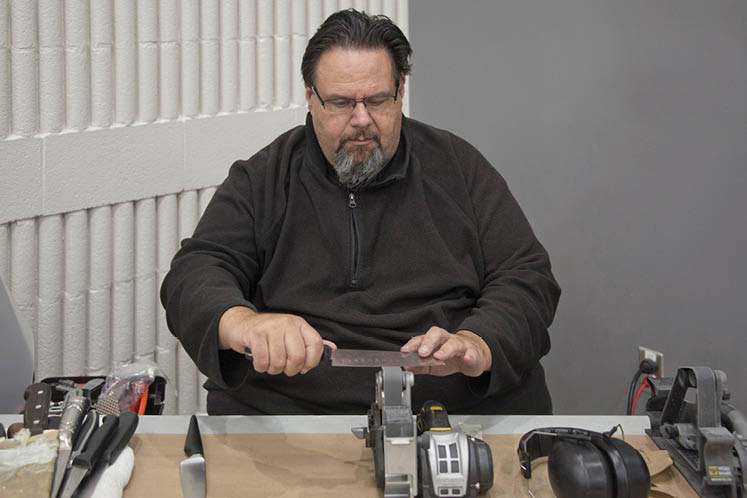
He has many satisfied customers, Mary Gore, who lives near Caledon East, among them. She brought two big kitchen knives. “I use them all the time,” she says. “I have a hand sharpener, but the knives stay dull. Cut myself? Oh gosh, yes. This will make it worse! I’m loath to throw things out, disposable society and all, but it is difficult to find people who fix things.”
Gosciola, moving on to the next client’s knives behind a curtain of sparks, sharpens dull things. He does so here, through ecoCaledon, for the small, but greater, good of his community.
This most recent ecoCaledon Repair Café, held last fall, was the ninth, held bi-annually, since 2021. Originating in Amsterdam in 2009 and later practised by Roncy Reduces (a community waste-reduction initiative in Toronto’s Roncesvalles neighbourhood), the event was adopted locally as part of ecoCaledon’s mission to promote community climate change action and to change mindsets. An easy and fun way to change behaviour, the Repair Café is also much more.
It has a core of eight to 10 fixers, with others coming and going over the years. New volunteers are always sought and welcomed, with efforts being made to broaden the areas of repair to include shoes or jewelry. With new fixers, knowledge is assumed and required, as is a willingness to collaborate – fixers seem to delight in getting heads together over a particularly tricky repair – and above all, an eagerness to try.


This said, there is only so much that can be done during the event, and some stuff presented proves to be either unrepairable or outright junk. But towels aren’t thrown in easily.
“That is in the nature of fixers,” observes Betty de Groot, one of ecoCaledon’s organizers and a spokesperson for the event, as she strolls among diligent fixers and grateful fixees. “The fact that they volunteer shows they are ready to step outside their comfort zone. They have a good attitude. They are eager to take on a challenge. We don’t need very, very skilled people; we just need people with skills.”
Repairing things, be they electronic, fabric, gear-and-sprocket or other, is often a combination of formal training and hands-on learning. A good fix-it bedside manner isn’t strictly necessary, but it helps with customer interaction and satisfaction. Service with a smile is a given among the Repair Café’s fixers.
Some repairs can’t be taken on in the four-hour time allotted, and no guarantees are given. No welding is done, and nothing involving refrigeration, gasoline power or items operating on power of more than 120 volts or different currents is accepted. And anything someone can’t personally carry in won’t be looked at. Your old army-surplus flamethrower? Sorry.
My doll’s saviour
Tony the Traveller is under the needle and that needle is wielded with tongue-between-teeth intent by a grey-haired grandmother in a Toronto Blue Jays’ shirt.
Chris Millar’s T-shirt looks new (at the time, the Jays’ 2025 World Series run was being thwarted), but her skills with a needle – and on the Janome serger sewing machine on the table before her – are lifelong. She has been happily sewing since she was a girl and has volunteered at every ecoCaledon Repair Café to date. As she turns Tony this way and that, pinning, threading needles and sewing up tears with an easy finesse, Millar sets me right about her – I’d supposed – dying, if otherwise charming, art.
“They taught sewing in home economics when I was in school,” she says. “A sewing machine can look intimidating. People come in, see you working, see your machine and ask what it can do. Sewing was a dying skill up until Covid. Then people were looking for something to do at home. It seemed to revitalize the craft.
“The joy comes with creating something with your own hands. Repair or new, it is all creating. I’m seeing a real trend. Teens are looking to be creative. I frequent second-hand stores. I’m seeing kids there grabbing second-hand outfits that might not suit, then taking them home and repurposing them with patches, appliqués, all sorts.
“Teaching young ones, even to sew on a button, why, they are so happy. Kids, they just go for it! Crooked, not sewn right, they don’t care. They are just thrilled that they are creating something. You put a little spark in there!”
At the Repair Café I attended, each of the 60 fixees had an average of three things repaired by 14 volunteer fixers. Some attendees learned about ecoCaledon’s objectives, sustainability and how to fix things themselves next time.
Up to 150 watched, dined on plant-based offerings and interacted with representatives of the environmentally minded organizations that were also present. These included Albion Hills Community Farm, St. John the Baptist School (students wove plastic milk bags into sleeping mats) and Friends of Caledon Public Library (volunteers sold off old books before the remainder were donated to Value Village).
Tony is handed back to me, repaired and still smiling. The mending took about 25 minutes. He has perhaps another two decades in my care, maybe more if I lay off the saturated fats.
I’m an artist. My mother knitted Tony the Traveller for me a long time ago. I was more than a little embarrassed, a grown man, to be given this gift. At the time, I never viewed knitting as her “art” – and didn’t appreciate the love invested in every clack of her knitting needles.
Beyond pleased with what Millar did at the Repair Café, I was delighted and humbled to see mended what I once thought a silly thing. As I write this, Tony sits on a shelf above me, smiling down. He was never destined for landfill, just sidelined and consigned to “I’ll fix it myself, sometime, probably a little while before never.”
Never mind never. Right now, I have a dull-as-algebra pocketknife in need of a good sharpening, a stiff bicycle that takes Herculean efforts to pedal, and a pair of painter pants with sentimental value and more holes than a golf course. What do you have?
I’m no eco-warrior, but I know where I’m headed to get my stuff fixed.
The next ecoCaledon Repair Café will take place on Saturday, April 18, from 10 a.m. to 2 p.m. at the Caledon Seniors Centre in Bolton.
Related Stories
The Appliance Guy
Back when things were built to last, a little know-how went a long way when it came to fixing things.
Caledon’s Biggest Thrift Store Thrives Thanks to This Secondhand Superhero
For Catherine Adair, Evolve Caledon’s tagline – Shift to Thrift – is a mission.