
Growing More Than Tomatoes
Small businesses for kids, like running a roadside tomato stand, teach important lessons about planning, earning and investing.
It’s mid-March, and the kitchen table disappears under pots of soil, one-inch seedling trays and tomato seeds in four varieties – cherry, Roma, beefsteak, and mini cherry. It’s time to germinate. Our family has obtained many seeds from local farmers and neighbours over ten years and some of our varieties are in their ninth generation.
Our eleven-year-old son and nine-year-old daughter jump right into planting the delicate tomato seeds. We dry them on kitchen napkins and store them at the end of each season. The children carefully rip the napkins, separating the seeds and placing the tiny seed-infused napkin bits into one-inch pots filled with soil. Just a small press of their finger and then they add a little more dirt – about a half inch to cover. As parents, we support the process by keeping their soil supply stocked and keeping more pots at the ready, while cleaning around them so they can enjoy themselves without trying to be neat. Well, I do throw a few reminders to try to be neat, but I quickly realize how futile that is.
They don’t need as much instruction anymore; they’ve been involved since they were preschoolers. But for the past three years, however, they’ve taken a much more active interest – it’s now, literally, their business. What began as a simple project to involve them in the family garden has become a burgeoning children-led seasonal community sale and fundraising operation entering its fourth year.
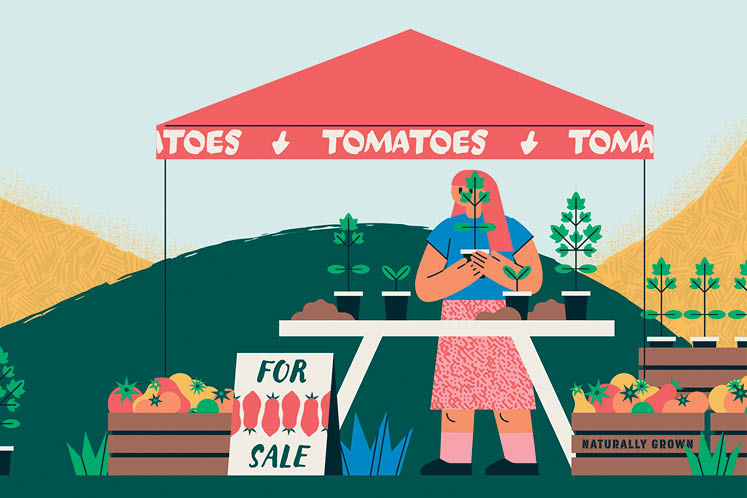
On the May long weekend, my kids set up a table groaning with tomato seedlings to sell to neighbours and passersby. The table sits halfway down the driveway, leaving enough room for a car to pull in. Handmade signs that say, “Tomato Plants for Sale! $3/each or 2 for $5” are placed on the side of the road across from and in front of our house. We tie red balloons to the address pole with a red wagon displaying a dozen tall sturdy tomato plants.
The kids work hard to set up. They are ready to reap the benefits of their labour. I will admit, although they’ve done most of the work, it was my and my husband’s nudge that got the, er, seeds planted.
During the Christmas before our first plant sale three years ago, we encountered the familiar moment, like many parents among us, when our children’s materialistic wants outpaced their understanding of a hard-earned dollar. The winter holidays were barely a month in the past, and they were already bored with the abundance of gifts they received and asked for more. In a moment of quiet reckoning, my husband and I decided it was time to humble their expectations and teach them the value of earning a dollar. Little did we know that our efforts to help them grow a little more financial sense would lead to the whole family chipping in to grow hundreds of tomato plants.
Our children understood the basic idea that money buys things, or rather our money did. We explained we earn it at our jobs, save it in the bank, and use it to pay for essentials and occasional fun. We also discussed that we should not spend more than we make. These reminders did little to curb their constant requests for toys.
We considered giving an allowance or paying them for chores, but neither felt right for us. We did not want to tie payment to the household responsibilities everyone shares, nor did we want to hand out money without explaining how to earn it. Supporting a kidpreneur venture, however, felt different. Through a small business of their own, our children could potentially learn meaningful financial habits, and gain skills that will support their future ideas and success.
If our kids wanted more, and could not wait for their birthdays and holidays, they would have to learn how to make and manage their own money.
Planting the Seeds of Sustainable Entrepreneurship
During a family dinner brainstorming session on kid-friendly business ideas, the kids eagerly filled the room with suggestions. Our son immediately shouted, “Lemonade stand!” – the quintessential mini-business venture. Our daughter proposed making bracelets or selling stuffies, but not her stuffies, of course. Generating ideas was easy. The hard part was explaining to them the business logistics and environmental impact of it all without crushing their creativity.
Living on half an acre at the edge of a forest, our sense of stewardship for the land has grown stronger each year. We realized we had an opportunity to teach the kids how to think like sustainable entrepreneurs, rooting their ideas in care for both the environment and their community. So we floated a few criteria. Could they offer a product or service that genuinely benefits people? Could they make it environmentally responsible? How about keeping it affordable for both the business and the customer? And lastly, could we build in a philanthropic element? It was a lot to ask.

On a cold day in mid-March three years ago, while sorting our seed collection and planning our spring garden, my husband wondered aloud about having a plant sale for the community. The idea fulfilled the four criteria, and the kids actually liked it. We were already in the habit of making donations to reforestation as a family with the international non-profit One Tree Planted, so we decided a portion of all sales would be donated there.
We had a plan, the children agreed, and so we were on our way to learning and growing minds and plants.
Patience, Responsibility and Real‑world Learning
Despite a hint of uncertainty about how this might pan out, we knew our children would at least enjoy a meaningful gardening project to carry them from winter into spring. Fortunately, they were very motivated by earning their own money and eager to participate, so we carried on.
As March ends, the kitchen transforms into a little greenhouse. Our large bay window is full of trays cradling over 150 seedlings and half our seven-foot table absorbing the rest with just enough space left for the four of us to eat together among the plants. Patience sets in as the kids watch for the first green shoots to appear.
Over the next few weeks, they stay involved through each stage: watering daily, rotating after school, and eventually transplanting the three-inch seedlings into three-to-five-inch growing pots collected from family and friends. Customers now return their pots for reuse, helping us grow a small circular economy. When mid-April arrives, it is time to acclimatize the growing plants to the outdoors, and the children have the added chore of bringing them out in the mornings before they leave for school and then back in again before the sun sets.
Sale weekend is always the May long weekend, the time most people begin to prepare their gardens and buy plants. As the seedlings get stronger, we begin to prepare and think about marketing.


Previously, we simply presented the business as a Tomato Plant Fundraiser Sale to our community. This year, the kids have decided to name their business The Little Plant Stand. I manage the social media advertising on Instagram and local Facebook groups, and the children help me create post ideas. We also discuss a sales pitch, building confidence to promote to their school community, and extended family and friends, a skill they have grown since that first year. They each create business cards that say, “Tomato Plants for Sale! Heirloom, Organic Tomatoes! 2 plants for $5. Every Purchase Plants a Tree!” This year they are excited about a new design that will display their new business name.
My daughter, focused on the practical side, notes that “You need a lot of advertisements, or people won’t see your business.”
While we presented the opportunity and supported the execution, they learned to be decisive and in control of every aspect of their business.
As that long weekend approaches, the children’s excitement begins to take shape, especially as they calculate the potential profit growth for this year, which reminds us of the true reason we began this project in the first place: money management.
Market Days and Managing High Expectations
Foot traffic is rare on our country road outside Bolton and cars often fly past without noticing the signs. In the first season, the kids waited patiently, tweaking sign placement and cheering each other through slow stretches. Now, with growing confidence, evolving marketing ideas, and returning customers, their business sees more traffic.
When customers arrive, the kids manage every transaction by explaining plant varieties, calculating totals, making change and packaging purchases in recycled boxes or paper bags we gathered over the year. I do not hover; our community is patient and honest if a calculation goes sideways. By now, they are well practised in teaching customers how to transplant and care for their plants throughout the season. My son reminds them to plant in full sun, plant them deep even past the bottom leaves, top with mulch, water every day, and use stakes to support their tall growth.
Last year we added lavender and mint plants propagated from our own garden to the market table. Our yard turns into a hub of visitors walking across the yard to see where it all grows and sometimes children flock toward the wooden swing and slide set beneath the apple and pear trees.
Since the first year, my son has initiated a business journal to track sales to determine which varieties are most popular – cherry and beefsteak always sell out first.
My daughter engages customers with a game, “Guess the mystery plant,” with just a small bud that’s tough to identify. A multiple-choice list is nearby to help the participants indulge her by making a random guess. Nasturtium, sunflower or pepper?
The hardest part is managing their expectations, watching them sit for long stretches, hopeful, then disappointed when hours pass without a single sale. But as my son has told me, this taught him about “perseverance and patience.” He says, “Not everyone is going to stop and buy something.”
Kids are also resilient creatures. Last year, a sudden rainstorm nearly tore our tent apart, sending all of us scrambling in the downpour to move everything into the garage and take down the tent. It was the kids who suggested posting an update on social media and offering online requests with pickup times on another day. Their ability to pivot turned a soggy setback into a successful day.
They have also formed their own criteria for what makes a successful venture. My son emphasizes that good customer service is key, and my daughter adds that it is important to “pay attention to your sales and what the customers say. For example, we need to grow more cherry tomatoes this year based on how quickly we sold out of them last year.”
Enthusiastic Support of our Community
The community’s response has been deeply encouraging. People light up at the sight of the children’s hearty, organically grown plants and their genuine customer service. Over time, we have gained a loyal group of returning customers who now look forward to our tomatoes, swearing they are the best they have ever tasted. Watching our children absorb this praise is its own reward; their motivation grows not just from sales, but from seeing the joy their efforts bring to others.
Once the long weekend ends, the children tally up their sales and make notes in the business journals for next year on projections and sales goals.
And they practise one of the harder lessons anyone in business will tell you: it’s not all profit.
“You have to portion your money well because you will need to buy supplies for next year, and you want to save some and keep some for yourself,” says my son.
The kids establish the donations for reforestation, deduct the costs they will need for supplies next year, and split the modest profits – anywhere from $100 to $150 each. Any leftover plants are donated to their school garden, which is managed over the summer by family volunteers.
Money Talk
At the start of this project, I often felt conflicted and worried we might encourage stingy or overly obsessive attitudes toward money. While many people were supportive, some gently suggested our children are “too young to worry about money.” Seeking reassurance, I was grateful to discover Toronto-based author Cinders McLeod, who gave our little endeavour a thumbs-up. McLeod’s Moneybunny series introduces early financial literacy with warmth and clarity. Beautifully illustrated and written for ages three to eight, books like Earn It!, Spend It!, Save It!, and Give It! present money concepts in simple, hopeful and age-appropriate ways.
I spoke with McLeod in January as she prepared to launch the newest Moneybunny book, How Do You Earn? She explained that the series began during the 2008 recession, when letters to the Globe and Mail, where she worked as a cartoonist, revealed widespread concern about children’s lack of financial literacy and resources for the subject. McLeod used her talents to create one of the first series of its kind – books designed not only for children, but to spark meaningful conversations with parents.
During our interview, McLeod was happy to hear what my children were working toward and embracing the message in her Give It! book with their philanthropic efforts. McLeod reminds me of “the idea that money, at the end of the day, it’s energy and it goes around and around, and if you’re a scrooge about it, well, there’s not much payback.” I wholeheartedly agree and feel hopeful that my children are setting up a sort of business karma when they share their profits toward reforestation.
The Difference Between Needs and Wants
In our first year, the “What are we going to do with the money we make?” conversations between brother and sister escalated quickly and unrealistically. We found ourselves explaining the true costs of their big wants: owning a dog or buying an ATV was not exactly achievable on the projected tomato‑plant profits. We also noticed that having their own money made them feel they could buy anything whenever they wanted, much of it destined to become space-stealing clutter in our tiny countryside house. Clearly, it was time for a lesson in needs versus wants.
In Ron Lieber’s, The Opposite of Spoiled: Raising Kids Who Are Grounded, Generous, and Smart About Money, making a distinction about needs and wants is important because “as early as age five, kids are ready to reckon with the framework that ought to govern a lot of their spending for the rest of their lives.” If we wanted our kids to be successful with their business, then we would have to share a framework for that success and hope they go for it.
Running a business meant covering costs first (product, supplies, advertising and donations) then reinvesting for next year. Only the remainder would be profit, split evenly between them. We could tell in their disappointed expressions that they were now visualizing their profits evaporating into the clouds. They were even less impressed when we further explained the save-spend-share model we would use to manage their profits.
This model means 50 per cent goes into a long‑term savings account, 25 per cent into short‑term savings jar, and 25 per cent for spending cash. Realizing they would get further together, they shifted to planning one shared purchase, pooling 25 per cent of their profits so they could own one of the items on their list – the newest Super Mario Nintendo Switch game. Watching that collaboration felt like seeing the first bud emerge as proof the roots had taken hold.
I had to suppress a self-satisfied grin when my son told me, “You buy things less because you realize it’s coming out of your pocket and then you think, Do I really need it?” and again when my daughter suggested checking second‑hand options first, and adding, “If you don’t want to spend money, you shouldn’t go shopping.”
They Find Their Own Way
Since starting this project, the children’s sales have grown each year, helping plant 205 trees across Ontario. This season, they bring a stronger sense of how their small business can support both their community with locally grown organic food, and the environment through reforestation in Ontario. They look forward to meeting neighbours who value healthy food, local growing and kid‑led projects that give back to the land.
This has never been about financial pressure or about great profit. Our children are not responsible for household stability, and they never go without necessities. Instead, it is a yearly lesson in how effort becomes income, how expenses shape profit and how saving creates opportunities.
The biggest change we have seen as parents is that now, when they want something, they ask if we can take them to buy it. They pause, think it through, compare options, and sometimes decide against a purchase when it would drain their savings or is not truly something they need. It is no longer about having more, but about spending with intention and understanding the value behind each choice. And we no longer have to persuade them on purchases. What they choose to spend their 25 per cent on is entirely up to them. Another bonus: we get to enjoy the literal fruit of their labour.
As we plan our 2026 venture, we hope this experience provides them with the ability to actualize future business or career goals rooted in respect for their community and the environment around them. This year, my son and daughter are working to achieve their business goal of planting about 25 per cent more than last year.
My son’s advice to others considering a kid plant sale? “Don’t stop and keep going.”
You can track our progress and tree donations on Instagram @little_plantstand.
MORE INFO
How to start an eco‑friendly kids’ business
A simple guide for raising young entrepreneurs who care for the planet.
Choose a sustainable product or service
Pick something that benefits people or the environment or reduces waste – seedlings, handmade upcycled crafts, gently used items, or even services like garden help, pet care or neighbourhood litter cleanups.
Use what you already have
Before buying supplies, look around your home. Turning reclaimed materials into products teaches creativity, lowers environmental impact and reduces cost.
Source locally and thoughtfully
If materials are needed, buy local and choose organic, plastic‑free, or second‑hand options whenever possible. For plants, consider saving seeds, trading with neighbours, or accessing your local seed library.
Start small
Give the project time to grow and develop. Aiming for high profits can prevent key skill-building opportunities.
Build with low‑waste methods
Opt for natural packaging and reused containers to avoid single‑use plastics. Encourage customers to return packaging for reuse.
Price responsibly
Encourage kids to consider material costs and donations, giving only brief attention to time. Emphasizing wages too early can lead them to overprice their product or service, so the focus should stay on effort and learning rather than calculating compensation.
Create a community‑focused marketing plan
Spread the word through neighbours, schools, workplaces, local markets and social media. Highlight the business’ environmental values. Eco‑minded customers love supporting kids who make a difference.
Give back to the environment
Donate a portion of earnings to a cause like tree planting, pollinator gardens, wildlife centres or community cleanups. Even small contributions help kids understand the power of circular generosity.
RESOURCES
Cinders McLeod. Moneybunny Books series (Penguin Random House Canada). moneybunnies.com
Mark Cuban, Shaan Patel, and Ian McCue. Kid Start-Up: How You Can Be an Entrepreneur (Diversion Books Edition, 2018)
Melinda Wenner Moyer. Hello, Cruel World! Science-Based Strategies for Raising Terrific Kids in Terrifying Times (G.P. Putnam’s Sons, Penguin Random House. 2025)
Ron Lieber. The Opposite of Spoiled: Raising Kids Who Are Grounded, Generous, and Smart About Money (HarperCollins Publishers. 2015)
Related Stories

Kids Summer Camps 2026
Our annual roundup of the best camps around Orangeville, Shelburne, Caledon, Erin, and Mulmur.

A Guide to Raising Backyard Chickens
Want fresh eggs? Flock owners share their tips for building a coop, choosing a breed, and taking care of your feathered friends.