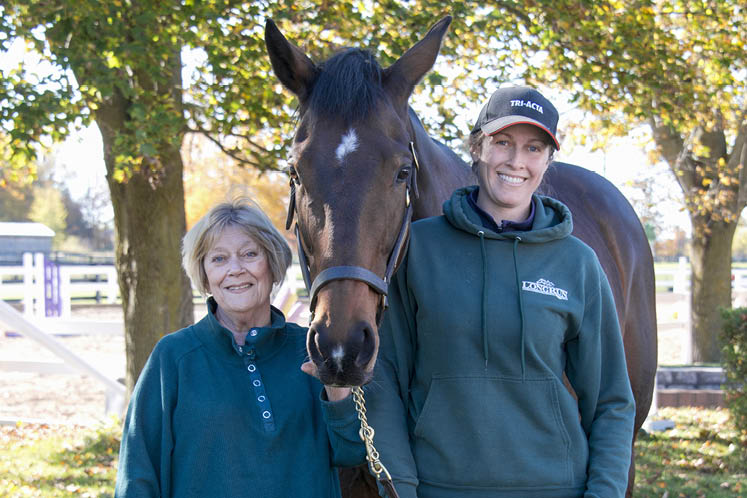
Horse Sense: Vicki Pappas and Lauren Millet
At Hillsburgh’s LongRun Thoroughbred Retirement Society, aging racehorses find new homes and sometimes even second careers.
Located near Hillsburgh, LongRun Thoroughbred Retirement Society sits on a picturesque 100-acre farm known as the Lana Hershelle Sniderman Facility. LongRun accepts retired thoroughbred racehorses – most from Woodbine Racetrack in Toronto and Fort Erie Race Track – and, when possible, adopts them out to new homes and post-racing careers.
In 2000, LongRun attained charitable status in Ontario, though it had been operating informally for a few years before that. “It was concerning that there was no safety net for these horses coming off the track years ago,” says founder and chair Vicki Pappas. “So a group of us trainers and people that I knew at the track got together and decided we had to put something formal in place.”
The Hillsburgh farm was acquired in 2016 thanks to a generous bequest from Lana Sniderman, a longtime fixture of the thoroughbred racing scene and niece of Sam Sniderman, a.k.a. Sam the Record Man. Before that, says Pappas, “We had horses at foster farms, sort of scattered all over the GTA, and even down around Fort Erie. So we would have situations where somebody applied to adopt and we might have three suitable horses, but they’d be at three different locations.”
LongRun “is funded in large part by the thoroughbred industry,” says Pappas. “We get half of one per cent of the thoroughbred purses. Then we receive donations from Woodbine and a lot of horse people, and we have people sponsoring horses.” Six full-time and two part-time staff, along with volunteers, keep the farm running.
Lauren Millet is the farm’s manager. At any given time, she says, 60-odd horses are on site, with 30 to 40 adoptions happening in a typical year. “The goal is that they don’t live here forever. They go on and do something else. But some of the older ones that can’t fully recover from their injuries mentally or physically, they have a spot here for the rest of their life.”
Pappas stresses that LongRun is not a rescue operation. “They’re donated by the owners and trainers because they want them to find a good life. On the track, these horses are so well taken care of, it’s unbelievable. Even if they didn’t love the horses, there’s a monetary factor. If they want them to win, it’s in their best interest to take good care of them.”

Domestic horses live an average of 25 to 30 years, and Woodbine Racetrack rules stipulate that thoroughbreds must retire by the age of nine, so LongRun adoptees find all sorts of second careers. “They become trail and riding horses, hunters, jumpers, eventers, dressage competitors,” says Millet. “We’ve also had barrel racers, Western and polo horses. You name it, and they’re doing it.”
But there are some things they don’t do. The farm does receive visits from groups of inner-city, at-risk and youth with autism, but the horses are not adopted out to riding schools because thoroughbreds are not well suited to that life. They also aren’t used for breeding.
LongRun is blessed with an abundance of potential adopters. “I probably receive five applications a week,” Millet says. “We just don’t have enough horses for everybody that’s interested.”
Though Pappas and Millet love watching new owners fall in love with their adopted steeds, both say they are most inspired by the animals. “That’s what it’s all about: seeing these horses succeed,” says Millet.
Related Stories

Local Heroes 2025
Our annual celebration of the people whose kindness, service and spirit uplift others.

Local Heroes 2024
A salute to eight people whose passionate work has changed our community for the better.