Beyond the Trade War
A Q&A with writer and pollster Michael Adams on tariffs, Canada’s recent election, and our strained relations with our neighbour to the south.
It has been nearly a decade since pollster, survey researcher and writer Michael Adams posed a pointed question in his book Could It Happen Here? Canada in the Age of Trump and Brexit.
It was written in 2017, while President Donald Trump’s first presidency was underway. Adams draws on years of surveying Canadians and Americans to determine whether Canada – a typically placid and welcoming nation – could one day see a right-wing populist government come to power.
“Could it, we ask ourselves in dog parks, at dinner parties, or in the stands of local hockey arenas, happen here? Will we ‘catch Trumpism’?” Adams, who divides his time between Toronto and Mono, wrote.
He was well poised to dig into what Canadians were thinking at the time, having dedicated his career to asking and answering these kinds of questions. Adams co-founded Environics Research Group in 1970 when he was a graduate student at the University of Toronto.
Over the years, Environics partnered with and cofounded a number of sister companies, including the big data firm Environics Analytics in 2000. In 2003 he wrote the best-selling Fire and Ice: The United States, Canada & the Myth of Converging Values. In 2006 he founded the not-for-profit Environics Institute to share with the wider public survey research on Canadian politics, society and culture. The institute conducts in-depth public opinion and social research on a wide range of social and geopolitical issues shaping Canada’s future.

In the years since Could It Happen Here? was published, Canada has faced new challenges both domestically and internationally, including a global pandemic, the Russia-Ukraine and Israel-Hamas wars, an affordability crisis and, most recently, a tariff war that has left many Canadians feeling bewildered and betrayed by a longtime ally. Many of the questions Adams has been pursuing for years were no doubt front of mind for many Canadians as we headed to the polls in April.
In early May, I sat down with Adams at his home in Mono to see if he had found the answer he was looking for back in 2017 or if the landscape had changed so much that it was time for a new line of inquiry.
EMILY DICKSON: We have so much to discuss, but first, I am keen to know your thoughts about the recent federal election. To what degree was it a referendum on how Canadians want our government to deal with the policies of U.S. president Donald Trump?
MICHAEL ADAMS: A year ago, the Justin Trudeau government was so unpopular that Conservatives were ahead in the polls, and a Tory win was almost seen as inevitable. Governments tend to last ten years. They make decisions; half the people like what they decide, and half don’t. But after about a thousand decisions you have got a lot of people who don’t like something you’ve done, and you become unpopular and end up being defeated. That’s our democratic system. It is a pendulum back and forth.
But when Trump got elected again, and started with the tariffs and musings about making Canada the 51st state and calling Trudeau the “governor of the 51st state,” Canadians started thinking “Wow, we’re in his crosshairs,” and we became very anxious. Then out of the blue comes Mark Carney, former governor of the Bank of Canada and the Bank of England, senior public servant in the Department of Finance and so on, and suddenly Liberal fortunes turned. So that was the Trump card, you could say, of the Liberal renaissance and eventual victory.
So far Trump hasn’t said anything disparaging about Carney; he may even respect him as a guy who knows about money. That is what Trump seems to like, so the fact that Carney has a history in the public and private sectors, maybe Trump will say, “Well, I can do business with somebody who knows how to do deals.”
ED: Could It Happen Here? was written during Trump’s first presidency, which you described as “unthinkable” at the time. Did you expect him to win a second time?
MA: I knew that America was divided 50-50 and that populism has a long history in the United States. It also has a pretty good history of sexism, of patriarchy and of racism. It’s also a country that has been trying to move in a direction of progressive egalitarian policies and attitudes since Franklin Roosevelt’s New Deal in the 1930s, and especially the idealistic 1960s – but that period generated a backlash in line with Isaac Newton’s third law of motion, that every action generates an equal and opposite reaction. So advancing the cause of Black people means that some white people are going to feel their jobs if not their status are under threat. So since the 1970s we have seen the politics of backlash in the United States. Ronald Reagan’s election in 1980 signalled the change in direction. I published American Backlash in 2005 that told this story.
Feminism as well – there’s always been a backlash. The year in which Canada put gender equality in its new Constitution in 1982 was the same year that the Equal Rights Amendment in the U.S. lapsed for failure of support among enough states to make the change. So you could always see in America a backlash to return to the way things used to be. We started out conservative and they liberal. Now after two centuries we have changed places.
Our Constitution is a living constitution – it changes over time. But in America, many conservatives think the constitution should be chiselled in marble and they should only be doing what the founding fathers intended.
Well, of course, if you stuck with the original constitution, women couldn’t vote, Black people couldn’t vote. If you go back to originalism, none of the progressive policies would have been made.
When you do my kind of work, which is to survey people’s opinions and values, and then you have to put it in a historical context, a comparative context, it allows you then to understand or try to understand how the two cultures – seemingly indistinguishable to most people on the rest of the planet – look. But in fact we are quite different.
We are “unarmed Americans with health care” is the joke. But if you look at the data, you realize in fact that it’s much deeper, and it’s been going on for at least 50 years since Canada began modernizing in the 1960s.
ED: Does Canada have the political and economic resources to manage the fallout from the tariffs imposed by the U.S.? What are your predictions?
MA: I suspect that we will negotiate with the Americans some new agreement that Canadians are sort of happy with, and Trump can position as a personal victory – whether it is or not – and then he’ll move on.
Since he’s taking on the entire world, what he’s doing with China is infinitely more important. What we sell to the Americans, consumers don’t see. What the Chinese give the Americans is filling Walmart with the trinkets that they like to buy, trinkets that China can make at a 10th of the cost that American producers could.


Even if the U.S. could revive their industrial economy, they’re never going to be able to make something that China can sell for a buck at Dollarama because the American version will be $10 and the American consumer isn’t going to pay that.
These are the rules of modern market economics; the theory of comparative advantage is the one that rules. Some countries are very good at doing this, and other countries are good at doing that, and then they trade with each other. But Trump is trying to turn back history to 18th-century mercantilism, and he’s going against the globalization that is inevitable in our world. And trying to preserve an economy that existed 100 years ago – the world no longer works that way.
ED: What effects of this tariff war are you seeing and sensing here? How can these national and international events play out on the local level?
MA: American consumers are going to be affected by tariffs. Investors, people trying to put money into businesses, will also be affected. But consumers who are buying goods made abroad that are cheap … they will be the ones to suffer.
Here in Canada what’s going to be affected is the agricultural economy, oil and gas in Alberta and the West, agriculture in Saskatchewan, and cars and automotive parts in Ontario. In the 1960s we made the Canada-U.S. Auto Pact. We decided to have an integrated automotive industry. Then the Auto Pact evolved into the Free Trade Agreement with the Americans in 1989 and the North American Free Trade Agreement when Mexico joined in 1994.
Canada’s bet was that we could have an integrated economy but stay sovereign in developing our own policies with what we do with the tax money we get from Canadians.
So what do we do with it? We give ourselves universal health care, good public education, equalization. In the last few years, we have added dental care, pharmacare, more money for daycare and so on. These are all distinguishing policies in Canada – closer to Europe – and are a direction that the U.S. is not going toward. Trump wants to go in the opposite direction.
ED: In the last four U.S. elections, voters bounced from Obama to Trump to Biden to Trump. You wrote that “if the U.S. can shift gears so radically, Canada must be vulnerable too. Or is it?” With a fourth Liberal term now underway, do you think Canadians are interested in shifting gears? Or simply staying the course?
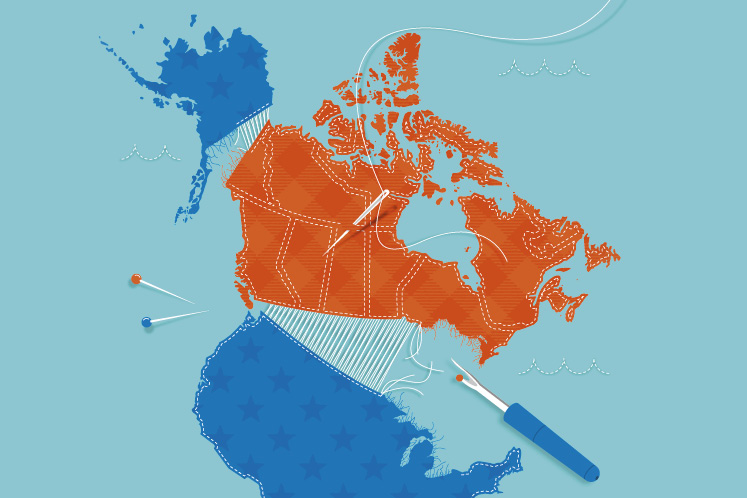
MA: Well, we are a country of mutual accommodation and America is a country that has a fight to see who is right. Our histories have been quite different … Americans have at various times been annoyed at Canada or looked at Canada and thought “boy couldn’t it be the 51st state?” And Canadians have consistently resisted it. There’s a long history of this going back to 1776 when we might have been the 14th colony to join the new American union.
But it was a surprise that tariffs were put on Canada at such a high level, even though we had renegotiated NAFTA under Trump, and he had apparently been happy with it when we did that in his first government. But then he does it again with his re-election and then we get this musing about the 51st state.
So that really irritates Canadians who normally are not nationalistic … I mean we’re patriotic when it comes to hockey and fighting Nazis, but basically we are a collection of provinces with people of mixed loyalties which have jurisdictions in their own areas – and they’re very jealous of those jurisdictions.
There is a sociological idea called “the strength of weak ties.” We’re not really deeply connected to each other; we don’t have that kind of ethno-racial nationalism that comes from a sense of “we” given that “we” is so diverse. We just don’t have that idea that “we’ve been doing things like this for the last thousand years” because we’ve been busy accommodating each other as long as Europeans have been here.
ED: In Could It Happen Here? you talk extensively about immigration, and describe Canada as “a country more positively invested in immigration than almost any other developed economy in the world.” Since you wrote this in 2017, more than 2.5 million immigrants have come to Canada, with 1.4 million in the last three years alone. What do recent surveys by the Environics Institute show about people’s current attitudes toward immigration?
MA: We had assumed that we were on autopilot with bringing in immigrants – that we could pretty well allow huge numbers in. That included international students who were enrolled in programs, but never went to classes – instead, they were working.
Their program was not giving them an education – it was giving them low-wage work, which displaced some people who had been here for three or four generations. Again, it is the idea of competition for jobs.
That and other abuses of our robust immigration system led to what Environics, and other research companies, found was a backlash against immigration.
But there is a difference between our attitudes to immigration and our attitudes toward multiculturalism because we have not seen a backlash against the arrival of particular groups of people, just the numbers our economy can accommodate.
ED: In the last decade or so, there has been a swing to the far right around the globe, including in Europe. Is Canada also “at risk of coming down with the malaise affecting other Western democracies,” as you’ve put it, despite the new Liberal minority under Prime Minister Carney?
MA: Everything that happens elsewhere happens here. It’s a matter of scale. So Chicago has 800 murders a year. And we have murders in Toronto. We’re about the same size, about 2.5 million people, but we have 80 murders.
We have 80 per cent first- or second-generation immigrants in Toronto – theoretically they should be fighting each other and fighting the wars that were fought back home. If you want to debate that Canada is the same as everywhere else, you can make a powerful statement by pointing to the terrorist incident in Quebec City, or the incident in London, Ontario, that are religiously or racially based murders. Everything elsewhere does happen here. It’s just the scale that is so different, the quantitative difference of many fewer instances in Canada of terrorist incidents, homicides, gun violence and mass shootings, and that makes a huge qualitative difference in the lives of Canadians.
Take the “woke agenda” – we did a survey a few months ago on attitudes toward reconciliation with Indigenous people. There has been no diminution of Canadians’ thinking that we ought to recognize the impact of residential schools, of First Nations, kids being away from home and not allowed to speak their native language, the forced assimilation and how wrong that was – and that we need to correct it. There is undoubtedly a backlash to reconciliation, but it is muted. When a member of Parliament makes some kind of racist or anti-Indigenous statement, the leader of their party dismisses that person. They shut them down and say this is unacceptable thinking and speech in Canada.


The topic of diversity, equity and inclusion, this is of course controversial in the United States. The Trump administration is saying “you have got to get rid of these programs,” and they’re even attacking universities that have these types of programs, for trying to encourage historically marginalized minorities to make up for the fact that there is a lot of racism – and that some kids in high school are not going to have much of a chance. So you get universities with huge endowments trying to help people. But in America the move is to get rid of this because it is discrimination, in a sense, against the historically privileged people.
So we wonder, is this backlash being felt out in the wider society? And overwhelmingly Canadians are saying no, this is a good thing to do. And we’ve asked people, “Do you feel you have been a victim of a DEI program?” And younger white men are no more likely than anybody else to say they have been discriminated against by these programs. And the numbers who say they feel such discrimination are seven per cent, ten per cent. They’re very small. But among what in America is a huge chunk of the population, especially less educated younger white men, who feel the culture has declared war on them, they express their frustration by voting for Trump and Republication candidates.
ED: The Institute for Canadian Citizenship and the Conference Board of Canada found in a 2024 study, The Leaky Bucket, that one in every five immigrants who land in Canada will decide to leave within 25 years. And over a third (34 per cent) of onward migrants will leave in the first five years. Why do you think new Canadians are giving up on “the Canadian Dream” of a better life?
MA: We don’t offer the rags-to-riches story – we don’t have a Las Vegas. We don’t have a place where you go and roll the dice and, maybe, win.
When you’re young you want to dramatically succeed – at least some people do – and America is the dream factory. We’re totally overwhelmed with American movies and one thing they portray is a very affluent society.
When people move to Canada, they realize that they can be comfortable. But if they really aspire to fabulous materialism and Hollywood hedonism, their chances are more likely if they become the one per cent in the United States. So if you want to go to Mars, you go to the U.S. If you’re happy with just going to Cape Breton for your holidays, then you stay in Canada.
This interview has been condensed and edited.
Related Stories

100 Per Cent Canadian
Our patriotism is a little tucked away, but it’s right there when we need it.