Busy as a Beekeeper
Sarah Allinson of Ontario Honey Creations minds her own beeswax.
Brightly coloured hives dot a treed property in the rolling Mulmur countryside as a few bees drowsily circle their homes. At the foot of the lane leading from the road sits a farmstand that offers honey, candles, eggs and honey soda. Nestled at the end of that lane is Ontario Honey Creations’ main shop and production studio, where owner and apiarist Sarah Allinson is as industrious as her honey makers.
Today she is making beeswax candles, using a byproduct of the honey harvest from her hives, which are scattered over private properties throughout Headwaters.
When bees sense that their honey is ready, they cap with beeswax each hexagonal cell they have created in the honey frames, the wooden casings that provide the structure for their honeycombs. When “capping” happens, Allinson knows the honey is just right for harvesting.

Whether harvesting honey or beeswax, she wears a full bee suit and uses a smoker. To harvest only beeswax, she removes a honey frame and uses an automatic hot knife to scrape off the caps. She then replaces the frame, enabling the bees to reuse the comb, as it is labour intensive for bees to rebuild a comb from scratch. She then repeats this process for all 10 frames in each box of a hive.
Once the “uncapping” is complete, some honey residue remains in the beeswax. Most of this is removed in a centrifugal extractor, and the wax is then pressed down to squeeze out any remaining honey.
The resulting beeswax is placed in a large melter, a steel drum containing equal parts boiling water and beeswax. The wax floats while the debris sinks. The water and debris are released via a valve at the bottom.
The clean beeswax is then captured in pails or a rectangular frame to make beeswax bricks. Once the bricks harden, any lingering debris is scraped away.
In her studio, Allinson feeds the beeswax chunks or bricks into a double boiler-like melter. The water temperature is at 85 F. Temperature is important – if it is too warm, the beeswax will crack in the candle moulds.
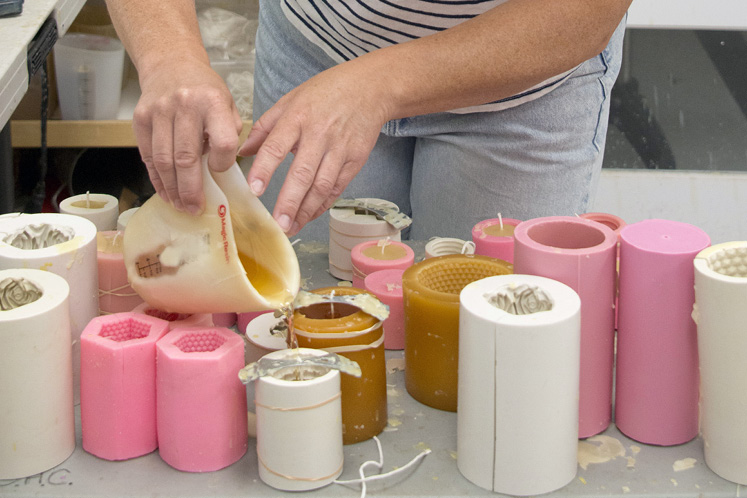
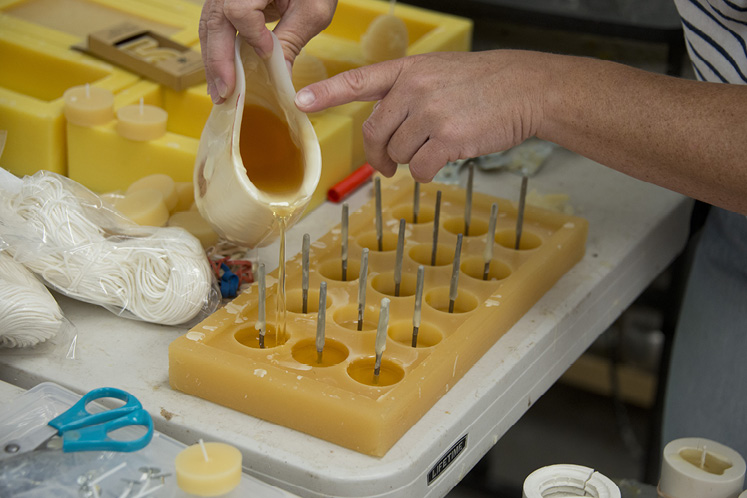
In about an hour, once the beeswax is liquid, she fills a silicone scoop and lets it sit for five minutes while she prepares a variety of silicone moulds. This resting stage helps prevent valleys or tunnels from forming in the candles. These can be fire risks.
Mould patterns include flowers, while shapes feature owls, turtles, traditional beehives called skeps, and numbers for birthday candles. Allinson has acquired moulds over the years from suppliers who exhibit at the annual conferences of various beekeeping associations. “You can also make your own moulds using liquid silicone,” she says. “I might try that soon.” Her favourite candle is the owl.
She uses braided natural cotton wicks in a variety of lengths and widths, wielding an upholstery needle to insert them into the larger candles through a hole in the bottom. A metal wick-centring device keeps the wick in place until it’s time to pour the liquid beeswax.


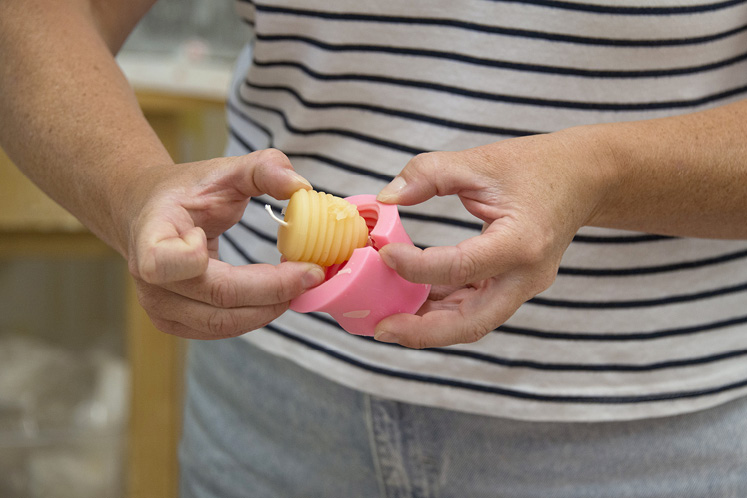
Larger candles can take hours to cool, while smaller ones just an hour. But all, especially those featuring an intricate design such as petals, must cool completely before being removed from the mould. “You can assess readiness by touch and colour. Pouring wax is a pale yellow – almost white – colour, but cools into the brighter yellow beeswax colour,” says Allinson.
After removing the candles, she trims the excess wick at the bottom and top. She saves small wick pieces to make birthday candles – hers is a no-waste operation.
It’s then over to her trusty hot plate, set to a low temperature, to smooth any ridges on the bottom, ensuring the candles sit straight. Only a couple of seconds are required for smoothing. “Beeswax has a low flammable point,” she says. “You have to be careful on the griddle.” Individual candles are packaged in gift boxes and sold at the Orangeville Farmers’ Market year-round, online or at her farm store or farm-gate stand.
Like Allinson herself, loyal customers are drawn to the candles, redolent of the scents of the hives, out of an appreciation for natural products and a clean burn.
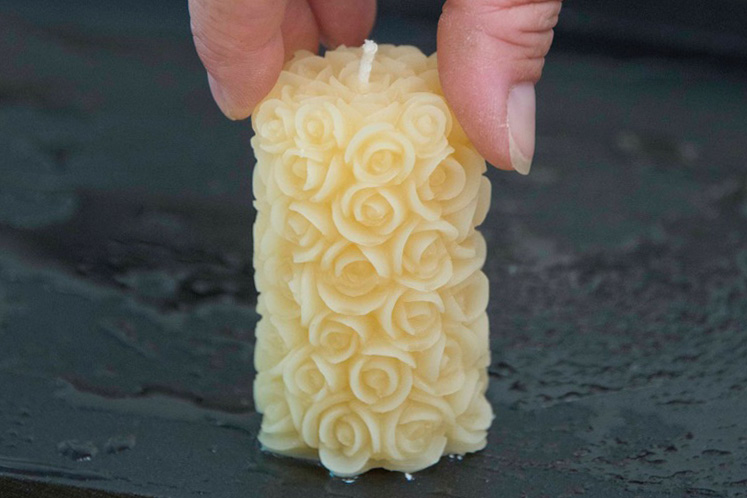
“Mass-produced petroleum candles and added synthetic scents – that’s not for us,” Allinson says. “Instead, every beeswax candle is unique, with variations in colour that depend on the bees. It really is a pure, simple and sustainable option.”
What started as a hobby 14 years ago became a full-time business in 2014. Allinson, who left a corporate career in human resources to tend to the hives, reflects on how much her life has changed since she moved from Toronto to Amaranth and now to Mulmur.
“I’ve always loved nature and animals, and this passion allows me to celebrate both as a career,” she says. “I believe in authenticity, not perfection.”
Related Stories

Meet the Maker behind The Liberty Inn
From hand-built floor tiles to tableware thrown on a wheel, Jacqui Liberty’s craft touches every room of the meticulously renovated Liberty Inn in Caledon.

Meet the Maker: Leslie Knight
With a rug hook and strips of wool fabric, this Caledon textile artist captures the beauty of nature.

Meet the Maker: Nicola Kidd
Mulmur printmaker Nicola Kidd captures tractors, raccoons, street signs and even the CN Tower on whimsical wooden coasters, magnets and postcards.

Meet the Maker: Branson Giles
Orangeville native Branson Giles designs and crafts his wood furniture pieces both to honour the designs of the past and to ensure they live long into the future.