Meet the Maker: Branson Giles
Orangeville native Branson Giles designs and crafts his wood furniture pieces both to honour the designs of the past and to ensure they live long into the future.
Custom furniture maker Branson Giles is Orangeville to the core. The 28-year-old is a fifth-generation resident and can revisit most of the key milestones in his life without going farther than a kilometre or two.
His childhood home and workshop are one and the same: the shop is in the garage of the century house his mom, Pam, still lives in. Branson’s late dad, Mike, was Dufferin County’s chief building official for 30-plus years. “He was very handy and the main inspiration for my work ethic. He taught me how to work with my hands,” says Branson.
A stone’s throw away is Pia’s on Broadway, where Branson’s fiancée, Jaclyn, works. “I built the Pia’s sign last summer, and I love seeing my work in the community that I walk through every day,” he says. The couple also lives in downtown Orangeville.
A few more blocks away is Orangeville District Secondary School, where Branson took his first woodworking class with Ian Budgell, who still teaches there. “I took to woodworking naturally and really enjoyed it,” says Branson.
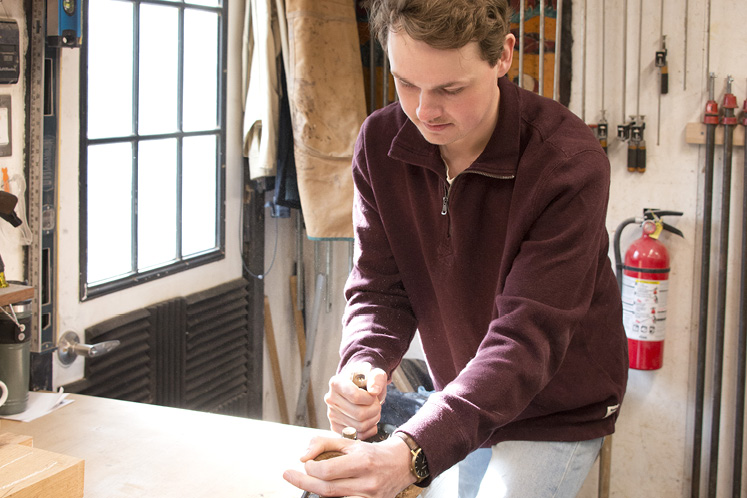
After building an acoustic guitar for his capstone project in the Conestoga College woodworking technician program, he was hooked on woodworking as a career. “I had the confidence to go for it, thanks to some great mentors along the way.”
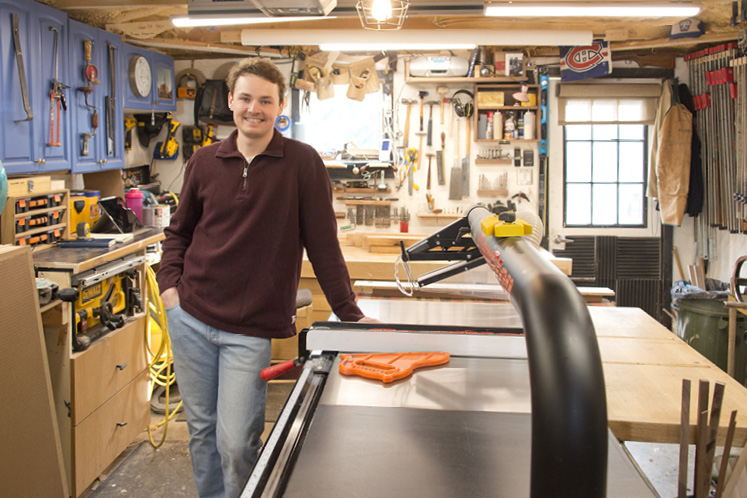
That was in 2019. Branson worked for a custom kitchen shop for six months and then Covid hit. He quit and started his own business, Giles Fine Furniture. Commissions from friends and family helped him build a portfolio – and a tool collection. “Every time I made money, I invested it into a new tool or machine that would increase my workflow, efficiency and accuracy.” He is content with his current setup. “It has everything I need or have room for.”
Branson’s style influences have evolved from midcentury modern to Scandinavian and Japanese furniture and architecture. “I love old furniture, buildings and architecture that stands the test of time,” he says. “I always have an eye out for these examples, inspecting techniques. There’s always something to learn.”
Commissions range from media units to tables, but his current favourites are chairs, which each take a minimum of 25 to 30 hours. After learning where and how a client will use the chair, he sketches it by hand. Once he and the client settle on the final design, he produces a 3D rendering on his iPad.
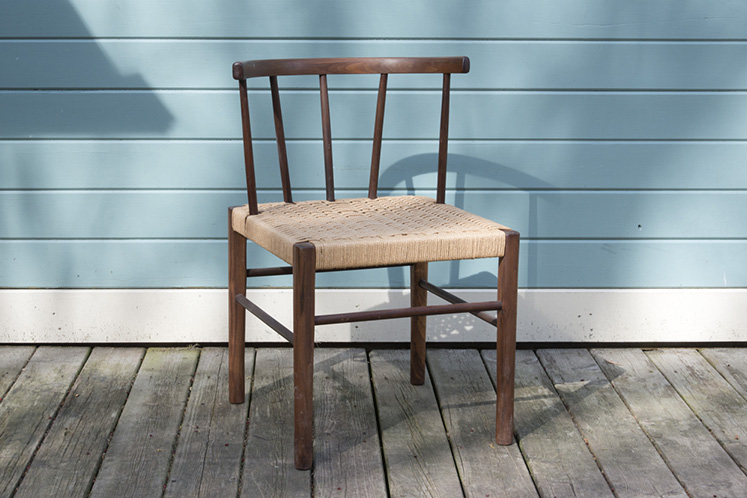
Domestic hardwoods such as oak, maple, cherry and walnut, locally sourced and grown – and dried to reduce their moisture content to 6 to 9 per cent – are the stars of the show. Luckily for Branson, his retired woodworker neighbour also shares leftover lumber that has been cut, milled and properly kiln-dried.
Starting with a rough board, Branson uses a planer and table saw to break it down into a squared slab of workable lumber from which he’ll cut pieces using a table saw, drill press, bandsaw, hand saws or chisels. “There is always more than one way to perform the same cut,” he explains. Still, he favours the age-old, tried-and-true mortise-and-tenon technique to join two pieces of wood at 90 degrees. After he assembles the pieces and glues them in place, he applies clamps for up to an hour. The chair then rests for a full day for curing.
Final sanding or shaping is next, using an orbital sander and hand sanding. After Branson uses an air compressor to remove dust, he wipes the chair with water in a technique called “water popping,” which drives the moisture into the grain and causes the wood fibres to pop up. Branson sands again with high grit sandpaper to remove the fibres.
Brush-on shellac or a natural hardwax oil seals the wood. For bigger projects or those bound to see some wear and tear, Branson uses a spray-on water-based lacquer. He builds up five to six coats or more, sanding out imperfections or hidden glue spots in between coats. “Sanding is half of what I do,” he laughs.
Branson’s quiet wisdom belies his age. “When working with wood, there’s no hiding or lying to yourself,” he says. If a joint doesn’t align, he revisits the process to create a functional, snug fit. “My dad always told me, ‘If you’re going to do something, do it right the first time.’ I aim for perfection, although it is hard to achieve, so that my work can be around another 100 years.”
Find Branson on Instagram at @gilesfinefurniture
Related Stories
Jigsaws and Routers and Drills, Oh My!
Theatre Orangeville’s technical director, Lisa Lahue, gets her hands dirty as she helps create the imagined worlds that enchant theatregoers.
Meet the Maker: Sean Singh
How a woodcarver finds his flow while crafting handsome – and durable – utensils and charcuterie boards.