How a Mono Garden Grows… and Grows… and Grows
A Mono gardener’s remarkable selection of plants pushes the boundaries of what will grow successfully in Headwaters.
I drive up the long lane through the trees, past the small “Hockley Hank” sign to the house and garden beyond. Henry van Oudenaren calls a greeting from somewhere among the tall plants and emerges, looking almost as if he grows here too. The avid gardener, and dedicated fruit and edible nut grower, spends most of every day among the many plants on his property – and he loves to talk about his passion.
“My hobby has always been gardening,” he says. “My Dutch parents came over in 1950 to Bobcaygeon, where I grew up. Dad also loved gardening. When I visited, he’d point out new and unique things and ask if I had any. If I’d say no, he’d get a shovel and dig me out a clump. That’s how I began to populate my gardens here.”
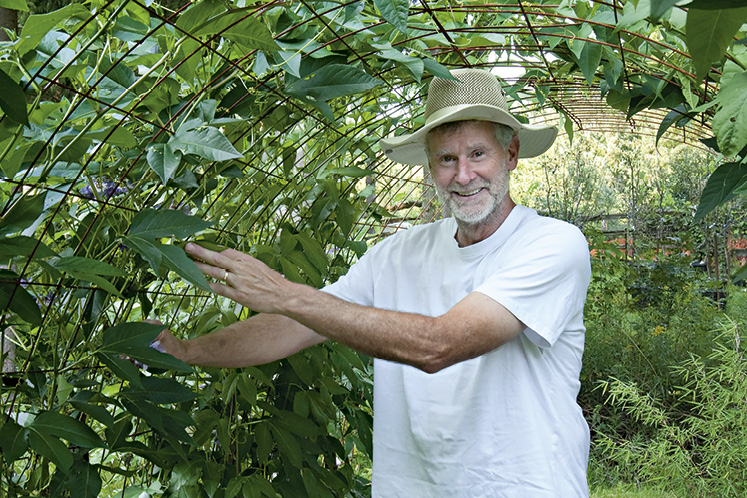
Before moving to Mono, van Oudenaren focused on growing ornamentals and vegetables at his home in Whitby. But this horticultural avocation was placed on hold when his work with a life sciences company – he was president and country manager – took him to the United Kingdom for three years and then to the United States.
When he and his wife, Wanda, returned to Canada in 2010 and their three children had moved on, the couple sold the Whitby house and found the Mono property, slightly less than 11 acres, with a small stream running through it, on the north side of the Hockley Valley, east of Airport Road.
At the time, the property was planted mostly in trees – rows of spruce, a few pines, some tamarack, and rows of black walnut. “Walnut gives off a plant toxin, so now I’ve got rows of black walnut trees in between rows of dead or dying pine and spruce,” van Oudenaren says. He believes one treeless area was a paddock because there were horse stalls in a small building. The grass and weeds in the former paddock had grown to a height of more than seven feet. So there was work to do.
“I started by digging a pond in the backyard,” he says, “planting stuff in and around it. Then I built 15 raised beds out of cedar logs from my forest out front.” He started planting unique and interesting ornamental perennials for the most part, and as they spread he would separate them and wonder whether they might sell. “We potted them up and they went like hotcakes, and ever since we’ve been adding to our collection.” And selling the extras.
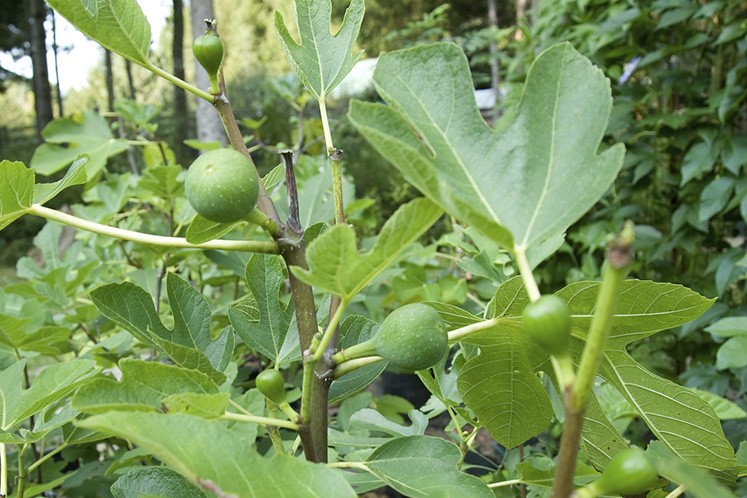
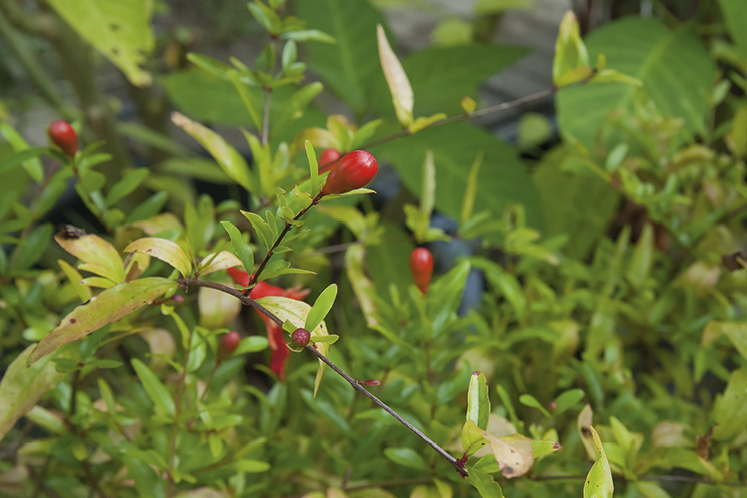
In 2017, when van Oudenaren retired at 55, he began to collect plants the way some people collect hockey cards. “I look from coast to coast during the wintertime for varieties of things that I don’t have yet. I get a few for myself and get another few to see if anybody else is interested.” And like most collectors, he never passes up an opportunity to add to his assortment.
He read about a woman who grew sweet – edible – chestnuts in the Cambridge area and drove down to take a look. The variety she grew originated in China, and he didn’t know how well it would grow in the Headwaters’ climate and whether it was resistant to blight. The chestnut blight, a fungus, has all but killed off the native American chestnuts in southern Ontario.
The trees van Oudenaren saw, however, were thriving – hardy and blight-resistant. So he bought a bag of nuts … not to eat, but to plant. “I researched how to cold stratify the nuts, how to germinate and grow them. I had a hundred per cent germination and 150 chestnut seedlings in the basement.” The next spring some went into his orchard and the rest were sold.
“We were going down to Kingston to see our son and daughter-in-law, and loaded up the car with as many seedlings as we could fit,” he says. He and Wanda pulled into parking lots in Belleville and Kingston to meet customers who had driven in from all around to pick up the seedlings they had pre-ordered.
From other growers and research centres, he has also sourced and grows hardy almonds, as well as English and Japanese walnuts, or heartnuts, to go along with his own black and white walnuts, aka butternuts. This year he added six varieties of hardy apricots to his collection, some developed at the federal government’s Harrow Research and Development Centre. The names of these varieties begin with the prefix Har–, signifying “Harrow bred and breeding rights.” He also added hardy cherries, developed by the University of Saskatchewan. These grow on bushes rather than trees.

Van Oudenaren also grows persimmons and pawpaws from various sources including some he has cultivated from seed. “Pawpaws are the largest native fruit in North America,” he says. “The trees used to be everywhere here. Nowadays there’s almost a cult following, with pawpaw conventions in the fall. Several states in the northeastern U.S. include places named Pawpaw.”
But he grows most of his plants, including apples, from either nuts or seeds. Apples are highly susceptible to all kinds of diseases and insects, he says, and don’t grow true to seed. This means a tree grown from a McIntosh seed, for example, is unlikely to produce fruit that looks or tastes like the fruit of the parent tree.
So as an experiment, he sprouts seeds taken from McIntosh, Honeycrisp and other store-bought apples to purposely grow trees genetically different from the parent tree. Their flowers are pollinated by other varieties. “I want to see what happens,” he says. “I may get the next best apple, or it may only be good for cider, but either way I want to see how disease-resistant the new apples are.”
In addition to seeking resistant varieties, van Oudenaren likes to push the northern boundaries of where plants will grow. After all, the placement of his garden on the sunny side of the Hockley Valley provides protection from the north and west and the worst of winter winds. Among the peach trees in his orchard are three he grew from Ontario peach pits. These trees started producing after just three years, and this year – season four – just one of them yielded more than 20 kilograms of insect- and disease-free peaches without the use of pesticides. In Mono, not Niagara!
He is also experimenting with growing his fruit and nut trees using the European espalier method. “[Europeans] will run wires horizontally and prune their trees to be two-dimensional rather than three, training the branches to grow against a wall or along wires – and that’s what I’m doing.”
With the assistance of a grant from Dufferin County’s Experimental Acres program, van Oudenaren is stringing wires at two-foot intervals up to eight feet – as high as he can reach without a ladder. He will then prune the trees and secure the branches so they grow horizontally along the wires or in V shapes, depending on each tree’s needs. With no ladders involved, the fruit will be much easier to pick, and he hopes also that this will make the trees less vulnerable to hungry deer (see “More Info”, at the end of this article).
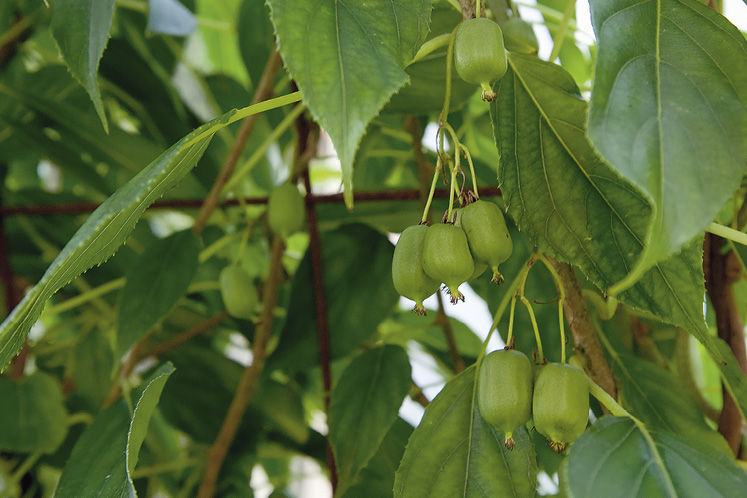
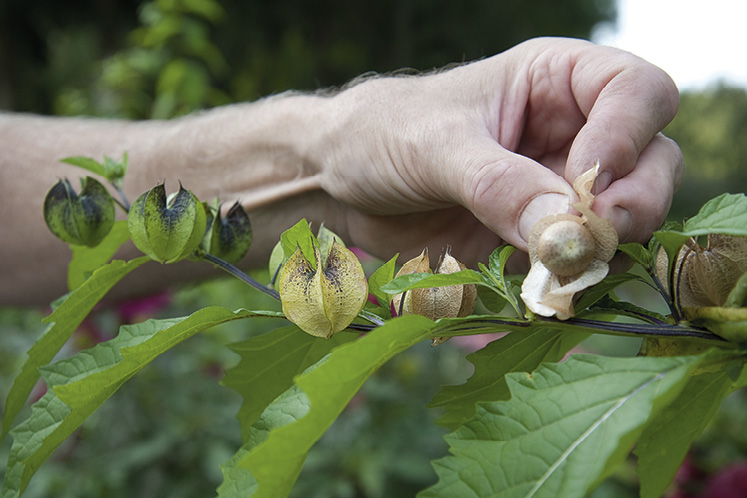
His garden continues to expand almost exponentially. Just this year he added 55 new varieties of fruit and nuts, which boosts his total to nearly 40 varieties of edible nuts (see note below) and about 200 different kinds of fruit. Not all the plants are mature enough to produce, but many are. He picks haskap, or honeyberries, in May, strawberries in June, raspberries in July, blackberries in August and goji berries in all four months. In addition, there are elderberries, sea buckthorn berries, kiwi fruit and 27 varieties of cherry, including the cornelian cherry. Native to central and southern Europe and western Asia, this plant is related to Ontario’s native red-barked dogwood.
“Our first priority is to fill our two chest freezers so that my wife and I have fruit for the whole year, because there is nothing better than in the middle of winter popping a raspberry or strawberry or sea buckthorn berry from your own garden into your mouth,” he says. “We’ve gotten to the point now where we have enough that we are also able to sell fresh or frozen fruit as it’s available.”
In late fall van Oudenaren posts his results on social media, including the Garden Ontario and Town of Mono Facebook groups, noting when the harvest started and ended, as well as the varieties of fruit and nuts it yielded.
He also keeps detailed records of all the plants in his garden, tracking their growth and yield, so he knows them well. And when other gardeners ask about or buy plants from him, he can speak with first-hand knowledge about how well each plant thrives in the Headwaters environment, especially those he has started from seed. “It has made it so interesting because you like to share your passion, and we have like-minded people coming here. Some just zoom in and zoom out, but others are interested in a tour of the ornamental gardens and orchard.”
Van Oudenaren’s botanical curiosity knows no bounds. “I decided to make syrup a number of years ago,” he says, “but could only find seven sugar maples among all my trees. I did the research and discovered many different trees produce sap to make into syrup. So I tap my sugar maples, silver maples, Manitoba maples, and I also tap the black walnut trees. They don’t produce as much syrup and it’s a darker colour but with a very interesting taste.”
He’s also curious about tropical plants and has a grove of potted plants he moves in and out of his house by season, except for one banana tree that survives winter outside, although the season isn’t long enough for it to produce fruit. Among the others are oranges, lemons, limes, grapefruit, kumquats, loquats, finger limes, passion fruit and a half-dozen different mulberries. There are greenhouses, beehives and birds, too.
Should you wish to visit, you can message Hockley Hank via his Facebook page. Once there, you can certainly zoom in and zoom out – but if you’re at all curious about gardening or out-of-the-ordinary plants, there’s much to discover and see for yourself, as well as a wealth of knowledge to tap.
Note: Categorizing fruits and nuts is sometimes complicated. When Henry van Oudenaren tots up the fruits and nuts in his collection, he groups them into their culinary category according to how they are commonly known. This means that, like most of us, he counts almonds, for example, as nuts. Botanically, however, almonds are not considered true nuts. Like peaches, they are a type of fruit called a drupe.
More Info
Doing battle with weeds
The fertile soil in Henry van Oudenaren’s garden, along with manure tea, provides his plants with what they need to thrive. Unfortunately, this means all his plants. “The best thing I grow is weeds,” he says. “The biggest and best weeds you’ve ever seen.”
One of van Oudenaren’s primary goals is to find ways to reduce his workload, so he gave these weeds his full attention, focusing especially on the seven-foot weeds in the paddock. “When I expanded into that area, I used a rear tiller and knew from experience that I was either waking up dormant weed seeds in the ground or preparing a beautifully fertile bed for weed seeds that blow in.”
Because he doesn’t use pesticides, herbicides or fungicides, van Oudenaren took another tack. He decided the raised beds he started with needed too much water, so he took them out and laid commercial-grade woven plastic ground cover over the entire orchard.
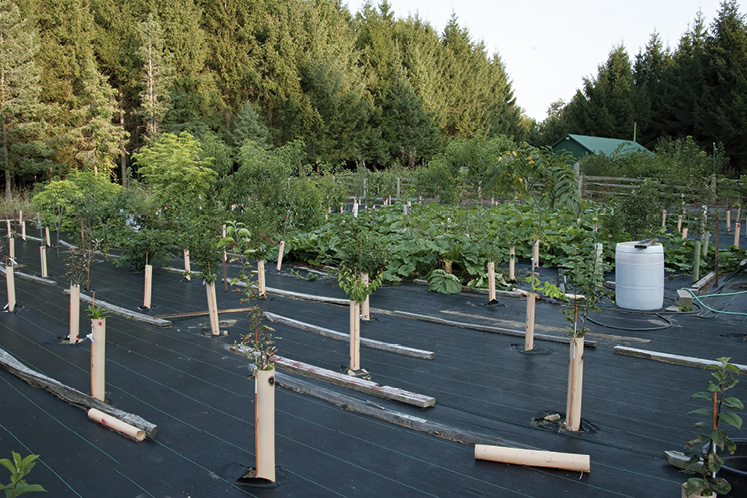
Van Oudenaren’s ever-expanding, south-facing orchard. The commercial ground cover eliminates grass cutting and trimming, reduces the need for watering, and keeps unwanted ground-dwelling insects and diseases at bay. The grow tubes deter rabbits from nibbling at the trees’ tender and tasty young bark.
“It’s been down for four years now and there’s no degradation,” he says. “It lets the rain through, but there’s no vegetation growing underneath. It’s like gardening in your living room. You could walk on there in your sock feet.” So there’s no mowing, no tilling, no trimming – and no gas fumes. The only weeds are the few that find the holes he cuts to plant in, but they’re easily controlled.
The ground cover also has other advantages. It acts like a mulch, keeping moisture in the soil so the garden needs little watering. And van Oudenaren believes it also keeps insects at bay. “I think the ground cover helps because a lot of these insects overwinter in the soil and the less soil there is available to them, the fewer insects you’re going to have.”
Avian allies
Ducks and chickens are another of his pest control strategies. He keeps two breeds of ducks: Indian runners and call ducks. These birds are out in the garden every day, even in winter. In fact, on a walk through the garden, it can feel as if you’re herding them. They scuttle out of the way muttering little duck quacks as they go. The ducks spend the day eating all the detrimental bugs and slugs, snails, flying things and weeds – but they won’t touch the plants.
The chickens, on the other hand, will eat the plants, so they’re relegated to their own fenced-in area. Still, they play an important role. Chickens gobble up kitchen scraps and weeds, turning them into fertilizer much faster than a compost heap.
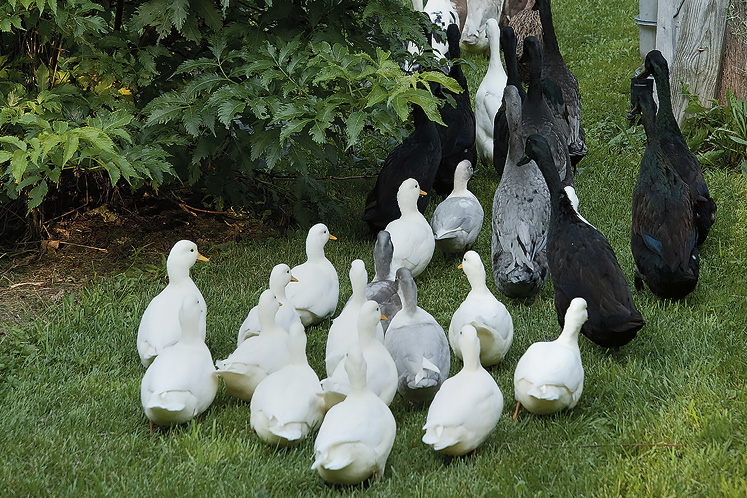
Call ducks and the larger, long-necked Indian runners eat weeds and help control bugs. Unlike the bantam call ducks, Indian runners don’t waddle and cannot fly. They walk or run; hence, their name.
“I take the manure from my ducks and chickens, and local farmers will drop off a load of cow or horse manure,” van Oudenaren explains. He likens the process of making manure tea to using tea leaves to make a cup of tea, though on a much larger scale. “I fill a barrel or trough half full with the manure and the other half with water, and leave it for a few days. Then just give it a good stir, strain it [to remove weed seeds and other debris] and use it to water the plants a few times each season.”
Fencing it in
Deer like to nibble on the tree buds and berries, so van Oudenaren has come up with a plan designed to deter their visits. He has strung three rows of highly visible white electric fence ribbon at intervals above the existing four-foot fence that encloses about half the former paddock – to make deer think they are facing an eight-foot fence. But deer can easily clear eight feet, so van Oudenaren has strung another length of similar ribbon three feet farther inside the paddock. Though none of the ribbon is electrified, to the deer this additional ribbon creates the illusion of a three-dimensional barrier, which discourages the animals from trying to jump.
The next level of defence is the espalier system that’s also eight feet high. The rows are close enough together that deer couldn’t land on the other side, so they don’t jump. And if they do somehow find their way in, they can escape only to the left or right, another deterrent.
To discourage rabbits, who love chomping on the tender bark of saplings, he places plastic grow tubes around all the young trees. Because the snow was so deep this past winter, he had to trudge through snowdrifts to add a second tube above the first.
To keep raccoons and other beasties out of the strawberries, van Oudenaren built a hinged wooden frame, topped with 0.5-inch hardware cloth and set it over the plants. Though effective against four-legged pests, it also keeps out the ducks, so slugs and ants had free rein. This season, however, applications of coffee grounds mixed with manure tea seem to be controlling them.
Seeking solutions
He’s also trying to figure out why the differerent varieties of serviceberry bushes start growing vigorously in the spring but fall prey to a disease or infestation just as they’re coming into bloom. A puzzle to be solved – and van Oudenaren is always interested in solving puzzles.
Then there’s the Japanese beetle that’s becoming so prevalent. “They spend 11 months underground” he says, “and one month eating and procreating, often doing both at the same time.” Unfortunately, the leaves of many of his plants are out of the ducks’ reach, so the beetles are able to turn the foliage into lace.
He has learned the problem with pheromone traps is that they attract bugs from far and wide, so the infestation expands. Fortunately – so far at least – the beetles have invaded only the ornamental and sales areas of the garden. Perhaps the ground cover in the orchard and the long grass surrounding it have deterred them. To this puzzle at least, maybe he has found a solution.
Related Stories

How to Grow a Green Roof
Naturalistic gardening booster Tony Spencer created a Mono rooftop garden that benefits the environment and nurtures the spirit.

A Guide to Raising Backyard Chickens
Want fresh eggs? Flock owners share their tips for building a coop, choosing a breed, and taking care of your feathered friends.
A Magnificent Obsession
Collecting and nurturing remarkable trees has been a 30-year passion for Caledon’s Gary Haslett.

Farm-to-Table Dining Shares the Journey from Seed to Celebration
A look at the farmer-chef ties behind truly local menus that exemplify the field-to-fork experience.