Farm-to-Table Dining Shares the Journey from Seed to Celebration
A look at the farmer-chef ties behind truly local menus that exemplify the field-to-fork experience.
Dirty hands. Hard-working people.
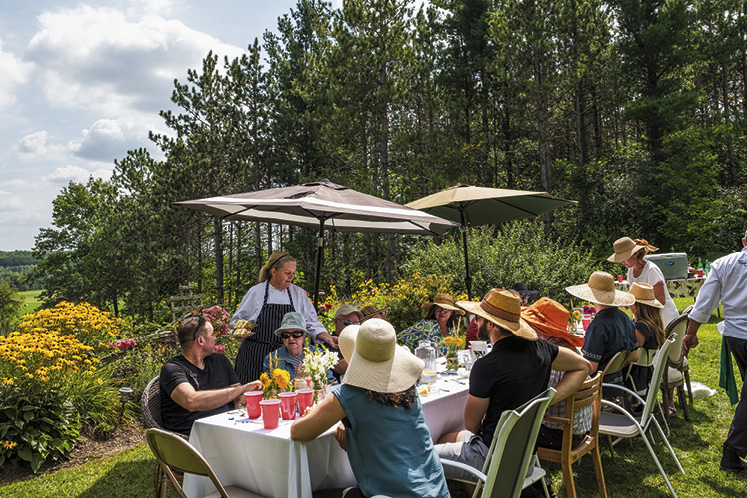
These were the inspiration for an imaginative, locally sourced, eight-course alfresco lunch for 16 in Marci Lipman’s beautiful upper Mono garden late last summer.
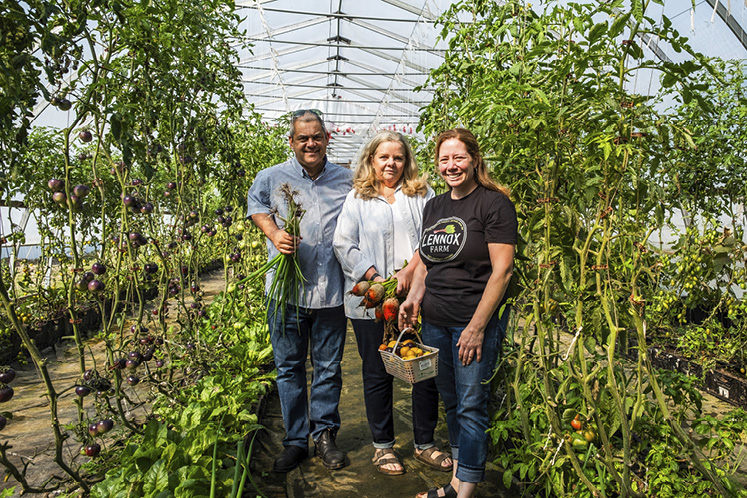
Farm-to-fork dining – meals consisting of fresh produce and proteins grown and raised in the area – is exemplified by Melancthon farmer Jeannette French, walking happily with a dirty bouquet of upturned, just-plucked yellow beets. And by Mono chef Christine Walker, bending to knock soil from carrots just harvested from her garden, while the sun rises and nearby pigs and chickens look on noisily.
On the morning of the lunch, Walker, former director of the chef school at George Brown College in Toronto, has been up since 4:45, baking sourdough bread. Her husband, Andre (executive chef at Alton golf club TPC Toronto at Osprey Valley), has been lightly roasting fresh-picked corn on the barbecue. It’s only 9 a.m. Together, the couple are Two Chefs in the Hills and are prepping a meal of tapas-style dishes to be served at Lipman’s nearby property just before noon.
Ingredients not already washed, chopped, diced, braised, baked, pickled or puréed are ferried onto a big, broad kitchen island. Yellow beets, which Walker finds difficult to grow, came the day before from Lennox Farm, about 15 minutes away. (The peaches for a dessert mousse, the most distantly sourced ingredient, are from Niagara.)
The beets made their way into a 15-layer creation that alternated cooked beets and goat cheese, and was chilled to gel for 24 hours before being sliced into squares (see recipe at bottom of page). It would prove to be a favourite with diners at the luncheon.

“People have lost sight of where their food comes from. I don’t think what we are doing [creating for field-to-fork dining] is new in any way,” Walker says as she kneads dough for a vegetable-studded focaccia. “There was a time when it was common for people to grow their own food and barter with neighbours for items they couldn’t produce.”
The lunch venue is five minutes away down a dusty dirt road on a beautifully sunny day. In the back garden of Lipman’s 50-acre property, a long table is laid with tablecloths, the place settings garnished with small pots of freshly picked flowers. The stunning, two-kilometre views across a valley could best be described as Mona-Lisa-background Mono.
In a small rec-room kitchen just off that garden, Walker and Andre are wearing chef’s coats emblazoned with Two Chefs in the Hills, along with their intent game faces. Working with precision, courses are fashioned – a salad, for example, is presented in a pouch of blanched cabbage leaf fastened with a clothes pin – cooked and served.
Walker MCs each course. She begins: “Thank you all for coming. We want to highlight everything grown locally and what is at its best right now. Everything – chicken, beef and vegetables – is from within 20 minutes of here. It is a local, local lunch. Enjoy!”
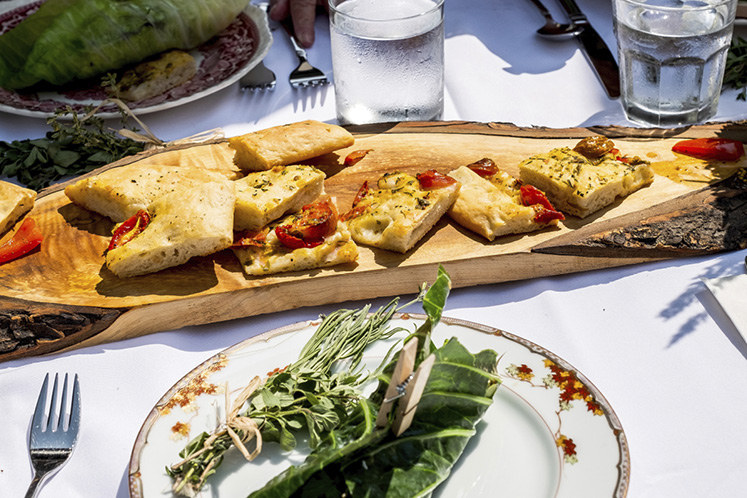
Lipman, who has lived in Mono for 30 years, co-chairs the Headwaters Food and Farming Alliance, or HFFA, which champions local farms and farming. “We are so lucky to live in this food basket,” she says.
But nearly a year after the outdoor lunch in her back garden, she points out that the world has changed, thanks largely to the tariff threats of American president Donald Trump. “Local food sustainability – knowing where your food comes from, supporting local farmers, local food producers – has always been important, but it’s even more important now. We want to – we absolutely must – ensure that local farmers can thrive.”
Out here in the fields
A day after Lipman’s lunch and a couple of dozen kilometres away, French – who with husband, Brian, runs the extensive Lennox Farm in Melancthon – is walking long green aisles of brassicas (cruciferous vegetables including broccoli, cabbage, Brussels sprouts and cauliflower). It is mid-afternoon and she looks weary. She is weary. She works so many hours at so many farm jobs, she no longer counts.
But on entering the farm’s greenhouse and pulling some beets, the same variety served by the Walkers, she brightens. She smiles. “I get excited!” She planted them. She babied them. She picked them. Now she’s happy to wash them and make them look pretty for the roadside food stand. “You can’t sell ugly vegetables.”
Food from supermarkets is cheaper, in abundant variety, and readily available in any season. French understands the appeal. “People want what they want and they want it now,” she says. Avocados all the time! Cheap imports from Mexico!
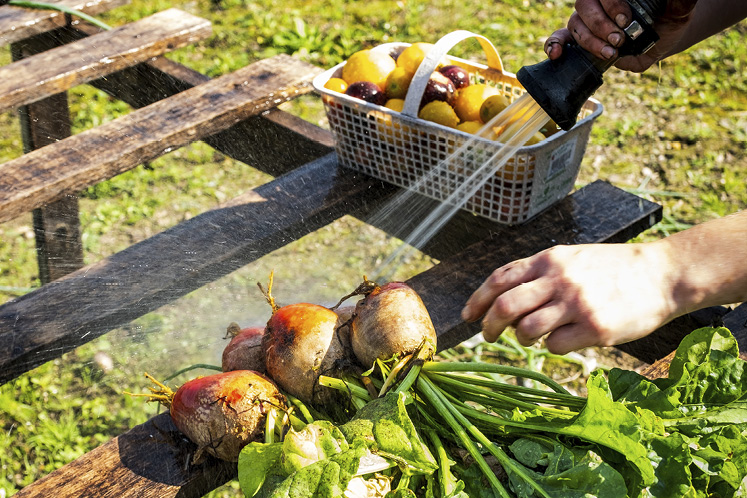
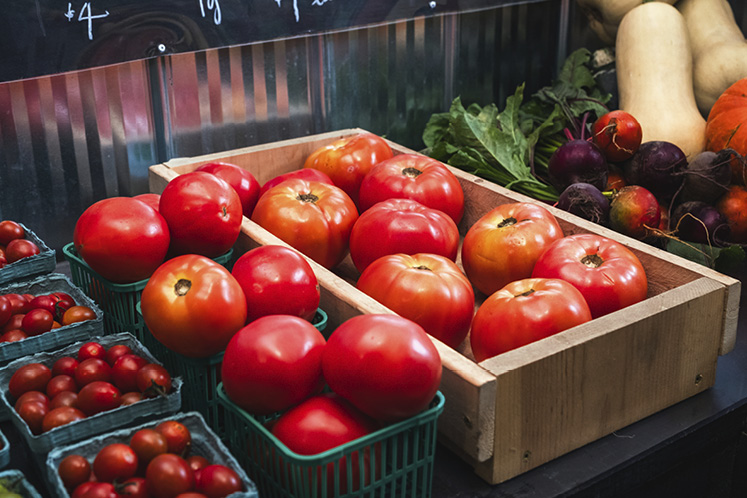
Lennox Farm has the natural local growing season for vegetables to consider, a 30-strong staff to pay fair wages to, harvesting to be done by hand (less bruising and damaging – and just Lennox’s way) and soil to be cared for and regenerated afterward. It all costs.
Area farms big (thousands of acres), smaller (such as the total 500 acres farmed by the Frenches) and even smaller (such as Fresh and Tasty Mushrooms in Amaranth) are tied into a huge, complex system that delivers food to our tables. Farmers may have contracts to supply produce directly to companies that process the product for supermarket shelves, or they may sell directly to the supermarket chains or to food wholesalers who, for a price, handle the logistics of getting produce anywhere in North America, using way stations like the Ontario Food Terminal in Toronto.
Lennox Farm works with distributors, but particularly values personal relationships with local restaurants such as The Goodhawk in Hockley, the Mono Cliffs Inn in Mono Centre and Beyond the Gate in Shelburne, which source local ingredients – but far from entirely so – and tailor their menus to be flexible with respect to local growing seasons and availability.
The Frenches would like to build more relationships with area restaurants, but the ease and appeal to restaurant owners and chefs of predictable menus and lower food costs weigh against this. Both farmers and restaurateurs are often too busy to handle the logistics of local pickup and delivery.
This saddens French. “You have to value local, sustainable and hand-grown food. We spend so much time researching [other products] we are going to buy, what we are going to wear. But we eat three times a day and don’t spend a lot of thought about what we put into our bodies, where the food comes from or how it gets to our plates.”
Lennox Farm creates their own pop-up restaurant at the annual Field to Fork dining series this summer with chefs from The Goodhawk, Mono Cliffs Inn, Soulyve Catering and the Walkers’ Two Chefs in the Hills.
Getting the word out
Encouraging people to consider the issues French raises is part of Jennifer Payne’s mandate as executive director of Headwaters Communities in Action. HCIA supports the HFFA, as its backbone charity, which Payne says is tasked with creating “the food system we want.”
The HFFA facilitates and encourages farmers’ networking and school food programs, and helps publish the Headwaters Farm Fresh Guide. The organization also hosts field-to-fork events, most recently at Mrs. Mitchell’s restaurant in Mulmur, to both raise funds and get out the word about local bounty.


All this to combat the force-ripened Mexican tomato available cheaply and year-round at any supermarket? “I don’t know that we are trying to,” says Payne. “I’d reframe it as community connection – an effort to educate and bring people to engage with their local food system. If you are just trying to put food on the table, there is no fault in buying a cheap tomato from halfway around the world.
“But when you know the farmer, know how they grow it, know the philosophy and ethos of the people who are involved with your food, you create a sense of connection. Maybe be encouraged to grow your own food. It is a way of seeing your food supply. It is not this tomato versus that tomato.”
On the menu
If and when that tomato is local, area restaurateurs are pleased to point out the good news on their menus.
Chef Sean MacMahon, co-owner with partner Natasha Priest of The Goodhawk eating house in Hockley, says, “How you word your menu gives prompts about where the meat is being raised and the produce is being grown. People like that.
“We try, whenever possible, to use local,” he adds. This includes vegetables from Lennox Farm and venison from Ontario Harvest Farms near Guelph, all picked up by the couple themselves.
“There is no third-party delivery,” he adds. “We don’t have those kinds of numbers. We have a one-on-one relationship with the producers. It’s such a tough industry that those kinds of relationships are important.”
Lennox Farm’s forced rhubarb (rhubarb grown in the dark for an earlier harvest of sweeter, more tender stems) has appeared on The Goodhawk’s menu in a seared duck breast main and a baked compote dessert.
“We are super small,” says MacMahon, “and we can change our menu every week or every other week in response to seasonality. It’s freeing but also limiting in that it can dictate the menu. For winter, we do preserving, pickling as much as we can – curing things, smoking things.”
At nearby Rustik Local Bistro in Orangeville, local mushrooms – grown by Shannon Coleclough and her husband, Sean Declerc, of Amaranth’s Fresh and Tasty Mushrooms – take the spotlight in dishes such as mushrooms on toast and mushroom paccheri, a pasta entrée topped with mushrooms and cheese.
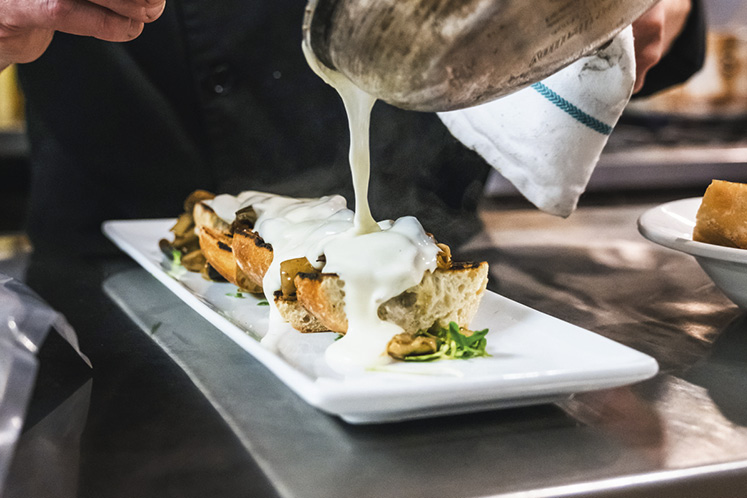
Most of the mushrooms the couple produces – they’re known for their shiitake, cinnamon cap, oyster, lion’s mane and maitake varieties – as well as the vegetables they grow on 30 acres and in a 3,000-square-foot greenhouse are delivered to places like Rustik or handed to farmers’ market patrons in brown paper bags.
“We do very little wholesaling,” says Coleclough. “It’s a preference. I’m not a huge fan of wholesale.
“We’re a small family farm. Not only is keeping it local a direct connection with people who are eating the food we grow, it is less of a headache at the farmers’ markets. There, we have money in hand, not having to chase down accounts or payments.
“If we were on a much bigger scale, that would change. Trying to get bigger and bigger is not necessarily the way to go. Be comfortable with where you are at with a more local clientele. Personally, I think we have to get back to smaller farms if we want a better society. Less global, more local.”
Laura Campbell of Pia’s on Broadway has a decade-long relationship with Fiddle Foot Farm, a small organic farm in Mulmur. Fiddle Foot grows a large variety of vegetables and, by choice and for environmental reasons, sells and delivers them exclusively to local markets, including Pia’s.
“Avocado on our menu comes from Mexico,” notes Laura, but most menu items are local or from Ontario. “From the ’90s, things have been global, including food. Go to the grocery store in 1995 and try to find an avocado. Now people expect them year-round. But things are changing. People are more aware of where it all comes from, and thinking more local.”
On Pia’s breakfast menu, vanilla French toast is served with local maple syrup. The restaurant’s seasonal soup, popular in cooler months, is made with Fiddle Foot’s root vegetables.
Choosing fresh and local
Whether focusing on his new LyvePatty storefront, running the summer food program at GoodLot Farmstead Brewing Co.’s beer garden, or his Soulyve Catering operation, chef Phil DeWar appreciates the “holistic vibe” of tiny Owl Dream Farm in Orangeville. He uses a variety of their microgreens in salads, in his gourmet Vytal Veggie patties and as garnishes in catering.
Sourcing local is affected by seismic global shifts, and the uncertainty created by Trump’s tariff threats have affected local chefs and restaurateurs, upping costs. “I’ve doubled down on things I was already doing,” he says. “But do people care? Are they willing to pay for this effort? The events of the past couple of months show that they do – and they are. People feel a sense of pride. It is empowering to be part of the big dance.”
DeWar believes that persuading people to choose fresh local products involves helping them feel as if they are part of the process. “I’d recommend starting at your farmers’ market with no expectations. Buy a couple of sausages. Buy some apples during apple season. Even just one thing. You may be going to get your chicken from a supermarket in a Styrofoam box, but for Sunday supper, buy some beef or pork at the farmers’ market and support area agriculture.
“You can participate.”
MORE INFO
Goat Cheese and Beet Terrine
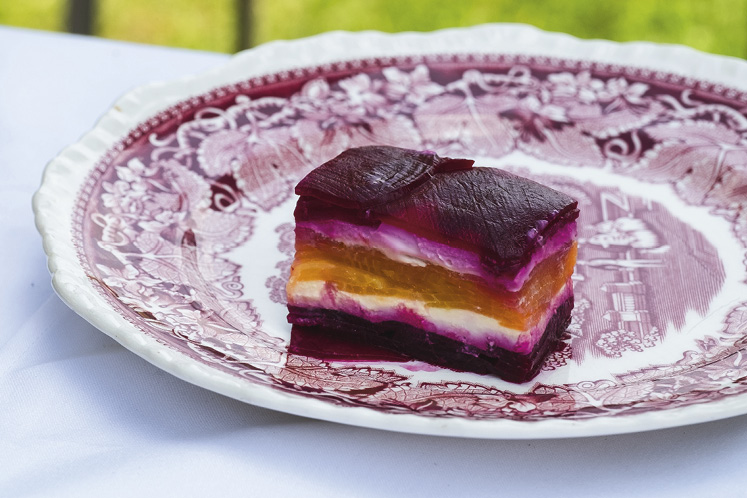
Serves 8, depending on mould used and how it’s sliced
INGREDIENTS
3 Ontario red beets
3 Ontario yellow beets
600 g local goat cheese
50 ml 35% cream
10 ml lemon juice
6 g chopped fresh lemon thyme
6 g chopped fresh parsley
salt, pepper and olive oil
DIRECTIONS
- Wash and lightly trim beets.
- Add beets to pot (cook the beets separately to preserve colours), fill pot with water and add 10 ml salt.
- Simmer beets until soft (knife will go in easily). Drain, cool slightly and peel (skin will come off easily). Let cool completely.
- Use a mandolin to slice beets thinly (keeping colours separate).
- Season beets with a little olive oil, salt and pepper.
- Use a mixer with paddle attachment to beat the goat cheese until smooth. Add the cream and blend until smooth. Season with salt, pepper, lemon juice, lemon thyme and parsley.
- Line a loaf pan with plastic wrap.
- Add a layer of sliced red beets. Use a spatula to add a very thin layer of the goat cheese mixture.
- Repeat with the yellow beets. Continue alternating layers until all the beets are used (or the terrine is your desired height). The final layer should be beets.
- Cover with plastic wrap, placing a weight on top to press the terrine.
- Allow the terrine to sit overnight in the refrigerator.
- Remove the plastic wrap. Place the terrine on chopping board. Slice into desired portions using a clean, sharp, hot knife (wiping in between to keep the slices looking neat and clean).
- Transfer to plates and serve with a side salad.
Related Stories

Cultivating Connection – Agritourism in the Hills of Headwaters
From pick-your-own berries to picnics in sunflower fields, Caledon, Dufferin and Erin have become hubs for locals and visitors who want to get back to the land.

The Art of the Hyperlocal Charcuterie Board
If a full brunch or sit-down dinner feels like too much, too soon after a winter of hibernation, consider gathering around an amped-up charcuterie board built with local meats, cheeses and toppings.
Feeding the Soul
Communal gardening helps newcomers nourish the sense of community lost when they were forced to flee their homeland.
Regenerative Agriculture Puts the Soil First
How cover crops, crop rotation and using livestock to fertilize fields puts local farmers on the front lines in reducing climate change.