
Explainer: Ontario’s Conservation System Faces a Major Overhaul
By next spring, familiar names like Credit Valley Conservation will disappear as 36 authorities are folded into nine – with potential ripple effects across the Headwaters region.
The Ontario government is moving forward with major restructuring plans to reduce the number of conservation authorities by 75 per cent and consolidate them under a new provincial conservation agency. The 2026 Ontario budget, which passed in April, officially mandates the consolidation.
Conservation authorities, municipalities and community groups across the province have voiced opposition to the decision. The main concerns are loss of local expertise, risks to programs and slower development approvals.
During a recent TVO panel discussion, Ontario Headwaters Institute executive director Andrew McCammon described the consolidation plan as “another in a series of cutbacks to really the most important watershed management form in Ontario.” OHI is a charity that promotes watershed security.
Michael Palleschi, chair of Credit Valley Conservation – which is responsible for restoring, monitoring and protecting the 950-square-kilometre Credit River Watershed – said in a March media statement that while the CVC supports modernization, “dismantling a high-performing authority that is already meeting provincial objectives does not advance that goal.”
To date, few authorities have shown support for consolidation.
Here’s what we know so far about the consolidation plans and the rollout, which is scheduled for completion by early 2027.
What’s happening to local conservation authorities?
On October 31, 2025, the Ministry of the Environment, Conservation and Parks announced the creation of the new Ontario Provincial Conservation Agency to provide centralized leadership for conservation authorities. A news release said the move is designed to improve service delivery, cut red tape and “help get shovels in the ground faster on homes and other local infrastructure projects.” The OPCA then laid out plans to consolidate Ontario’s current 36 conservation authorities into larger regional bodies.
Conservation authorities manage watersheds to safeguard against natural risks, such as flooding, and support the protection, restoration and responsible use of natural environments. They also act as critical environmental gatekeepers for building approvals for infrastructure projects, housing and roads.
The consolidation would affect the watersheds of the four conservation authorities in Headwaters: the Toronto and Region Conservation Authority, Credit Valley Conservation, the Grand River Conservation Authority and the Nottawasaga Valley Conservation Authority.
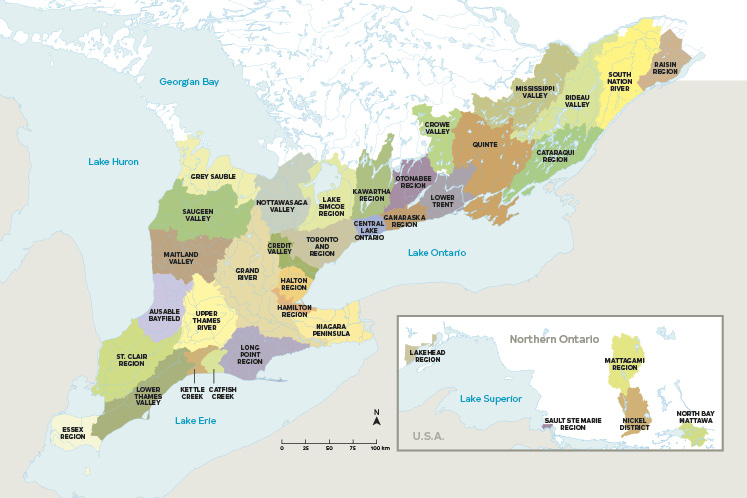
Though none of the NVCA’s conservation areas is located in the Headwaters section of the Nottawasaga River’s watershed, the other three conservation authorities own and manage popular conservation areas in Dufferin, Caledon and Erin:
• TRCA: Albion Hills and Glen Haffy conservation areas in Caledon
• CVC: Belfountain, Ken Whillans and Terra Cotta conservation areas in Caledon, as well as Island Lake Conservation Area at the edge of Orangeville and, along with the GRCA, the Elora Cataract Trailway (in partnership with the Elora Cataract Trailway Association)
• GRCA: the Luther Marsh Wildlife Management Area in Grand Valley and, along with CVC, the Elora Cataract Trailway (in partnership with the Elora Cataract Trailway Association)
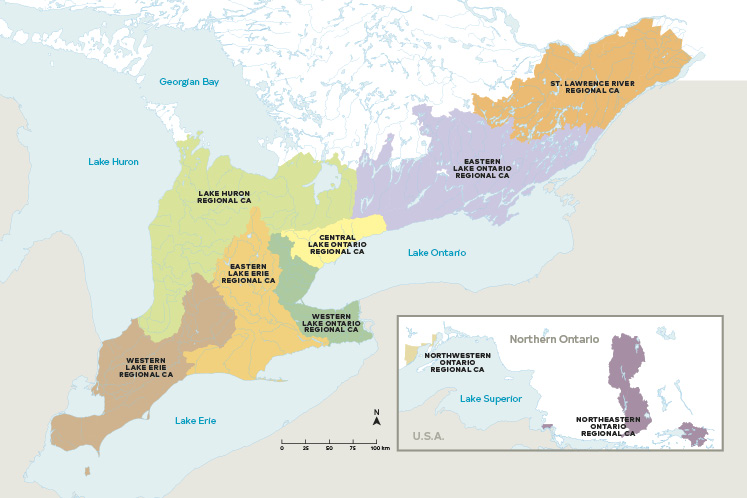
After consolidation, the existing conservation authorities become part of the new amalgamated authorities and will no longer operate under their current names. The TRCA becomes part of the Central Lake Ontario Regional Conservation Authority; the CVC joins the Western Lake Ontario Regional Conservation Authority; the GRCA falls under the Eastern Lake Erie Regional Conservation Authority; and the NVCA would be merged into the Lake Huron Regional Conservation Authority.
Why are conservation authorities being consolidated?
The Ministry of the Environment, Conservation and Parks stated that the current conservation system has become “fragmented,” and that inconsistent standards and timelines “can slow down development approvals.” This risks hampering the authorities’ abilities to protect their communities from floods and other natural hazards, the ministry said. Other stated reasons for the consolidation include unpredictable service delivery, outdated data systems, administrative duplication and a lack of transparency with respect to asset management.
The province’s initial plan was to consolidate the authorities into seven regional bodies. However, in November 2025, after holding regional workshops and consultations with conservation authorities, municipalities, stakeholders and Indigenous communities, the province amended the proposed number of regional bodies to nine. Analysis of the feedback indicated that seven authorities would be too large to manage and would align less effectively with geographical regions and their watershed needs.
The Lakehead Region Conservation Authority, based in Thunder Bay, avoided amalgamation with other authorities along Lake Huron – some more than 1,000 kilometres away – following significant public pushback. The LRCA will be rebranded as the Northwestern Ontario Regional Conservation Authority, but will remain a separate entity, which LRCA chief administrative officer Tammy Cook said, “feels like a victory.”
To support the transition, Ontario has earmarked $3 million in annual funding to the OPCA beginning in 2026. The restructuring is expected to be complete by February 2027.
Why do conservation authorities oppose consolidation?
Most conservation authorities have criticized the move, citing risks such as potential loss of local watershed expertise and community representation, threats to conservation programs and partnerships, operational disruption and slower development approvals – contrary to what the province predicts.
The CVC disputed the province’s claims that conservation authorities stand in the way of development, saying that it currently processes development permit applications within an average of 14 days, “far exceeding the province’s 90-day service standard.”
The Peel regional chair and CEO, Nando Iannicca, expressed concerns about whether other municipalities could gain jurisdiction over Peel’s conservation authority lands. He added that the CVC and the TRCA, both of which manage conservation in Peel, “have the capacity and capability to remain standalone regional conservation authorities.”


The NVCA took issue with the large scale of the consolidation, suggesting that a more “geographically coherent” plan would involve merging with nearby Georgian Bay-area watersheds to achieve better alignment, reduce transition costs and provide local accountability protections.
And the Grey Sauble Conservation Authority has raised concerns about donor trust: the area contains properties donated to, or sold to, the authority by residents who expect their long-term care to be managed by a local body.
So far, there has been limited support for the consolidation. In one example, the GRCA stated that it sees “no direct implications for the GRCA’s current programs or services” at this time.
How has the consolidation plan been challenged?
Since the consolidation announcement, environmental groups and concerned communities have led opposition efforts via protests, petitions and letter-writing campaigns.
Ontario Nature, a charity that works to protect wild species and spaces, launched an online petition to “re-empower conservation authorities” and urged the government not to proceed with the consolidation. On March 25, the organization joined a coalition of environmental and civic organizations and professionals, including the National Farmers Union of Ontario and the Federation of Ontario Cottagers’ Associations, for a press conference at Queen’s Park.
According to Josh Suppan, president of NFU-O, the planned amalgamation “threatens the livelihoods and conservation efforts of farmers and Ontarians as a whole,” as it could erode protections for farmland and natural heritage lands.
As part of the province-wide Fight Ford rally on April 25, protestors demonstrated outside MPP Sylvia Jones’ Orangeville constituency office, calling for protection for the Headwaters region.
On the TVO panel discussion, OHI’s McCammon criticized the government for being “completely focused on land-use expansion [and] sprawl development.” Without integrated land-use and watershed planning, he said, the province will continue to face flooding and water insecurity.
What happens next?
In the coming months, conservation authorities are required to follow a step-by-step transition process across key functions such as HR, finance and IT, based on a roadmap set by the Ministry of Environment, Conservation and Parks.
The current authorities must also appoint two members to a transition committee, led by a project chair appointed by the OPCA. Each chair will act as the authority’s chief administrative officer for 24 months. CVC confirmed that its board is following the guidelines and is currently forming its transition committee, which should be in place by this summer.
During the transition, no new conservation authorities can be created, existing boundaries cannot be changed and the ministry can issue binding directions to conservation authorities.
Once consolidation is complete, the new regional conservation authorities will form watershed councils to maintain local expertise in watershed management and planning, and to identify top priorities for programs and services.
The CVC said that it will continue working with its conservation partners to support a smooth transition. According to chief administrative officer Terri LeRoux, “Our focus will be on ensuring continuity so communities continue to receive the programs, services and watershed stewardship they rely on, without disruption.”
What do you think about the conservation authority consolidation plan? Leave a comment or email [email protected].
This story was updated on June 9, 2026.
Related Stories

How Construction on Highway 413 Will Begin Much Sooner Than We Thought
With the passing of Bill 212 on November 25, the government plans to speed up land
appropriation and avoid an environmental impact assessment.
Explainer: Why Is Controversy Swirling Around Caledon’s ‘Swan Lake’?
While activists and their allies fight to protect a body of water at a rehabilitated gravel pit, the Town of Caledon is considering new bylaws that could alter future land use regulations.

Could a Caledon Health-care Hub Ease the Pressure on Our Strained Rural Hospital System?
Proponents of a collaborative care model say it will improve access to health providers and ease pressure on overburdened hospitals and emergency rooms – all in one place.

Building the Case Against Illegal Trucking Yards
How the rise of truck depots on Caledon land zoned for agricultural use has galvanized local governments and activists to work together to turn back the tide – if it isn’t already too late.





CA consolidation is a misguided concept. Fixing some current issues of inconsistencies in CA capacity to deliver programs or fee structures makes sense. Taking years to amalgamate up to 7 CA’s into one new Regional CA with no lower tier municipal representation or voices on these very large bodies does not make sense, will slow current activities including permitting and will result in harm to our watersheds.
Rob Messervey from Pickering on May 28, 2026 at 5:45 pm |