Rest and Repeat
The importance of rest – whether napping or just taking a break – as a form of self-care.
As the final summer days stretch into fall, we are greeted with puffs of fresh, crispy breezes and cozy fall feelings. The cooler air arriving through the curtains makes you feel lazy, but there’s also some FOMO (fear of missing out) on the last wisps of summer – all mingling with the beginnings of back-to-school (the real new year). Oh, and a little dash of Where did the time go?
At the beginning of June, I started taking inventory of the summer and my goals. One word that came to mind was rest. And I found it not so much in lazy days at the beach or the spa, but in breaking away from around-the-clock activity, especially in our world that seems unavoidably “on” 24/7. It is a change I hope to carry into the fall.
Summers typically mean vacation time, camp for kids and a few long weekends – this should feel relaxing, and those breezy days of summer should feel extra-long. Maybe not whole-August-off-long, as we imagine summer in Europe to be, but a retreat from the everyday. Somehow, they don’t. Turns out, trying to stuff fun into an already busy schedule isn’t restful at all. What makes it so hard for us to rest? And what does rest mean?
At the same time, I struggle with the whole idea of self-care equalling rest. These days, self-care to some can often mean going to the spa. Grasping a short bit of alone time and paying for a time-limited service linked to a healthcare-adjacent business doesn’t meet my criteria for rest. I usually feel anxious about the treatment cost, and I like my own space better. However, the bath-with-candles option chez Lee doesn’t work for me either. When I’m home, I find it hard to stop cleaning or cooking, or tending to the dogs or checking email one last time.
So I’ve started some other habits that are helping me define my version of rest.
First, let’s start with sleep. I’m now very protective of my shut-eye time. A friend recommended the book, Why We Sleep: Unlocking the Power of Sleep and Dreams by Matthew Walker, and I took the science to heart. Longevity studies and neuroscience tell us we need to allow the complicated brain to cleanse itself through sleep. Come my (early) bedtime, I’m wrapping things up and tucking in. My husband, Derrick, still likes to stay up late and watch TV – I do not. My son, Adrian, likes to spend time in his room online with his puppy, Otto, by his side. I no longer care if the movie is half done or if there is one more load of laundry I can flip. I’m protective of my sleep like a momma bear.
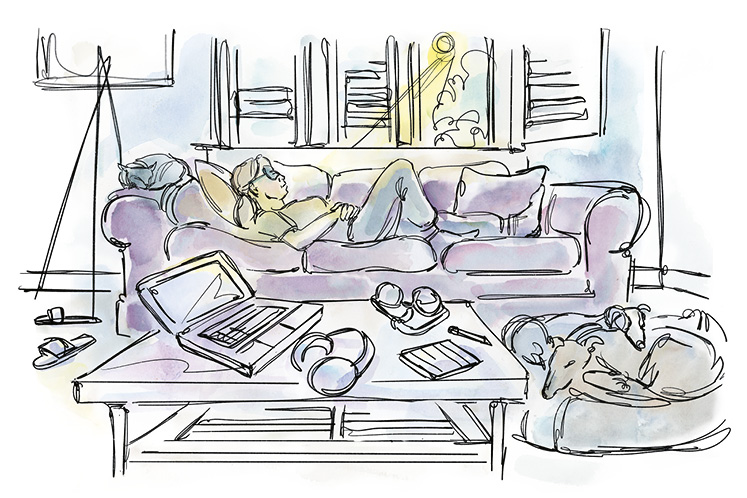
I’ve also been trying to commit to the practice of the “micro-rest” through very short walks, small stretch breaks and even lying on the couch ten feet from my desk for a breather. Sometimes it’s a mere five minutes. Petting the animals helps or taking them out for a quick spin. Sometimes I’ll just look up at my favourite tree and enjoy the breeze on my face or the sun shining on my skin.


I also recently helped enact a change at my workplace. Now we wrap up meetings five or ten minutes short of the half or full hour. Hurrah! A short time for a micro-rest, a drink of water or “bio break.” We are making it a habit and making it official. We’re also dropping the guilt that seemed to build over Covid that if you don’t fill your day with back-to-back meetings, you aren’t working hard enough. What baloney.
I also use time management apps on my devices to alert me when I’ve hit my daily limit (one hour and 15 minutes) on social media. Sometimes, I hit snooze for another 15 minutes, but my time spent online consuming little scrollable bits has gone down significantly.
My concept of rest is clearly changing. Is yours? I’m unlearning old habits and rejecting outdated suggestions from articles about what equates to rest. We might never get back to full days with nothing to do, no news or packages arriving, no instant social-media gratification. And I’m okay with it – I’m embracing the small moments instead.
More Info
Nest Ideas
Why We Sleep: Unlocking the Power of Sleep and Dreams, by neuroscientist Matthew Walker, shares evidence that sleep is one of the most critical aspects of our lives. sleepdiplomat.com
In the book Outlive: The Science and Art of Longevity, Peter Attia, a podcaster, author and longevity expert, discusses how to embrace sleep in the chapter “How to Learn to Love Sleep, the Best Medicine for Your Brain.” Attia explains the short- and long-term damage that accumulates through sleep deprivation, and how managing sleep is one of the pillars of Alzheimer’s prevention. This book sits on my bedside table, and I refer to it from time to time to remind me of my longevity goals. peterattiamd.com
A fabulous Toolkit for Sleep offers 12 tips from neurologist Andrew Huberman in a worthy five-minute read. hubermanlab.com/newsletter/toolkit-for-sleep
The Trails retreat – where food, mindful movement, rest and nature meet – sounds right up our (quiet and restful) alley! A two-storey log cabin available for bookings in Mono backs onto natural hardwood forest paths near the Bruce Trail and Island Lake. Yoga and functional movement classes in private or group settings too. Sounds very restful to me. thetrailsretreat.ca
Related Stories

The Allures and Dangers of the Open Road
Here in these hills, we are a car-reliant community. But driving can sometimes be overwhelming and terrifying.

Spring Cleaning Season
I’m no Marie Kondo, but every once in a while I want to dig in like this, scrub everything down, and have a little purge.

Wrapping Up Memories
Christmas has a way of bringing up childhood memories of family time with parents who are long gone, but not forgotten.

Making Space for Public Places
As our towns grow, the need to create and protect places to play, explore, climb, run, pedal and paddle is more challenging than ever.