Still Waiting for the Bus
Rural communities are built for drivers – but what about everyone else? As new transit efforts gain ground, riders are hoping for more than a lift.
Orangeville Mayor Lisa Post knows all too well the difficulties of relying on public transportation to get around. As someone “born and bred” in town, she remembers trying to catch the bus home as a teenager from Orangeville District Secondary School to her house on the west side. She often had to wait more than an hour if the buses were full – sometimes in the dead of winter.
It’s one of the reasons she is so proud that the public bus system, Orangeville Transit, has been fare-free since 2023. “I think it is crucial, absolutely crucial,” Post says, adding that despite the initial skepticism about funding a free transit program in a commuter town like Orangeville, there has been overwhelmingly positive feedback since the pilot launched.
According to Tony Dulisse, the town’s manager of transportation and development, ridership has swelled from about 102,900 annual users in 2019 to about 260,000 a year since 2023. The program has been extended to 2027. In April this year, a town report revealed that the bus route network at the time, which had three routes, provided coverage to 67 per cent of the town. The report proposed changing this to two 45-minute routes with more bus stops that would expand that coverage to more than 80 per cent in September. “Our goal is to make sure that 100 per cent of Orangeville is covered by transit,” Dulisse, one of the authors of the report, says.

For Orangeville and other Headwaters communities, a truly robust transit system can often seem out of reach in a deeply car-dependent culture. In the city, relying on bike paths, short-term car and e-bike rentals and public transit are a part of life. In rural areas and small towns, those without access to vehicles or who don’t drive, such as the elderly and people with mobility issues, have few available choices for travelling to jobs, health services, shops and other essentials – not to mention friends, family and social gatherings, which are just as important.
Indeed, Orangeville’s fare-free bus has helped residents combat isolation, says Post. However, a hyperlocal solution alone is not enough, she acknowledges. Residents also need to get to other small towns in the area and to urban centres such as Toronto, Brampton and Mississauga. “When people need to get around, they need to have an option that’s reliable, affordable, and can get them to the places that they need to be.”
A new five-year initiative announced in June by Ontario’s Ministry of Transportation may offer some promise in bolstering more realistic transit networks. The Ontario Transit Investment Fund has pledged $9.5 million in funding to improve transit between Dufferin County – home to Orangeville, Shelburne, and other largely rural towns and townships – and Grey and Bruce counties to the north. In August Grey Transit announced that starting in September, the Dundalk–Orangeville route will be covered by an increased number of daily trips between towns.
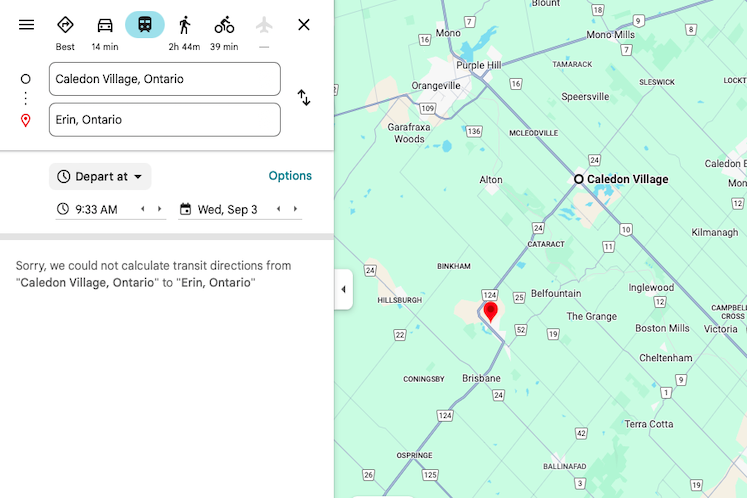
Change can’t come fast enough for anyone who has typed a query for transit directions into Google Maps and received a response of “Can’t seem to find a way there.” And while directions do pop up for some destinations – say, from Owen Sound to Orangeville – the result may as well be nil. In this hypothetical situation, the transit route involves three or four bus or train transfers, a stop at Union Station in Toronto, and more than six hours of a traveller’s time.
A patchy transit map
Currently, Orangeville is the only town in Headwaters with a dedicated public transit system. Caledon has five bus connections to Brampton in the GO Transit regional public transportation system. Erin has none. The Town of Shelburne ran a free pilot program in 2023 and 2023, but ridership proved minimal.
Grey County operates a bus route from Dundalk to Orangeville, with stops in Melancthon and Shelburne along the way. (Starting in 2024, however, Grey County residents were given priority access to that service). To travel farther south – say to a GO Transit train station in Brampton to eventually get to downtown Toronto – it’s necessary to travel to one of the GO stops in Orangeville, Caledon, Victoria or Bolton. This can be time-consuming and challenging, as bus connections are often infrequent or available only during rush hour.
Short trips that would take less than 30 minutes by car are maddeningly impossible, as a visit to any local Facebook community group reveals. “Is anyone willing to drive back and forth from Shelburne to Orangeville twice a day at 9 a.m. and 5:45 p.m.?” a member asks in the Shelburne and Area Q&A group. “Please do not suggest cab companies as I have tried. They are very expensive, and the bus does not line up with work hours.” In an Orangeville-focused group, a mom describes waiting 40 minutes with her son for the bus he needs to catch to get to his summer job at the local Home Depot. Another wonders whether it is possible to get from Shelburne to the Mount Pleasant GO station in Brampton by 9 a.m. (Spoiler alert: It’s not.)
Martina Rowley, who has lived in Orangeville for eight years and has not owned a car since moving from England to Canada in 1998, uses public transportation daily to get around town and travel to urban centres such as Toronto. That journey takes careful co-ordination because the connections between the Orangeville bus, the GO bus and the GO train, which she catches in Brampton, can be infrequent with significant gaps in scheduled service.
“The last bus you can take in the morning to Brampton and Toronto from Orangeville is at 7:30 a.m. Then the next one isn’t until 3:35 p.m. to get you into town for something in the evening,” she explains. Rowley, who volunteered on the town’s transportation task force in 2019 and 2020, notes that the local fare-free bus can often be 20 to 30 minutes late due to heavy traffic, bad weather or service disruptions.
The town is listening to rider feedback and working on improving the journey. Dulisse says two new buses are coming in 2026, and the town’s goals include better connecting the east and west sides of town. The September plans Dulisse backed, which are set to increase the area covered by Orangeville Transit to more than 80 per cent, will expand services to underserved areas, offer more stops, shelters and efficient routes, and shift stop locations to improve safety and flow.
Meanwhile, the town continues to have talks with Metrolinx, the provincial agency that owns GO Transit and that is tasked with co-ordinating and improving transportation across the GTA. The aim is to increase the frequency of GO bus service to and from Orangeville, and to have the town’s Centre Street Transit Hub double as a GO bus stop to increase the ease of catching a connecting bus. Looking ahead, Dulisse says commuters could one day even see service that extends from Orangeville east to Caledon, King City and even Newmarket, depending on demand.
“I think it is challenging for people when they move here and see that there are limited options for transit,” says Post, who hopes some of the annual ridership data collected by the town will help inform Metrolinx about how to better invest in GO service for Orangeville. “They’re relying on our ridership growing before they make changes to our service. And my argument is you need to change the service to grow the ridership, because people aren’t taking it because the times don’t work.”
From isolation to access
The new provincial funding for Dufferin, Grey and Bruce counties aims to strengthen the network of rural communities in partnership with Saugeen Mobility and Regional Transit, a not-for-profit ride-booking service for residents experiencing mental or physical challenges.
“The funding that we receive for the first year – so for 2025 – is to continue service between Dundalk and Orangeville and conduct a study to determine the best way forward,” says Stephanie Stewart, manager of community transportation for Grey County. The study results will aid in planning routes and which types of transit to offer, including on-demand and fixed routes along main highways.
All this comes at a time when many residents’ travel and commuting habits are in flux. When the Dundalk-Orangeville route opened in September 2020, Stewart says, people used it to travel to Orangeville either for work or to access the GO bus to commute to larger cities. But Orangeville, Shelburne and Dundalk have all grown, creating more opportunities for local employment within those communities and new demand for routes between counties.
The biggest challenge, Stewart says, is the sheer size of the region these three counties cover – about 10,000 square kilometres, or more than the entire Greater Toronto Area. Each county comes with its own demographics and population spread, from larger towns like Owen Sound, which boasts tens of thousands of residents, to tiny communities of just a few hundred. “The type of service that people may need in Dundalk, Shelburne and Orangeville is different from what somebody out in Melancthon needs, or somebody in Thornbury,” she says.


A feasibility study conducted in 2023 by Bruce County found a traditional bus service, which typically offers services during peak morning and evening commutes, is not the answer. The population includes many young people and retirees, as well as seasonal tourists who do not necessarily need a bus during those times. Instead, the study recommended alternative options, including ride-sharing apps, on-demand transit services, charter buses for tourists and seasonal workers, and expanding the user base of Saugeen’s SMART Transit.
With the latest round of provincial funding, there may be opportunities to create new routes based on demand and possibly reintroduce services that had been shut down, Stewart says. Grey Transit Route previously offered routes from Owen Sound to Dundalk and Owen Sound to the Town of The Blue Mountains, but both were discontinued in March this year when previous provincial funding ran out. “We’re working very hard to try to make sure that everybody has access to transit, just like any other social service,” she says.
To offer the increased number of trips on its Dundalk–Orangeville route in September, Grey Transit Route will stagger the schedules of the two buses on the route. Previously, they ran two buses simultaneously. According to Stewart, there will no longer be any restriction on who can ride this route. Riders are encouraged to book in advance.
Orangeville’s mayor hopes the partnership with Bruce and Grey counties will be “wildly successful.” The increase in usage “will really help us to continue to advocate for better GO bus service here,” Post says. “And that will help to feed the cycle of transit.”
Orangeville is one of the few places in Canada with a fare-free transit program, and it’s now seen as a model for other towns looking into similar initiatives, Post points out. “Because the fact is, everybody needs good public transportation. Everybody takes the bus. And if we make it accessible for everybody, then everybody will continue to take the bus.”
More Info
Public transport in Dufferin, Grey and Bruce Counties
Want to find bus schedules and fare information? Click on these links for more details.
Orangeville Transit – Within Orangeville
Grey Transit Route – Dundalk/Orangeville
Metrolinx GO Bus Route 37 – Orangeville/Brampton
Related Stories

Beyond the Trade War
A Q&A with writer and pollster Michael Adams on tariffs, Canada’s recent election, and our strained relations with our neighbour to the south.

The Search for Foster Families
As child welfare resources are stretched thin across the province, Dufferin Child and Family Services’ open houses are one way the agency connects with potential caregivers.

Building the Case Against Illegal Trucking Yards
How the rise of truck depots on Caledon land zoned for agricultural use has galvanized local governments and activists to work together to turn back the tide – if it isn’t already too late.

How Construction on Highway 413 Will Begin Much Sooner Than We Thought
With the passing of Bill 212 on November 25, the government plans to speed up land
appropriation and avoid an environmental impact assessment.