Forgotten Factories: Remembering Bolton’s King Street Ashery
Discover the history of potash production in Headwaters, and the rise and fall of entrepreneur Edward Porritt’s ashery in the late 1800s.
Recent threats to the global potash trade have propelled this humble compound into news headlines, but long before large corporations began mining potash from underground deposits, farmers used wood ash to both nourish crops and make lye, an essential ingredient in soap.
For early settlers, the hardwood forests of Headwaters provided plenty of raw material. When clearing a field for farming, they would chop down the trees and leave them on the ground. During winter, they burned the felled trees, covering the field in a layer of ashes. The next spring, when preparing the field for planting, the ashes were plowed under to supply their crops with fertilizer.
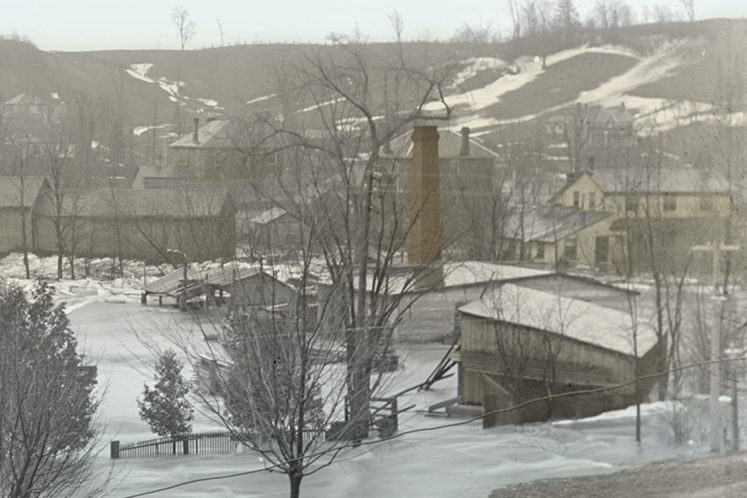
In Bolton, an entrepreneur named Edward Porritt saw a business opportunity in the area’s plentiful supply of wood ash. In about 1868, he built an ashery and began using wood ash to produce lye and potash. Located on the south side of King Street East, roughly across from the end of today’s Humber Lea Road, the ashery’s towering smokestack became something of a local landmark.
For much of the next 20 years, Porritt and his wagon were a familiar sight as he drove around collecting wood ashes, probably in exchange for a bartered item or a small cash payment.


At the ashery, Porritt ran water through the ashes to produce lye, but he also created a more refined product by “cooking” the lye in large iron pots in the ashery’s furnace building. This process transformed the lye into potash (a combination of the words “pot” and “ash”), while the tower dispersed the resulting smoke high above the village.
By 1885, however, Headwaters forests were largely gone and the supply of wood ash had dwindled. The ashery was abandoned, though it remained in place until at least 1912, when the photo was snapped during that year’s devastating April flood. It was later dismantled so that this photo, and a few others, remain the only evidence of the ashery that once stood on the site.
— With thanks for information provided by the Albion Bolton Historical Society.
Related Stories
The Trees Had to Go!
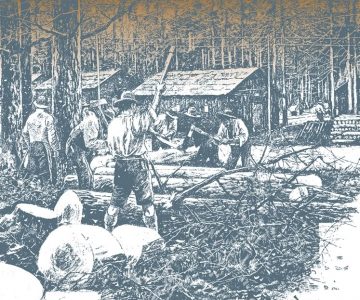
Settlers in the 19th century came here to farm, and to do that they had to clear the trees. Their success with that was thorough and dramatic. So was the impact on the landscape.
When Cattle Were a Traffic Hazard
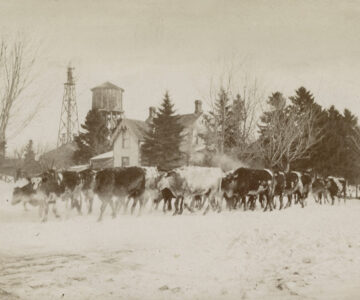
Cattle drives were once a familiar sight on Owen Sound Street in Shelburne – often to the dismay of local residents.

When Peepabun Was More Than a Name on Google Maps
Once a thriving centre of Christian revivalism, Peepabun was known for its annual camp meetings in the early 1900s.

The Little Engine That Could
Steam locomotives like the James McKay helped shape and build our communities in the early 1900s.