
Guardians of the Gravestones
Each weathered headstone holds a story. Three dedicated volunteers are making sure Caledon’s departed rest in peace, and are not forgotten.
A young man is wrangling a weed whacker on the grounds of Boston Mills Cemetery, the rasp of his noisy machine drowning out gentle birdsong in the cemetery’s trees.
Working away, he wears grass-stained sneakers, the peak of his ball cap turned backwards despite the sharp summer sun. I wonder how much he cares about the history of this place, about the stories – the joys and sorrows – of the souls who rest beneath his feet.
The only other person working here is far from young. And he definitely cares about this place. Deeply.
Herb Van Arkel is 80. Standing casually in the deep shadow of one of the cemetery’s mature trees, he surveys the long shadows cast by other trees across the well-kept, undulating grounds. He’s wearing blue jeans, a ball cap reading “Cheltenham, Home of The Badlands” turned the right way round, and a look of contentment.
Everyone else here is dead.
Cemeteries are silent, solemn and accurate societal archives. On ancient stone and in old burial records, family genealogy, community history and cultural values are written. Even the dates of death inscribed on headstones, studied closely, speak to today.
“We have graves; mother, father, young children, neighbours, who all passed away around the same time,” Herb notes. “Something (a communicable disease) went through the community. There wasn’t medicine like there is today.” He suggests that today’s anti-vaxxers would be wise to heed the warnings in these stones.
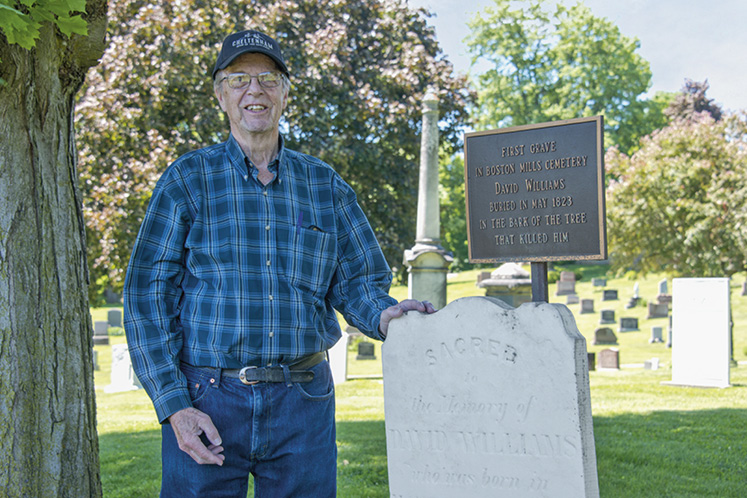
For him, history and community abound here, and the many tasks he undertakes at this designated heritage site are unpaid and voluntary.
The town of Caledon manages 31 cemeteries across the municipality. A further 13 are not operated by the town. Four are run by a church or diocese, and nine – including Boston Mills Cemetery – are community, charitable entities administered and maintained by volunteer boards.
“Administered and maintained” understates Herb’s work. He acts as secretary-treasurer, as well as chair, of the cemetery’s volunteer board. A welder by trade, and later a facility manager for the Region of Peel, he has been, by inclination, a volunteer firefighter and chair of the board of trustees of Cheltenham United Church, now closed.
If that were not enough, he has been hands-on and heart-in at the cemetery since 1984, doing office work (“It’s not rocket science, just good bookkeeping”), selling plots (Boston Mills remains an active cemetery); arranging for grounds maintenance, grave digging, insurance and memorial services; soliciting donations; issuing tax receipts (the cemetery is a registered charity) – and doubling as a ghost.
Eerie, late-night lights and noises once reported from the cemetery were probably Herb laying a cement foundation in the basement of the old, one-room Boston Mills schoolhouse, relocated to the grounds for use as a morgue and chapel.
Strolling, inspecting the cemetery’s groomed grounds – the young man is doing a good job; Herb settles for no less – he uses his boot to gently scuff dirt and grass cuttings from small flat grave markers sunk flat in the lawn (“They’re murder on the mowers”) and makes a mental note to raise one a little using limestone gravel underpinning.
Who pays that small cost, among a great many? Board-run cemeteries get no funding from municipal governments, though as a designated heritage site, Boston Mills can apply for town grants to pay for specific projects. But most funding for supplies and upkeep comes from charitable donations, the sale of plots and investments.
“Board members realized that long-term funding was needed, so they started buying War Bonds, back in the day. That money is still sitting there (now in GICs),” says Herb. “I use the interest, when needed, to pay for things.”


In addition, for some years now, a percentage of the fee for any interment or scattering of ashes must be rendered to the Bereavement Authority of Ontario, which oversees the province’s “death care sector.” The funds are placed in a trust and paid out to ensure the continuing upkeep of any cemetery, especially those no longer active.
Herb’s labours are, of course, unpaid and done out of his commitment to community service.
He isn’t thinking of BAO funding or bookkeeping today. Out in the sunshine, he diligently wanders, tapping or stroking the occasional gravestone to check that its footing remains firm before stopping at the site of the cemetery’s strangest burial and oldest plot, that of David Williams.
Born in Merionethshire, North Wales, in 1794, Williams died on this very spot in 1823, when the tree he was felling to build a cabin felled him. Wrapped in the bark of the same tree, he was buried.
Herb stoops to remove a few twigs from the gravesite and stands easy by it. After Williams’ death, those interred here were local residents, generations of early area farm families: the Sinclairs, the Campbells, the Wilkinsons, the Maxwells. The cemetery may be the oldest in Caledon, and the history of the area is etched into its decaying stones, some propped up by the em-brace of stainless steel channels that Herb himself created and installed.
He values old cemetery logs, which record all burials, to identify those interred beneath such headstones or, indeed, those buried with no stone at all, which was sometimes done back in the day.
Herb finishes his day at a new headstone under a spreading tree. “Van Arkel” it reads, marking the final resting place of an urn containing the ashes of his wife, Joyce, who died only last year. Herb dug the hole and chainsawed a few impeding roots. His name, too, is etched in the stone: “Beloved Husband” with the date – and Herb himself – to be added later.
“When might that be?” he is asked.
“I ask God that every day, but He hasn’t answered me …”
A little to the northwest of Boston Mills on the east side of Mississauga Road lies Blair-Belfountain Community Cemetery, where Gayle Lawr is speaking. “A lot of cemeteries will allow only a flat marker, or a stone of a certain height. Here, we’re not that fussy. We allow people to be a little more creative with their monuments.”
“We” is the four-person Blair-Belfountain cemetery board. At 79 and full of life, Gayle, the secretary-treasurer, is the board’s oldest member. The youngest is 60-something.
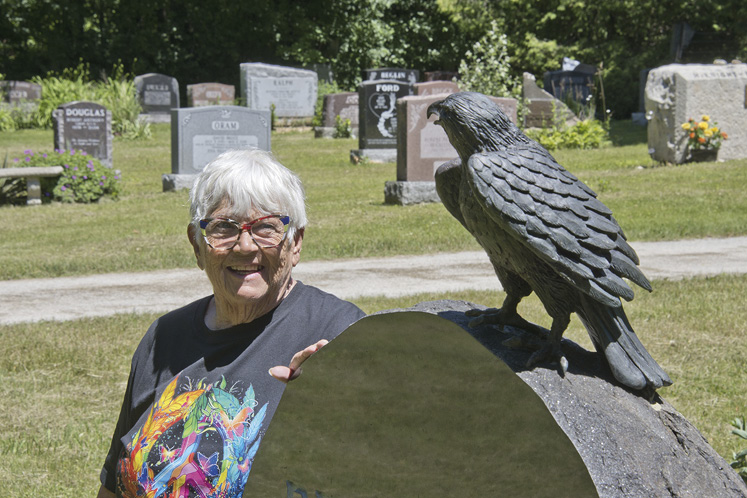
Gayle is seated on a marble bench, an example of the creativity that the Blair-Belfountain board allows. One day in the future, this bench will mark the final resting place of Ron and Leslie Swackhammer, whose names are already engraved on the monument. Nearby is a similarly unique gravestone: a huge granite boulder, polished on one side and topped by a large bird of prey worked in metal.
Gayle herself presents creatively: colourful eyeglasses, multicoloured “Imagine” T-shirt and magenta toenail polish that sparkles in the sun. With her in this “acre and a bit” graveyard are many family members and friends. She, too, will be buried here one day. This will never be a sad place for her.
A former clerk in Bell Canada’s engineering department, Gayle has been enthusing over and volunteering here for about 30 years, bookkeeping and “neating the place up” on hands and knees, pulling weeds or picking up trash such as dried-up Christmas wreaths. Like Herb, she cares.
In 1855, members of the Blair family donated what had been their family burial ground to the community of Belfountain. And in 1960, the cemetery was enlarged thanks to a donation by Harry Willis, a prominent Belfountain-born lawyer who was assembling development land in the area and who would go on to become a Tory senator.
Today, Gayle is worried about who, if anyone, may follow on the board and what might become of Blair-Belfountain without the TLC of people like her. Without local volunteers, the cemetery would come under the auspices of the Town of Caledon.
“Caledon does an okay job there (at the Alton Cemetery),” she says with a shrug, “but the town doesn’t have an affection for a place like people who have family buried there and want it to look nice. For them, it’s a job. Then on to the next job. To us, it’s a labour of love.
“The population of Belfountain has become more transient. People come, buy a home, live here a few years, then sell and move away. The people who lived here, you used to know from the area, you saw them, they maybe move to a nursing home, but you know they are going to be buried here. Even if they moved away, they want to be laid to rest here. It emphasizes the importance of this cemetery to the village.
“Every little board like ours is concerned for the future. We try to interest new people. But young people are not that interested. At the cemetery on a Sunday afternoon, you see only older people. Young people aren’t concerned with death and dying. People don’t own a cemetery plot in their 20s, 30s or 40s. It’s not like it was a generation or two ago, when families would own big family plots. Things are different.
“Now people bring and leave plastic flowers,” Gayle sighs in a fleeting moment of regret.
Jack Gibson is 93. He was in insurance. He lives in Palgrave. He was born there. He will die there. He will be buried there – and he knows just where: alongside his wife, Lenore, in a plot purchased long ago in Morningside Cemetery, where about 15 of his family members are buried. He has been a member of the cemetery’s volunteer board for 40 years. Like Herb and Gayle, he cares.
As with Boston Mills and Blair-Belfountain cemeteries, Morningside Cemetery’s board members are aging and concerned about what happens after they’re gone.
“We hope that next year, or the year after that, someone might show interest and come on the board. That the board would keep operating. That has been the case for a hundred years. If not, legally, the municipality takes over.”
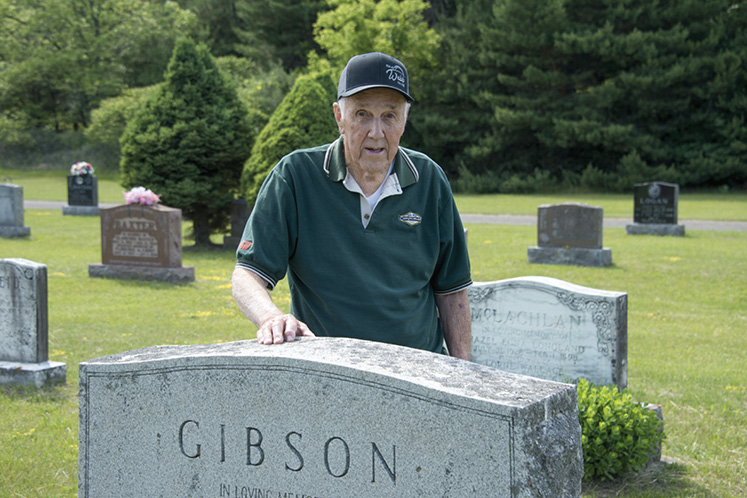
Jack also cares about keeping a local cemetery as the final resting place for local folk. “The board approves new plot sales and burials,” he says. “Mainly me. If you were to phone me up and say, ‘I want to be buried in Morningside Cemetery,’ I’d ask, ‘Where are you from? Who are your relatives? Why do you want to be buried here?’ You might say, ‘I love the cemetery; it’s so pretty, et cetera.’ Is that a good enough reason?
“If you are down in the city, it will cost you 10, 20, maybe 30 thousand for a plot. You can see why they want to come here. (Plots in Morningside go for a small fraction of that.) I try to keep it local. What happens in the future, I don’t know.
“The history of this place is important to me,” he says, looking slowly over the neat, orderly rows of headstones, at the symmetry of his cemetery. “I know a lot of the people that are in here. In my lifetime I knew them, or knew of them. Morningside is a nice place to come to rest.”
Nearly 30 kilometres away, Greenlaw-Baker Cemetery is tiny and takes a little finding. Most, in fact, nearly all, of the drivers making haste up and down Mississauga Road are utterly unaware of it, though it lies but metres away at the intersection of The Grange Sideroad.
Who cares? Well, town of Caledon staff maintain it, and though easily missed, it is neat and tidy. But it has no Herb Van Arkel, Gayle Lawr or Jack Gibson to care for it.

Long listed as “inactive,” this cemetery was home to burials from 1852 to 1956. It is now the sole remaining vestige of the pioneer hamlet of Greenlaw, also known as The Grange, and its church. The church closed in about 1900 and was demolished in about 1940. A parsonage, a blacksmith shop and possibly a small cluster of other homes and shops came and went – and the history of the community, old and not rich, has been consigned to Google for the few who might care.
Be it sunny, rainy or snowy, the hamlet’s etched history is today becoming tough to read on the eroded stone comprising a jigsaw cluster of shattered markers laid flat into a cement slab by the town of Caledon, which assumed responsibility for this cemetery in 1974. Behind this, a few larger headstones battle the sumac gloom at the tip of the cemetery’s three-eighths of an acre, square-shaped lot. That’s it. A short visit here, even in summer sunshine, feels sad.
But there is no time for sadness. Life has gotten busy. The dead can rest in peace. The rest of us have stuff to do. Home Depot opens at 6 a.m.
It is long past 6 a.m. in Morningside Cemetery. It’s late afternoon and Jack Gibson’s day is coming to an end. He walks away slowly through the pretty, ordered rows of lawn and headstones, past those where his own bloodline lies. He does not look toward the plot at the edge of things, where he and his wife will one day be buried.
Looking younger than someone in his tenth decade, Jack seems content. “This is home to me,” he says with a proud wave of a large hand. “My expectation is that the people on the board in the future would look after this place as it has been for the past one hundred years. I hope so.”
More Info
GRAVE MARKERS: A BRIEF HISTORY
Cemeteries and grave markings have always reflected changing societal tastes. Places for interring the dead, they are designed for the living.
Here in Headwaters, early settlers were often buried in family plots on their own homestead, their graves unadorned except for an uninscribed fieldstone or a marker fashioned from local wood.
As isolated homesteads grew to hamlets, gravesites became more communal, the dead being buried beside – and sometimes under – the local church. As these graveyards became crowded and unsanitary, and hamlets grew to villages, then towns, cemeteries moved to their outskirts.
Church and public cemeteries gave way to private, for-profit resting places. The grounds of these cemeteries became more managed, designed as beauty spots where the bereaved (and otherwise) can stroll, reflect, even picnic. “Memorial gardens” featuring winding paths, draping willows and shady grottos became the graveyard norm.
As towns became cities and land prices rose, larger burial grounds became more functional – for ease of maintenance, with uniform grids and flat-to-the ground grave markers that aided mowing efficiency. Indeed, they came to mimic the uniform, ordered suburbs that often surrounded them.
Cremation and alkaline hydrolysis, aka “aquamation” or “water cremation,” have become popular options, with urns buried or housed in above-ground niches.
Ontario law allows the scattering of ashes on all unoccupied Crown lands and waterways (avoid bathing beaches, marinas and municipal intake pipes), as well as on your own property or someone else’s, with their permission. Ashes may also be scattered in conservation areas or provincial parks, though some allow this only in designated sections. Check first. And think “upwind” when planning.
Headstones, which literally indicate the location of the head of the deceased, are traditionally upright and vertical. The material used to fashion these markers has gone from wood to fieldstone to marble, all of which were relatively soft and easy to carve and buff to a pleasing sheen. But as can be seen in any old graveyard, these materials decompose with time and harsh winters.
As the technology needed to etch harder stone evolved, granite, more durable and available in a pleasing range of earthy colours, replaced marble.
Over time, the symbols etched into headstones also altered to reflect changing attitudes toward death and an afterlife. From century to century, they moved from the solemn, even macabre (skulls, skeletons, warnings of damnation) to the hopeful and serene (cherubs, flowers and willows) to the extravagant (the excess of the Victorian era).
Today’s digital technology has meant that headstones may now be cut into a wide range of non-geometric shapes and sizes, and inscribed with near-photographic images such as a portrait, a favourite scene, a family photo or a meaningful image such as a letter, song lyrics or a visual nod to hobbies and achievements: pilot’s wings, a musical instrument or an artist’s brushes.
Grave markers may even have a QR code on a plaque embedded in the stone so that, when scanned with a smartphone, it links to a biographical photo gallery or videos of the deceased literally speaking from beyond the grave.
Or the memorial may reflect an eco-conscious life by leaving a minimal environmental footprint. “Green burials” entail no embalming and a biodegradable casket or shroud. Interment may take place in a non-landscaped “natural” site in a cemetery. Think of a meadow where the grave is marked by a bush, rock, tree or simply a GPS co-ordinate.
R.I.P.
Related Stories
Stories in the Stones
Murder, Hollywood intrigue and heroic deaths are among the tales that lurk on tombstones in cemeteries from Bolton to Horning’s Mills.
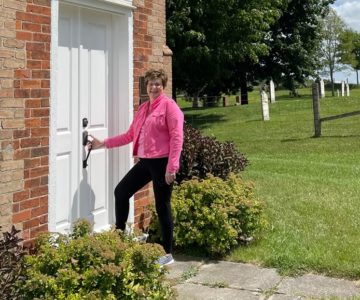
Donna Holmes
This devoted Relessey Cemetery Board volunteer helps the group manages the graveyard next to the Mono church, which dates back to the 1870s.





Thank you so much for putting together this article. I’m now a much more informed consumer! I’m currently in the process of purchasing a burial plot for us, so the information you provided is especially helpful.
Tony Leo from Brampton, Ontario. on Sep 16, 2026 at 10:29 pm |