
Making Room for Misfits
In his debut novel In The Hills alumnus Ken Weber draws on his decades as a special education pioneer to ask what makes us different – and how our community can embrace us anyway.
Ken Weber has had an illustrious career. Most In The Hills readers will know him for the 27 years he spent contributing stories about Headwaters history, and his long-running puzzle page. However, that didn’t even begin until after his retirement as a professor at the University of Toronto’s Faculty of Education and Institute of Child Study, where he published many academic textbooks, and was a pioneer in the field of education for special needs students.
In the 1990s and early 2000s, Weber also published the Five-Minute Mysteries series, seven books each containing about 40 brief cases of murder and mayhem, all designed to be solved in about five minutes. A particular hit in Japan, the series has gone on to sell more than five million copies worldwide in 20 languages.
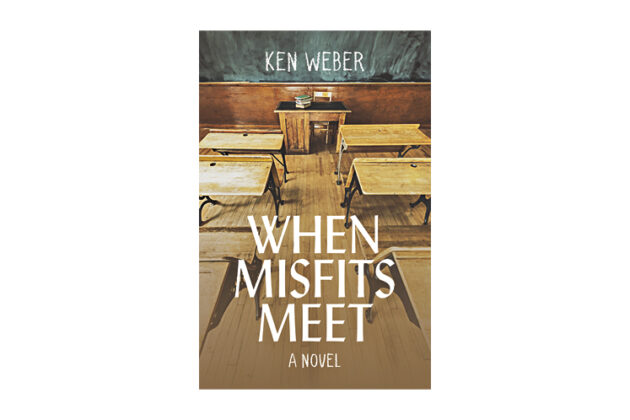
Weber retired his In The Hills column in 2022. Now, at age 86, the prolific writer has published his first novel. Set over four months in the fall of 1951, When Misfits Meet draws together a wide collection of characters in the fictional Ontario village of Halbstadt. City boy and newly hatched teacher Owen Hesch arrives to much curiosity from the locals. His assignment is experimental both on his part, and that of the school board. Owen isn’t sure village life is for him, and the school board isn’t sure about what was then an unheard-of concept: special education.

Today there is a whole lexicon of terms used to describe special needs students, like autism spectrum disorder, dyslexia and Down syndrome. In 1951 such terms were unknown, especially in small rural schools. What clinical terms there were – the discriminatory slur “mongoloid,” for example – fell out of favour in the years following.
The students in Owen’s class are trying to pass Grade 8, though many are well into their teenage years. As we get to know them, we see that while each has challenges – and some quite profound – they also have strengths and abilities waiting to be unlocked. We come to see their humanity and beyond their special needs.
The book is a highly readable and entertaining look at how we all have ways we don’t fit in, and how we can be embraced by the community nonetheless.
I sat down with Ken Weber in the backyard of his lovely Caledon home to talk about When Misfits Meet.
JEFF ROLLINGS: You’ve had a long career publishing non-fiction, and the Five-Minute Mysteries series was a series of short fictional stories. But this is your first long-format novel. What inspired that change?
KEN WEBER: Yes, if you count the schoolbooks I’ve written, this is my 52nd title. The truth is, I just wanted to see if I could write a novel. Enough people have read it now and convinced me that I’ve succeeded, so that makes me feel pretty good. But at the time that was the main motivation.
JR: Was there a moment when the whole thing gelled, or when you knew you had a story?
KW: There was a moment when I realized I had a basic outline. I knew I wanted to set it in a country village because that’s where I grew up. And I wanted to place it in 1951. There were two reasons for that. One was that I wanted the village to be a character itself as much as the people in it. And given what villages are like today, with the internet and paved roads and cell phones, they’re really variations of a city without the noise. Villages in those days were really individual and unique.
The second reason was that I wanted to make a point about the evolution of special education, because that was my academic career.
JR: How would you describe that evolution?
KW: Not to be arrogant, but I think it’s fair to say I was one of the founders of special education in Canada. I was the founder of the Special Education department of the University of Toronto Faculty of Education, and I spent a lot of the ’70s, ’80s and ’90s travelling across Canada, talking about special ed.
When I was a young teacher, in the early ’60s – I started in high school – I thought that teaching was the most fun you could have with your clothes on, and just loved it. I don’t think young teachers today have that same experience, and I wanted to make a point about how interesting and how much fun it was to teach special kids at a time when there was very little interference. In the modern education system, there are so many administrators, so many regulations and policies, not to mention so many experts. Advocacy groups have their hands in too. And everybody talks about funding as if it’s the answer to everything.


In my experience, the first step to addressing special needs is a combination of goodwill and common sense, and that’s got to have the teacher at the centre. When you’ve got so many administrators and so many experts and so much policy, the teacher gets moved to the periphery. In my book, the teacher, Owen, who’s the main character, is pretty much on his own with these so-called misfits, these special kids, so he has the opportunity for creativity and there’s room for common sense and goodwill.
Everybody assumes that for a special needs kid there has to be a program or a special method out there somewhere. But the whole notion of a special needs child is just that: special. That kid may fit into a general category like, say, autism, and a program may have a general view of what can and should be done, but for anything to succeed for that particular kid, it takes the teacher who sees him or her in school every day, and I was hoping to make that point in the book.
JR: What part of the book was the most fun to write? And the most challenging?
KW: That’s an interesting question I haven’t thought about. I think the most fun was dealing with the women, dealing with Owen’s love affairs. I would have the same problem making a decision about which direction it will go as he does at the end of the book.
As to challenging, the thing that’s so different about writing a fictional novel is you really have to create a world, and then get into it. My other writing always had borders. There were facts I couldn’t alter and I often had to make academic arguments. And there was a limited audience. With a novel you have a wider audience and you want everybody to be pleased. I think the hardest thing wasn’t getting into the world, but at the end of the day getting out of it and coming back to my family. I really have to give them thanks. My wife Cecile, particularly, was very understanding.
Still, you have to get into the world because once you’re in it, stuff happens that begins to make sense. You know, you’re writing something and an idea occurs to you because it would be only natural for this character to behave that way, because they have become people you know.
When Misfits Meet is available at BookLore in Orangeville, and online in both electronic and paperback formats. Weber will be donating all income from sales of the book to the Bolton and Orangeville food banks.
More Info
EXCERPT
A Rough First Day
Ken Weber’s When Misfits Meet is a novel that unfolds in the fictional village of Halbstadt, Ontario, told as the diary of first-year teacher Owen Hesch. Owen is in charge of a classroom of kids the town has quietly written off as misfits. By late October 1951, Owen has settled into the rhythms of his unusual classroom, but a new arrival is about to test them. In this excerpt, Sullivan “Sully” McDonagh-Schwartz starts his first day at Halbstadt Public School, and it does not go quietly with classmates who have been together since their days in the Little Room, the school’s room for its youngest students.
Monday, October 22, 1951
Sullivan McDonagh-Schwartz began his first day at Halbstadt Public School pinned to a wall. When I walked into class, Ruthie Mae was holding him by the neck with one arm, high enough for his feet to be dangling well above the floor. His arms were spread wide, hands pressed against the wall, one of them just touching what we now call the Wittmeyer Clock. The expression on his face was a combination of shock and terror.
“He called Clayton a gimp!” Harold informed me, his expression one of pure fascination, whether at Sullivan’s nerve or Ruthie Mae’s reaction, I don’t know. The rest of the class was staring in awe. Everything and everybody in the room was so quiet we could hear ourselves breathing.
The strategy I had prepared to begin the day was useless now, yet I can’t believe I was this cool. “Good morning, Sullivan,” I said. “I see you’ve met Ruthie Mae. Okay, Ruthie, you’ve made your point. Please take your seat.”
Ruthie Mae slowly, almost gently, lowered him to the floor, nodded to me, and walked to her desk and Sullivan, breathing hard, moved quickly to the closest one near him.
“We have a new student in our class today, everyone,” I said. “This is Sullivan McDonagh-Schwartz.”
I think we were all a bit surprised when he spoke. What he said came out plaintively. “Plea… please.” He was struggling to control his breath. “Can it be Sully? Call me Sully, please?”
“Yes, of course,” I replied, after waiting long enough to imply that the request had to be mulled over. “If that’s what you want, Sully it is.” I cleared my throat. “Now, you should know … perhaps it may not seem this way to you at the moment, but in this class, we make it a point to get along, to go out of the way to be kind to one another; we …”
Maybe I was overdoing it, maybe it was the drama, but as soon as I said it Norbert got to his feet, turned to face Sully, and began to sing “Jesus Loves Me,” a favourite in the Little Room when Marlea was here. Everything went on pause; there was no stopping him, and I thanked him quickly before he could begin the second verse. But then Amos stood up. He’d been noticeably still and appeared to be as interested in events as the rest of the class, but as soon as Norbert sat down, he began to bob and weave and went over to the wall to make a minute adjustment to the clock. When that task took longer than it should, Mrs. Wittmeyer got up too and stood with him for a few seconds before gently guiding him back to their pew.
Thanks to Norbert and Amos, although I’m reserving a tiny bit of credit for myself, the temperature had dropped after Ruthie Mae took her seat, and what passes for normal in the room in the back began to return. No matter how varied Sullivan’s – Sully’s – previous school experiences have been, it’s a dead certainty he’s never been in a class quite like this one. Whether that’s a plus or a minus, who knows? In the meantime, the rest of the day lay ahead.
“We’re going to be singing ‘God Save the King’ now, Sull… er … Sully,” I said, “and after that, we don’t say the Lord’s Prayer aloud in this class. What we do is have a personal, silent prayer moment, each of us in our own way with our own thoughts. I suggest you use that time this morning to reflect on how you are going to apologize to Clayton. Everybody stand, please. Okay, Raymond, tune us up.”
Related Stories

The Year in Books: 2025
Discover a plethora of good reads for all ages, penned by local authors.

The Year in Books: 2024
Curl up with a few good books this winter and discover the talent of Headwaters authors.