Barrier Buster: Tamara Limebeer
Accessibility shouldn’t be an afterthought. This Caledon resident is on a mission to fight for everyone’s right to enjoy life in their community.
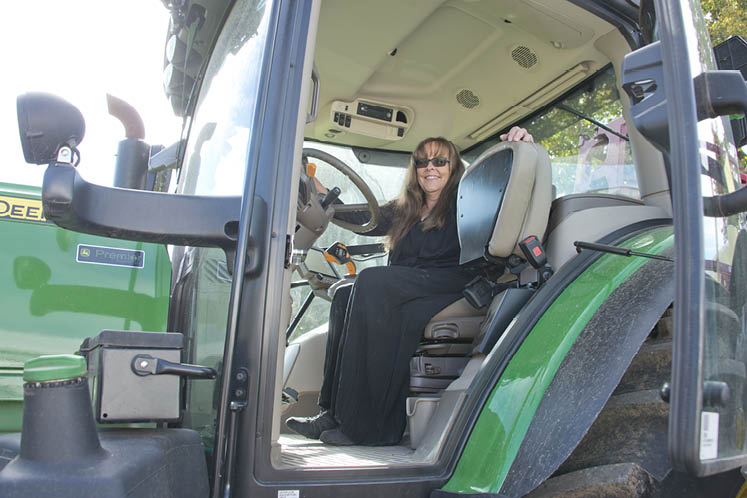
Tamara Limebeer didn’t always have mobility issues. She grew up in Caledon, married a farmer, raised a family on their 130-acre farm, and worked as an office manager at a veterinary clinic. But after being diagnosed with multiple sclerosis 35 years ago, she has had to adapt to her own changing mobility, and for the past 13 years she’s been using a wheelchair. However, that hasn’t stopped her from continuing to help with some farm work, including driving the tractor for hay baling. (The driver’s seat is well over Limebeer’s head, and her husband, Cameron, has to give her a leg up the steps.)
As the wheelchair became a necessity, Limebeer realized how difficult day-to-day mobility can be. This led her to begin advocating for improved accessibility in local public spaces and municipal facilities.
Under the Accessible Canada Act, a barrier is defined as anything that “hinders the full and equal participation in society of persons with an impairment.” Ask someone who uses a wheelchair about barriers and you’ll quickly find out how many exist: a parking spot without an access ramp to the sidewalk, a door that’s too narrow, a bathroom without a power door, a restaurant without an accessible entrance. The freedom to move around and make everyday choices is something many take for granted – until those choices are no longer available.
Over the years, Limebeer became well versed in the existing laws and bylaws – including the Accessibility for Ontarians with Disabilities Act. It was created to ensure barrier-free access for everyone. Limebeer speaks regularly at council meetings as a delegate, a member of the public who registers to address council (“I go to every one,” she says with a laugh), advocating for the removal of physical and procedural barriers and making recommendations for implementing regulations.
Examples of recent “wins” include improved parking spots with the required access aisles at Orangeville’s Alder Street Recreation Centre, town hall and Headwaters Health Care Centre – and at the Inglewood and Caledon Village community centres.
“There are lots of people with disabilities, and there are seniors that need accessible parking and accommodations,” Limebeer says. When she delegates, she says she tries to take a broad approach. “It affects everybody in the community. It’s not just me, because I’m in a wheelchair. It affects lots of other people in different ways.”


She recently finished a four-year term as chair of Caledon’s Accessibility Advisory Committee where she reviewed accessibility issues and municipal site plans. At Headwaters Health Care Centre, she is part of the Patient and Family Advisory Partnership and the Inclusion, Diversity, Equity and Accessibility Committee. She has consulted with accessibility advisers in Caledon and Orangeville, and participates in accessibility audits for businesses and organizations. On top of all this, she gives her time and effort to Volunteer MBC (Mississauga, Brampton, Caledon), her church and the Caledon Fair, to name just a few.
Limebeer says that her own accessibility – her ability to leave her home and drive her vehicle – gives her freedom, and this freedom grants her time to advocate. She is not just championing a wish list; she’s fighting for “legislated responsibility,” which municipalities should be incorporating into all their planning.
Her goal is to make things easier for everyone. “I know a lot of people like me don’t leave their homes because they can’t – there’s too many barriers or they’re too afraid to,” she says. “So if I can knock down some of those barriers, that’s what I’m trying to do.”
Related Stories

Local Heroes 2025
Our annual celebration of the people whose kindness, service and spirit uplift others.

Local Heroes 2024
A salute to eight people whose passionate work has changed our community for the better.