The Birds of Winter
From as far away as Nunavut, Churchill and Greenland, Arctic and boreal birds flock to Headwaters every winter. Here are a few species you may be lucky enough to spot.
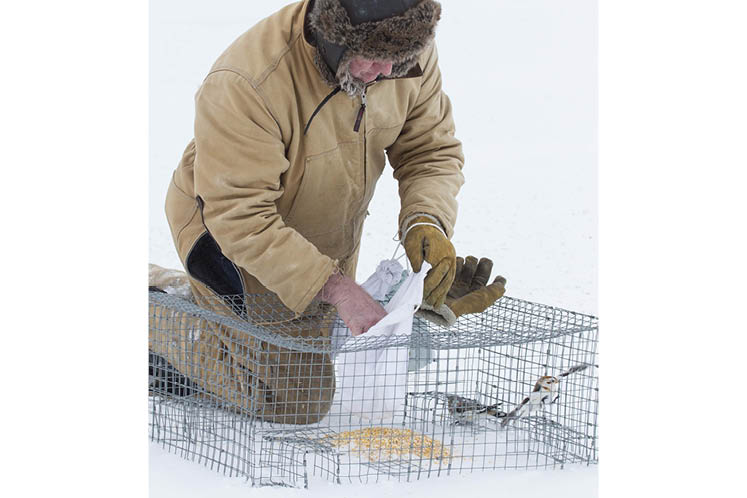
A wan sun rises over the eastern horizon, revealing a white landscape. Ice crystals sparkle on the roadside grasses, and a pair of ravens croak overhead as they begin their daily errands. A man emerges from a truck, dressed in the garb needed to soften winter’s bite: parka, thick farmer’s overalls, Russian fur hat. He carries three two-by-three-foot cages – traps baited with corn – into a farm field and trudges back to his truck. Snow buntings are his quarry. He hopes to band 100 or more.
Over the past 38 years, David Lamble, a Fergus resident, has banded more than 250,000 birds in Wellington and Dufferin counties and the region of Waterloo, many in the dead of winter. Most of those winter birds have been snow buntings, songbirds that visit Headwaters after breeding in the Arctic.
As counterintuitive as it may appear to cold-averse mammals like those of us who live in these hills, snow buntings and other Arctic and boreal forest birds such as redpolls, northern shrikes, evening grosbeaks and snowy owls see Headwaters as a winter refuge. When David Lamble is banding, he needs to don all the trappings necessary to endure winter’s cold, but the birds are comfortable.
Cold is a concern, but if the birds can find food to stoke their internal furnaces, they will be fine. Their feathers provide layered insulation. Their outer feathers are akin to our parkas, while the soft down closer to their skin acts like thermal underwear.
For these northern birds, the longer hours of daylight here mean more time to find weed seeds, grain and berries. Though Headwaters offers less than nine hours of sunlight at the winter solstice, this is about five hours more than the shortest day in Baker Lake, Nunavut. Farther north, beyond the Arctic Circle, a “polar night” lasting up to three months prevails.
Food shortages in the boreal forest also drive northern birds southward. For decades, researchers have kept track of the seed and berry abundance in the North to predict the numbers of finches and other songbirds likely to visit southern areas in winter (see sidebar: Winter Finch Forecast). Years with large crops of mountain ash berries, for example, keep most Bohemian waxwings in the North, while poor crops of birch seed push redpolls southward.
Of course, the character of much of Headwaters terrain in winter – flat and relatively treeless fields – can resemble tundra. These open spaces provide the necessary food for Arctic birds and may remind them of home.
The following is a selection of the northern birds that often choose Headwaters as a winter home. For each, a hypothetical point of origin is offered. This point is based on data from the National Audubon Society’s Bird Migration Explorer (see sidebar).
Snowy owl
Baffin Island, Nunavut to Grand Valley, Dufferin County
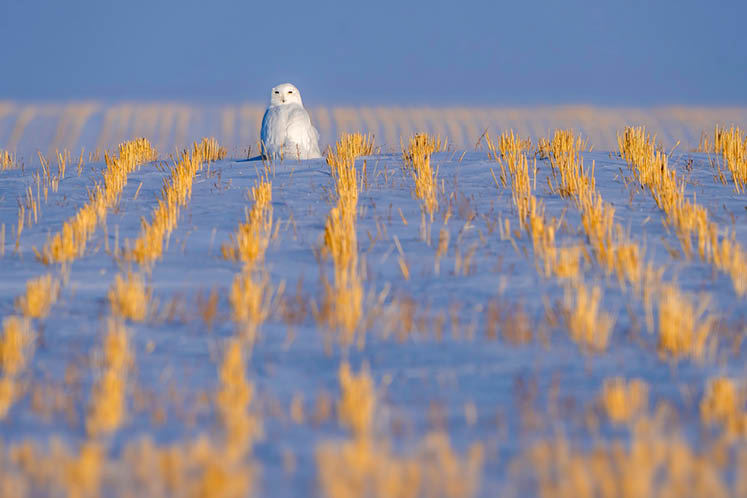
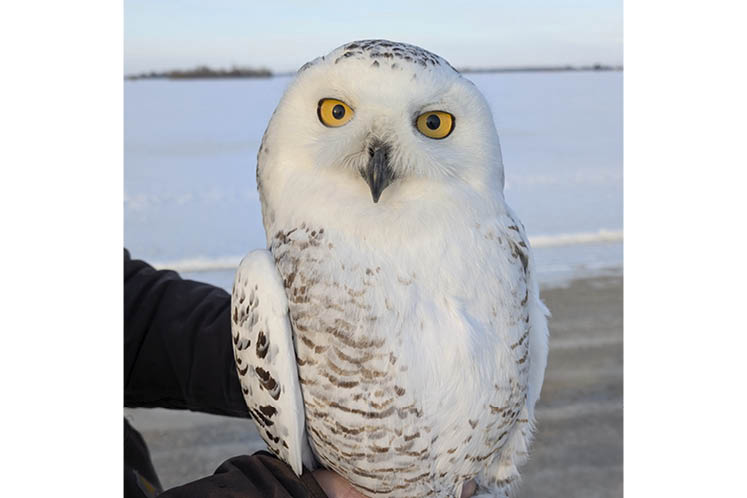
Birders and non-birders alike love snowy owls. These beautiful raptors – delightfully “ookpiks” in Inuktitut – can often be found by slowly cruising country roads from January through March. They sometimes make the search easy by perching atop utility poles, but at other times, they settle on snow-covered fields. Spotting white birds on white backgrounds is no mean feat. It takes a discerning eye to distinguish the owls from lumps of snow and errant plastic bags.
Project SNOWstorm, established in 2013 by scientists in the eastern United States, and now in partnership with Canadian researchers, studies snowy owls and tracks their movements. To date, 120 snowy owls have been fitted with tiny backpacks containing GPS transmitters.
Of local interest is Perth, a female snowy owl that was captured and fitted with a backpack by Toronto bird banders Charlotte England and Malcolm Wilson on February 26 this year in, predictably, Perth County in southwestern Ontario. (How do you catch a snowy owl? With hamsters, of course, shielded from the owl’s talons.)
England discovered that she had originally banded Perth in 2020, when the owl was about four years old. This means that when the 2026 recapture occurred, Perth was about 10 years old, making her one of the oldest snowy owls in the Project SNOWstorm study.
Perth’s transmitter signalled that she began tracking northeast in mid-March this year. She crossed into Wellington County south of Conestogo Lake on March 19, flew over northern Waterloo Region on the same day, then lingered briefly in the Belwood Lake area. On the morning of March 21, she entered Dufferin County, then flew northward just west of Grand Valley. By about 8:30 p.m. on the 21st, she was over Melancthon Township north of Shelburne. From there, she left Dufferin County and flew west of Creemore to Georgian Bay on March 22 – and eventually north to her Arctic home.
Along with tracking snowy owls, Project SNOWstorm also studies their health. The findings are alarming. More than 400 snowy owls have been autopsied, and blood samples have been taken from many living owls, revealing a variety of toxins in their systems, including pesticides and mercury. That mercury, as tragic human examples have shown, can cause behavioural and reproductive problems.
The origin of the mercury should give us pause. Much of it comes from car exhaust and coal-fired generating plants, providing another sobering reminder of why we need to shift away from burning fossil fuels. Also worrying is that roughly half the deceased snowy owls had rodenticides (rat poison) in their systems, something that, unsurprisingly, affects other birds of prey as well. This uptake of poison from predated rats appears to be increasing.
These human-generated threats are likely contributing to the decades-long decline of snowy owls, whose population is down about 43 per cent in this century alone. In response, the Committee on the Status of Endangered Wildlife in Canada has listed snowy owls as threatened.
Snowy owls visit Headwaters every winter, but numbers vary. Periodically, these hills are treated to a phenomenon called an “irruption,” when snowy owls fly south in greater numbers than usual. These irruptions appear to follow breeding seasons with an abundance of lemmings. Snowy owls target these pudgy rodents to feed their young. More lemmings translate into greater numbers of first-year owls. It is these youngsters, along with some adults, that thrill us in winter.
Bohemian waxwing
Whitehorse, Yukon, to Luther Marsh, Dufferin County
On a winter birding adventure recently, my friends and I found a flock of these elegant birds just south of Luther Marsh near the ghost hamlet of Peepabun. They were gorging on profuse sprays of tiny crabapples, one of their favourite winter foods. Happy with the gustatory windfall of the apples, the waxwings largely ignored us.
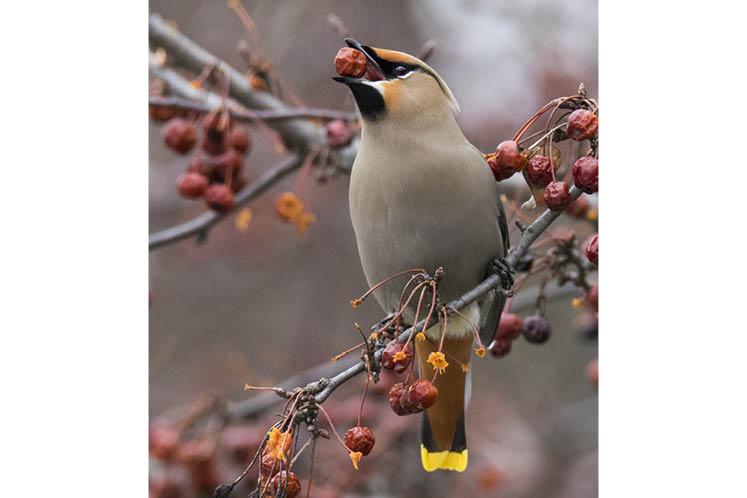
This gave us an opportunity to admire their incomparable plumage from a respectful distance. Bohemian waxwings and their cedar waxwing cousins are visual delights. “Dapper” is the oft-used term to describe their clean lines, pastel colours and jaunty crests. Subtle differences separate the two species. Bohemians are slightly larger, and the feathers on the underside of their tails are rusty, while the cedars’ under-tail feathers are grey-white. Best to study the differences before a winter birding outing.
Though cedar waxwings, with their reedy calls, are year-round residents of Headwaters, Bohemian waxwings are rare winter visitors. Both species are frugivores (fruit eaters). Bohemian waxwings travel enormous distances from northwestern North America to feed on fruit such as the crabapples of Peepabun. Other choice waxwing fare in winter includes wild grapes, mountain ash berries and the berries of the invasive common buckthorn. The sporadic presence of this food across the landscape influences the waxwings’ winter movements. They become feathered nomads in search of sustenance.
Northern shrike
Great Slave Lake, Northwest Territories, to Forks of the Credit Provincial Park, Peel Region
On a recent Christmas Bird Count, I watched in suspense as a northern shrike pursued a cardinal over an ice-covered reservoir. The cardinal, perhaps winded by the pursuit, landed on the ice. The shrike, just a little larger than the cardinal, landed nearby, and the two birds – prey and predator – locked eyes for several seconds. Then the cardinal took off and the chase resumed. The two birds disappeared into a spruce grove near the shore.
Despite their small size, northern shrikes are fearsome predators. They will occasionally kill larger birds such as cardinals, but smaller birds such as sparrows are more often their victims. They also hunt small rodents such as deer mice and meadow voles.
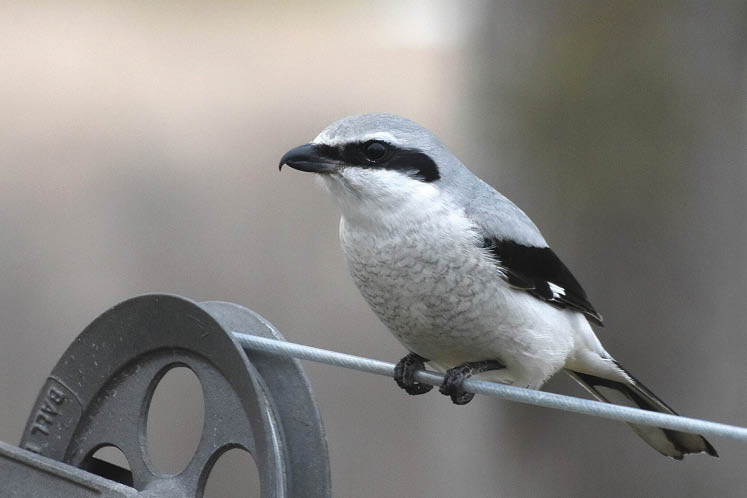
Shrikes are known as “butcher birds,” an unflattering but accurate moniker. They lack the strong talons of owls and hawks that help dismember prey, so they use thorns and barbed wire to impale their victims. Then, with the bird or mouse held firmly in place, they tear the flesh with their hooked beaks.
David Lamble once witnessed evidence of this “butchery.” When he was banding snow buntings, a northern shrike entered one of his traps. Lamble responded quickly and ran to free the birds, but by the time he arrived, the shrike had killed a dozen buntings – recalling the trope of a weasel in a chicken coop.
If you look for northern shrikes in winter, exercise patience. They are usually present in Headwaters but are often widely dispersed. Seek them in open country on high perches where they scan their surroundings for prey. If you spot a lone robin-sized bird sitting atop a tree or utility pole, it’s a good bet that it will turn out to be a northern shrike.
Common redpoll
Ungava, Quebec, to Alton, Peel Region
As a young lad besotted by birds, I hatched a plan to invite redpolls into my home after reading a tale from a New England naturalist. Let me explain. The naturalist, whose name I’ve long forgotten, fed flocks of these lovely finches in winter.
Gradually, he would lure them closer to his house by moving his feeders, until eventually they were feeding beside his kitchen window. The next step was to open the window and offer the redpolls a delicious spread of millet and black-oil sunflower seeds on the kitchen table. Soon his kitchen was aflutter with feathered breakfast guests. (He failed to mention the inevitable throughput of that feasting.)
I begged my mother for permission to follow the naturalist’s lead. She wasn’t receptive.
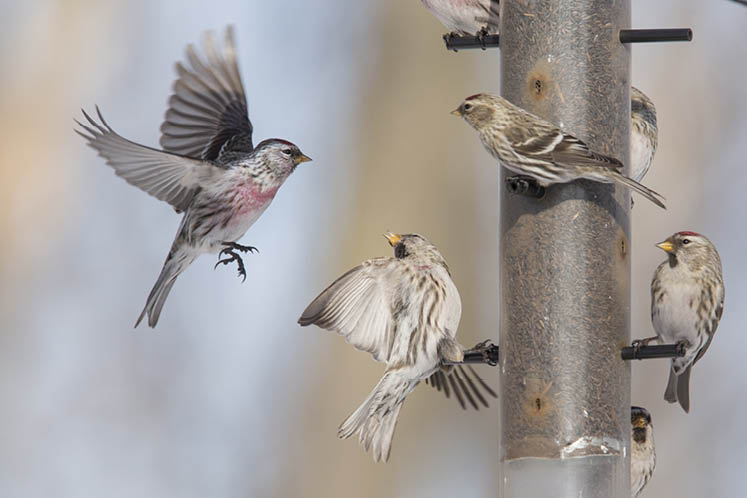
Common redpolls nest in tundra habitats and the fringes of the boreal forest across the Arctic. Periodically they venture south en masse in winter, seeking meadows and woodlands where they find a bounty of small seeds to sustain their metabolisms.
They love the tiny seeds packed into birch catkins, something that attracted them to our yard when I was a child. They also visit roadsides for gravel to top up their seed-grinding gizzards, muscular organs that serve as organic food processors. Predictably, this puts them in harm’s way from traffic.
Evening grosbeak
Gaspé, Quebec, to Mulmur, Dufferin County
I mourn the fading numbers of these glorious birds of massive beaks and golden plumage. Evening grosbeaks were once common winter visitors. I recall a large flock of them feasting on Manitoba maple keys in Orangeville in the late 1990s. Many of us undoubtedly remember – perhaps with mixed feelings – grosbeak flocks monopolizing our bird feeders and quickly emptying them of sunflower seeds.
But alarmingly, evening grosbeak populations have fallen off a cliff. Canada, the United States and Mexico collect and analyze data from roadside bird counts through a project called the North American Breeding Bird Survey. This project has revealed a staggering 83 per cent drop in evening grosbeak numbers since 1970. Data from North American Christmas Bird Counts are even starker, showing a 94 per cent decline as of 2022. This includes a stunning 97 per cent drop in parts of Ontario.
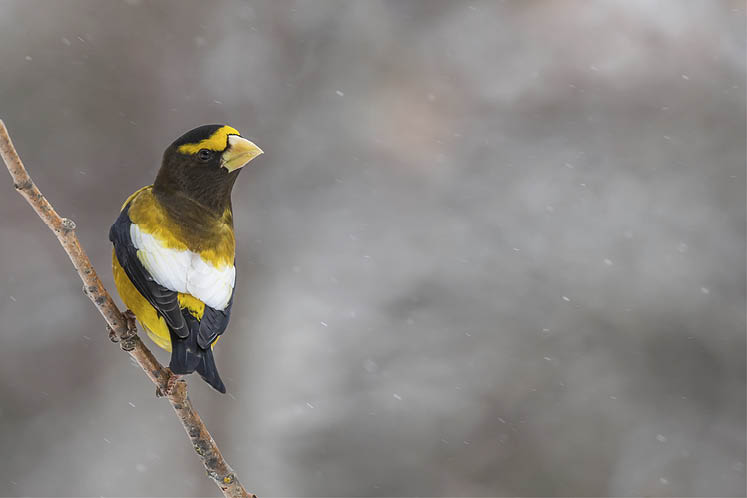
Data from the Christmas bird counts here in Headwaters bear this out. Whereas from 1987 to 1994, counts of evening grosbeaks averaged more than 95 birds a year, with a high of 393 observed in 1990, the latest eight counts averaged slightly more than two birds, with none at all observed in most years.
A host of maladies, including climate change, habitat loss, diseases and collisions with cars and windows, is likely responsible for the decline. In addition, a reduction in insect abundance, particularly in the spruce budworms that are fed to nestlings during the breeding season, has probably played a role.
Let’s hope that research will soon clarify why this magnificent species is disappearing – and offer solutions. A sliver of good news is that in recent years, numbers have stabilized. Whether this is simply a pause in the death spiral of the species or a prelude to a modest recovery is yet to be determined.
Rough-legged hawk
Churchill, Manitoba, to Shelburne, Dufferin County
These cliff-nesting raptors spend the breeding season on Arctic tundra and amid the stunted trees of the northern boreal forest. In winter, they often grace Headwaters with their presence, favouring the same open landscapes as snowy owls. About the size of red-tailed hawks, they exhibit two distinct colour phases or “morphs” – light and dark. Regardless, all rough-legged hawks are beautiful. Binoculars reveal intricate patterning on their tails and underwings, evocative of expensive tapestries.
Like red-tailed hawks, rough-legged hawks perch on utility poles and fenceposts. When hunting, they can be observed “kiting” over fields and meadows. The term is apt. They face into the wind and tweak their wing tips and tail feathers to remain in place, like kites on strings, keeping their heads still as their eyes scan the ground for prey. For rough-legged hawks, that prey is usually voles, mice and the occasional cottontail.
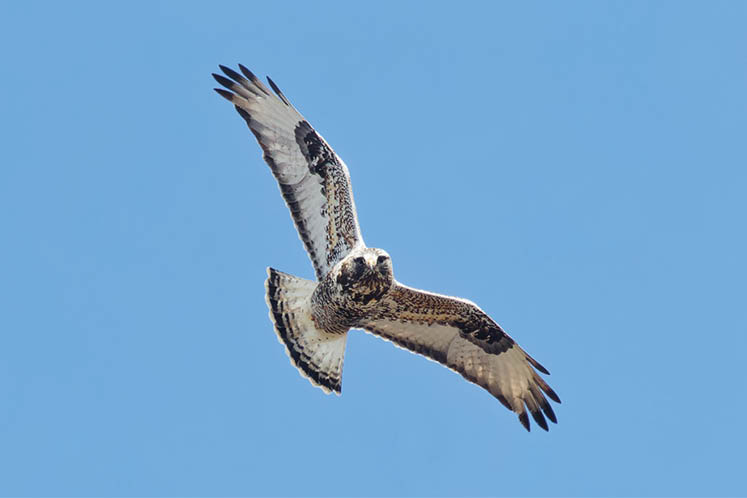
In winter, prey availability seems to be the primary motivator for the movement of this species. As snow blankets their northern hunting grounds, rodents become harder to catch, and the hawks drift southward. Of course, Headwaters, too, is often blanketed by snow, but for a shorter time than the North – and there are periodic winter thaws.
But the Arctic is becoming warmer, and snow cover is not as reliable as it once was. Rough-legged hawks may be adjusting their migratory habits to remain longer in the North or to stay there for the entire winter. This might explain the perception that winter sightings of these hawks are not as common in Headwaters as they once were.
This hypothesis is supported by data from the Headwaters Christmas Bird Count, which takes place from December through March. In the eight years from 1987 to 1994, the counts averaged seven rough-legged hawks a year. Over the most recent eight bird counts, the average has been less than one. Despite this, seeking this glorious species is worth the effort!
Snow bunting
Greenland to Wellington County
Behold the most northerly breeding songbirds in the world! Snow buntings breed near the northern tip of Ellesmere Island, less than 10 degrees of latitude from the North Pole. There, on the treeless tundra, they nest in rock clefts and cracks, which provide shelter from the wind and cold.
Although few Canadians will ever see these glorious birds in the Arctic, Headwaters welcomes thousands in winter. The flight of snow bunting flocks is poetry in motion. The flocks twist and turn in unison as if orchestrated by an avian choreographer. To witness this spectacle is to know the joy and appeal of birding.
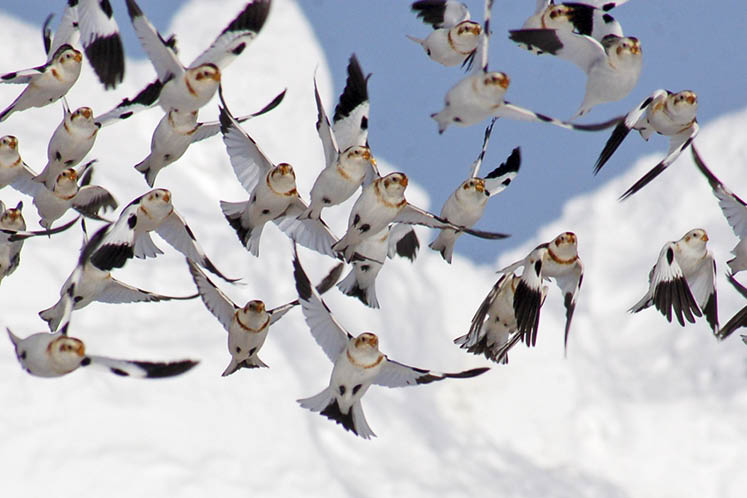
In winter, snow buntings are at home in these hills, feasting on weed seeds and grain – especially corn – that escapes the combine threshers. These are the captivating birds that draw bander David Lamble from his warm winter abode to the windswept fields of Wellington County.
After capturing each bird, he handles it gently, measuring its mass and blowing on its chest feathers to check its critical fat stores, visible in yellow on its breast. Then he quickly reunites it with its flock. Remarkably, snow buntings banded by Lamble have been found breeding near Nuuk, the capital of Greenland! On their return flight to Greenland in spring, these birds follow the St. Lawrence River, then fly across the Labrador Sea.
Snow buntings, like other winter birds, wander widely in search of food. This itinerant lifestyle means they are not uniformly distributed across Headwaters, a reality borne out on the Christmas Bird Counts conducted by Headwaters Nature. Buntings often elude most bird count teams, but a lucky team or two will usually find a large flock. Since 1987, the average tally for the Headwaters count has been 214, though 2018 was a bumper year, with 740 buntings recorded.


Sadly, like the numbers of evening grosbeaks, snow bunting numbers have been falling in recent decades. Estimates of their decline since the 1970s vary widely. Partners in Flight, a network of more than 150 conservation organizations in the Americas, estimates a drop of 38 per cent, while Christmas Bird Count data suggest a stunning 80 per cent decline.
Lamble’s bird-banding records reflect that decline. When he started his snow bunting research in the early 2000s, he could band from 6,000 to 7,000 buntings every winter. Today, with similar effort, those totals have dropped to about 3,000 birds.
Lamble identifies several possible causes. Among them are climate change affecting breeding success in the Arctic; changing farming practices, including more efficient harvesting; and the loss of wintering habitat.
Lamble celebrates the beauty and toughness of snow buntings. They will need that toughness to survive in the uncertain world humanity has created.
Seeking these lovely migrants in Headwaters and beyond is a joy and an affirmation that life finds a way even in the depths of winter. But a deeper appreciation comes from the fact that the tendrils of this bird migration connect Headwaters to the boreal forest and the Arctic. In fact, birds link these hills to the entirety of the Western Hemisphere. The astonishing mobility of birds means that we in Headwaters need to act locally and globally to find solutions to the problems that beset them. The remarkable birds of the North will thank us.
More Info
Locating birds
Most of the birds highlighted in this article are open-country species. Look for them in agricultural landscapes with few trees and good sight lines. Cruising rural roads slowly with several sets of eyes scanning the fields and fence posts can be productive.
Dan MacNeal, a regional co-ordinator for the latest Ontario Breeding Bird Atlas (birdsontario.org), now in preparation and slated for publication in 2027, recommends checking the flat terrain of Wellington County north of Belwood Lake and south of County Road 109. In Dufferin, he suggests driving roads where the windmill farms, west and north of Shelburne, are located. Know, however, that winter birds can be found anywhere in Headwaters.
Apps and online platforms can help your search. Among other things, eBird Canada (birdscanada.org/ebird-canada) enables you to find out where birds have been seen in your area and beyond. And the Ontario Field Ornithologists’ Discord Server (tinyurl.com/OFO-Discord) is an online platform that also identifies sites where specific species have been spotted.
Winter Finch Forecast
Eagerly anticipated by birders in eastern North America, the Winter Finch Forecast was initiated by Ontario birder Ron Pittaway in the late 1990s. It continues today under the auspices of the Finch Research Network. Data on food abundance in the boreal forest is analyzed to predict the southward migration of seven northern finches, including redpolls and evening grosbeaks, and three non-finch migrants, including Bohemian waxwings. See the forecast for 2026–27 here: finchnetwork.org/winter-finch-forecast-2026-2027.
Bird Migration Explorer
Maintained by the National Audubon Society, this novel online platform taps into a wealth of data that track the migratory movements of hundreds of species of birds: explorer.audubon.org/home
Christmas Bird Counts
Christmas Bird Counts are undertaken within circles 24 kilometres in diameter. Each circle is divided into sections, with a birding team assigned to each section. Headwaters Nature divides their Christmas Bird Count, centred on Orangeville, into six sections. In 2025, the group decided to add a second count circle in the Luther Marsh area and will do so again this year. If you would like a taste of winter birding, and the opportunity to see some of the birds featured in this article, why not participate in one, or both, of these counts? Dates hadn’t been set as of publication, but protocol requires that they must fall between December 14 and January 5. For information, contact [email protected].
Project SNOWstorm
Visit projectsnowstorm.org to find out more about the migratory movements of snowy owls and about research into their health and well-being.
Related Stories

Two in the Bush
The Christmas Bird Count provides a snapshot of overwintering local birds and an opportunity for birders, experienced and inexperienced, to enjoy some holiday camaraderie.

The Allure of Owls
Owls generate great excitement among birders, and they tug, irresistibly, at our heart strings with those big, expressive eyes.
In the Bleak Midwinter
Don Scallen explores how birds, mammals and reptiles have adapted to survive our long, trying winter.

Boreal Birds
Over 300 species, totalling billions of birds rely on Canada’s boreal forest as breeding grounds.