Brief Encounters
A fleeting glimpse of one of these five rare Headwaters species can feel like magic – and like a warning we can’t ignore.
During the most recent ice age, the flora and fauna of this part of southern Ontario were scoured away by glaciation, and the land was smothered under hundreds of metres of ice. In a warming climate the ice gradually receded, eventually exposing a barren landscape that evoked the high Arctic of today.
Initially, only the hardiest species survived. But over thousands of years, this corner of the continent was transformed into the verdant, species-rich landscape we know today – one that supports myriad plants and insects, and a rich assemblage of vertebrates including reptiles, amphibians and mammals, as well as more than a hundred species of breeding birds and a growing population of humans.
This expanding human presence has built the communities we love, with opportunities to work, play and follow creative pursuits. Clearing land for agriculture and industry has given us local food, contributed to the economy, and supported crucial social needs such as hospitals and schools. But the story of growth in Headwaters isn’t all positive.
In today’s human-modified landscapes, many plants and animals struggle, and some of those now hover on the brink of local extinction.
What follows are the stories of five species that may soon disappear from these hills. For millennia they have lived here, contributing beautiful threads to the fabric of Headwaters life. I’m struck with awe whenever I encounter them, but I’m also saddened by the knowledge that they may soon be gone.
Born to wander
An old Blanding’s turtle roams its Headwaters territory. In her 80 or so years, she has seen great changes: forests felled, and wetlands drained and replaced by strange new things – buildings, quarries and roads. As with others of her species, wanderlust is baked into her existence. She has evolved to ramble, to move from wetland to wetland in her quest for food and mates. During the warm months, she’ll wander hundreds of metres within a territory that she knows intimately. In her early years, her journeys were largely uneventful. She walked through forests and beaver swamps. She walked through farmland and apple orchards as well, but she always knew the next wetland wasn’t far off.

Blanding’s turtles are remarkable animals. Their domed shells, much higher than those of the familiar painted turtles, are reminiscent of army helmets. Long necks, when extended, reveal rich yellow throats. Their plastrons (the bottom part of their shells) are yellow with dark blotches; each plastron is as unique as a human’s fingerprints and permit identification of individual turtles over their long lives.
Blanding’s turtles were once far more common. Their wandering habits, so important to connect them with habitats and others of their species within large home ranges, are now their undoing. And what an undoing! The loss of thousands of years of genetic heritage, the loss of their millennia-long contributions to the local ecology, and the loss of wonder for those of us who love our fellow creatures.
The pox we have visited on the house of Blanding includes habitat loss and a network of killing roads. These roads are ribbons of death for Blanding’s turtles and many other reptiles. Stand on the verge of Highway 9 in Headwaters and ponder how a plodding creature like a turtle might hope to cross. Even lesser roads are becoming increasingly busy year after year. Any species with the temerity to risk a crossing plays Russian roulette, not with bullets, but with vehicles.
Blanding’s turtles likely still exist in Luther Marsh, one of the few areas of Headwaters offering a large expanse of roadless wetland. Occasional sightings elsewhere in these hills suggest remnant populations, but nowhere is this threatened species common.
If you cross paths in Headwaters with this marvel of creation, consider yourself fortunate, as I did recently on a visit to a friend’s property along the Niagara Escarpment. It was spring. Hepatica and bloodroot were opening to the warming sun, and the virtuoso song of a winter wren serenaded us as we arrived at a vernal pool (a temporary spring pond) to look for clumps of jelly, the eggs of spotted salamanders. My friend looked up and exclaimed, “A turtle!” Knee deep in water, I followed her gaze across the pond to a mossy bank where a magnificent Blanding’s turtle sat, soaking up the sun.
In my friend’s 25-year stewardship of her escarpment property, she had never before seen a Blanding’s. But there it was, having presumably arrived to feast on the vegetation and tadpoles in the vernal pool, and perhaps on the salamander eggs we sought. A week later, it was gone, having wandered off, as Blanding’s turtles are wont to do, to avail itself of the resources offered in other parts of its extensive territory.
Herb of desire
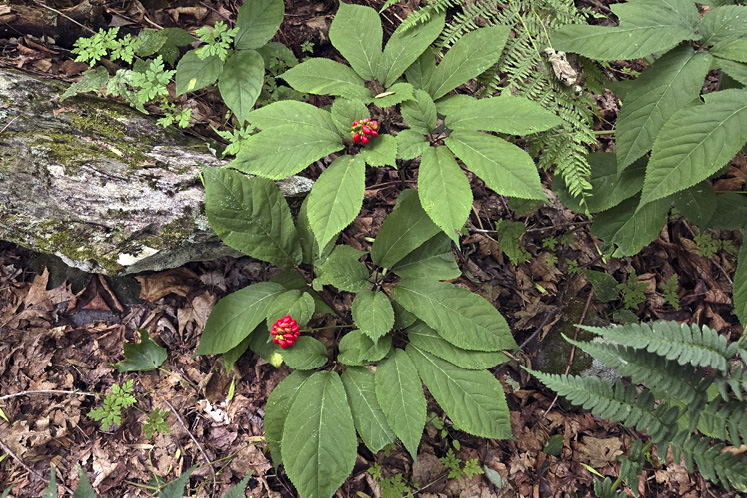
In the dappled shade of a sugar maple forest, the glint of red berries signals the presence of rare plants steeped in history. The sublime flute-like song of a wood thrush rings out from a grove of nearby hemlocks, providing an apt musical accompaniment to the discovery of a patch of wild ginseng. The ginseng grows in the company of common woodland herbs, including bloodroot, zigzag goldenrod and sarsaparilla, and draws nourishment from soil rich in leaf mould. Thus far, these particular plants have escaped poaching and habitat loss, the twin threats that plague wild ginseng populations in Canada.
Most Canadians have at least a passing understanding of the fur trade, which fuelled the early settlement of North America. Beaver pelts sparked intense rivalry between the British and the French, and First Nations’ economies adjusted to supply the insatiable appetites of fur-crazed Europeans.
Few realize, though, that ginseng was also coveted and exploited by the European powers. The value of ginseng exports from New France in the first half of the 18th century was huge, second only to the fur trade, building fortunes and driving conflict. Beaver pelts were fashioned into hats, driving North American beavers to near extinction. Ginseng, valued as a panacea for a host of ailments in China, followed a similar trajectory. Beavers have made a resounding comeback; ginseng hasn’t.
The roots of Asian ginseng (Panax ginseng), a species closely related to American ginseng, have been prized for their purported medicinal benefits since time immemorial. Ginseng devotees consider it a treatment for myriad maladies, including fatigue, diabetes, asthma, anxiety, cancer and cardiovascular disease. Its genus name, Panax, derives from “panacea.” Ginseng is also purported to boost athletic performance, ease age-related issues and enhance sexual performance.
That most of the alleged benefits of ginseng haven’t been validated by science doesn’t matter. Ginseng as a cure-all is a deeply entrenched belief in Asia, and now in other parts of the world as well. This means the demand for ginseng will likely remain strong into the future. Much of this demand is now satisfied by agriculture, and Ontario is one of North America’s biggest producers. Production flourishes in Norfolk County, where ginseng is grown on land formerly devoted to tobacco. Since ginseng is a woodland plant, shade cloth is necessary to limit sun exposure.

But cultivated ginseng only partially alleviates the pressure on wild populations because of the unfounded belief that wild ginseng roots have superior therapeutic properties. This has driven the price of pirated wild ginseng roots, especially forked roots that are interpreted to represent the arms and legs of humans, through the stratosphere. A single root can fetch hundreds of dollars – and even more – on the black market.
And this, of course, is the attraction for poachers. Ontario’s Endangered Species Act made it illegal to harvest or trade in wild ginseng. This act was recently replaced by the Species Conservation Act, which was rolled into the controversial Protect Ontario by Unleashing Our Economy Act. How this new legislation will affect protections for endangered species remains to be seen. Even if prohibitions remain in place for harvesting and possessing ginseng, this plant’s future could be imperilled if the new law permits cutting the forests critical to its survival.
A biologist, familiar with ginseng poaching, told me poachers are skilled “naturalists” – albeit naturalists who have crossed to the dark side. They are guided by intimate knowledge of the plants and where they might be found.
In a 2017 interview with CBC, Jean-François Dubois, then senior wildlife enforcement officer with what is now Environment and Climate Change Canada, compared the severity of ginseng poaching in Canada to high-profile poaching in other parts of the world. “This is our ivory horn. This is our rhino horn,” he said.
I’ve found American ginseng just south of Headwaters and in Simcoe County. It probably occurs sparingly throughout these hills. If this storied herb grows on your property, take a moment to celebrate your good luck, but be careful who you tell about it.
Fleetingly airborne
The fisher sits at his workbench and takes stock of his fly-tying materials: fish hook, moose hair, deer hair, squirrel fur, feathers, and assorted artificial fibres and threads. Satisfied, he begins to tie a green drake fly. An artisan who has honed his skills over hundreds of hours of practice, this fisher is a practitioner of a time-honoured craft linking him to the beautiful fish that flourish in the burbling waters of clean, cool streams. He looks forward to the annual emergence of green drake mayflies and hopes his artificial green drake will be accurate enough to fool a wary trout. In fly fisher parlance, this is called “matching the hatch.”
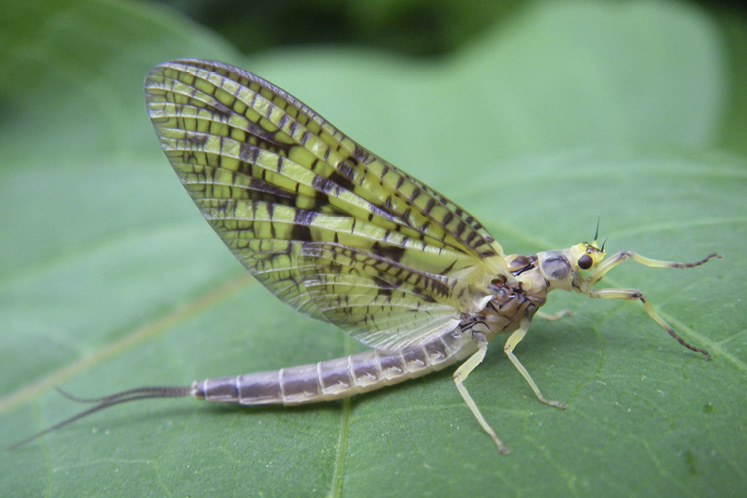
Green drake mayflies have elongated, diaphanous wings, networked with black and lime green patterning, rendering them as beautiful as butterflies. But alas, they are little known, due to their brief tenure as adults and their diminishing numbers. Like other mayfly – aka “shadfly” – species, green drakes spend most of their lives as aquatic nymphs (larvae) that burrow into the coarse gravel sediment at the bottom of streams. They feed by filtering organic matter from the water.
After two years or more, they rise to the surface and transform into immature flying forms called “duns.” Finally, in a day or so, they undergo a second metamorphosis to become reproductive adults that participate in mating swarms above the streams and, true to their genus name, “Ephemera,” live only briefly.
Henry Frania is an entomologist who uses facilities at the Royal Ontario Museum to study mayflies, though he is not formally affiliated with that institution. At the ROM, he analyzes data gathered over a two-decade span at several sites along the Caledon stretch of the Credit River to research the eastern green drake mayflies of the river’s watershed.
The data reveal alarming declines. Twenty years ago Frania recorded large numbers of green drakes along the West Credit. By 2020 they were effectively gone from this section of the river. Similarly, other sites along the Credit now produce only negligible numbers of these mayflies. Only the Middle Branch, through the deep, wooded gorge between Cataract and Forks of the Credit, has yielded heavy hatches in recent years, though these hatches follow a curious cycle: heavy one year, light the next.
Like canaries in coal mines, green drake mayflies are among the first organisms to recoil from environmental insults. With mayflies, this usually means deteriorating water quality as agriculture, aggregate extraction, and housing have replaced forests and reduced the flow of water in the Credit. The loss of forests means that soil, previously held fast by tree roots, washes easily into waterways during storms. This silt covers the gravel streambeds that are essential habitat for green drake nymphs.
Another threat, says Frania, is “much more difficult to assess and mitigate.” This involves the witches’ brew of chemicals “from homes, lawns, industry, farms, and roads that are going into our sewage and storm sewer systems, or percolating directly into the ground.”
From south to north, he has tracked the local extinction of green drake mayflies along the Credit. He believes that before European settlement, “they probably occurred in all the riffles and rapids right down to the mouth of the Credit River. By the 1930s they were gone from Erindale, by the 1950s the downstream limit was Terra Cotta, by the 1990s Inglewood, and now the Credit Forks. The future prospects for the green drake mayflies are grim.”
If these insects disappear, the brook and brown trout the upper Credit is famous for will lose a food source, and the fly fishers who eagerly await the green drakes’ emergence and try to “match the hatch” will lose a treasured connection with the river.
Aquatic jewel
Tiny splashes triggered by the Lilliputian leaps of small fish called redside dace dimple a crystalline stream flowing through a Niagara Escarpment woodland. The dace, equipped by evolution with large upturned mouths and big eyes, are hunting aerial insects. Among the 20 or so minnow species in Headwaters, only they can do this.

Named for the brilliant red stripes that adorn their flanks, redside dace are eye-catching fish. Decades ago, I pickled a few for a university biology class. That was long before they were recognized as endangered, but I wince at the memory. My professor remarked that they looked as if they had been painted by mercurochrome, a red-coloured antiseptic formerly in widespread use as a topical medicine.
My first encounter with this species was bankside near the confluence of a tiny stream and the Credit River. Gazing into a limpid pool, I was held spellbound as shafts of sunlight illuminated their brilliance.
Redside dace have a limited range in southern Ontario. They are present in a few of the watersheds of rivers flowing into western Lake Ontario and southern Lake Huron, and are now designated “endangered” due to their declining numbers. The Caledon Hills Bruce Trail Club celebrates them by offering a badge emblazoned with their image to hikers who have walked the entire Caledon Hills section of the trail.
As visual predators, redside dace need clear waters that enable them to peer upward to track the small flying insects they feed on. A silted stream means hunger – they simply can’t see their prey. After a rain, many Ontario streams and rivers run like chocolate milk, carrying the sediment washed into them from roads and farmland. It’s no surprise, then, that redside dace, along with other fish that depend on sight to find their meals, have been eradicated from many of these waterways.
Last spring I visited a familiar stream to check on a redside dace population I’ve followed for years. In places the stream is so narrow that I can straddle it with spread legs. Trees protect this special place. They offer cooling shade and their roots hold the soil, preventing it from sullying the stream after downpours. My good fortune that day was to witness the dace spawning in the nests of creek chubs, perhaps the most common Headwaters minnow species.
Male creek chubs use their mouths to pick up small pebbles and to excavate bowl-shaped depressions in gravel streambeds. When this process is complete, females arrive to lay their eggs and the males release their milt (sperm) to fertilize them. Redside dace also arrive – and lay eggs in the creek chub nests. The larger creek chubs don’t seem to mind that their nests become incubators for the eggs of the smaller dace – another example of the myriad links that connect organisms and how the fortunes of living things are intertwined.
Small undiscovered populations of redside dace probably continue to exist in streams that flow into the Credit. Finding and protecting these vestiges of a once-thriving population is paramount to the survival in Headwaters of these beautiful fish.
Forest phantom
The winter has been long and cold. For much of the season, deep snow covered the forest floor. But cracks are beginning to show in the ice world. The days are warming and meltwater has begun to trickle into the subterranean haunts of Jefferson salamanders. The water reaches the salamanders deep in the ground and they begin to stir. The moisture signals change, and the salamanders respond. They start to wend their way upward through fissures in the rock and through the dark tunnels of shrews and moles. At the surface it is raining – optimum weather for Jefferson salamander travel. Though snow still covers much of the ground, the salamanders crawl out of the earth and begin the trek to their breeding ponds.
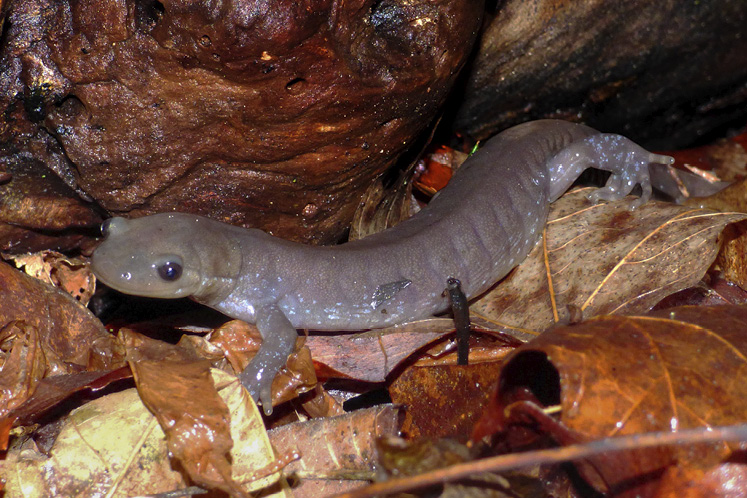
Jefferson salamanders can be the length of an adult human’s hand. They are rather plain, with grey-brown bodies, but close inspection reveals flanks speckled with light blue.
They emerge in late winter or early spring to walk to vernal pools, a grand odyssey for animals whose legs are the length of a human fingernail. The ponds that beckon them can still be largely ice-covered at that time of year, but a fringe of open water is usually present at the margins, where the ice has melted in contact with the warming earth. Jefferson salamanders slip into this open water and soon begin to breed. They are ultra-hardy.
Pure-blooded Jefferson salamanders are rare in Headwaters but can be found at least as far north as Mono Cliffs Provincial Park. Strange multi-genetic salamanders that incorporate Jefferson salamander genes are found more widely, but I won’t dive into that odd phenomenon here. (It’s complex and confusing, even challenging perceptions of what defines a “species.”)
Extensive forests are critical to Jefferson salamander survival, but forests alone aren’t enough. They also need ponds containing no predatory fish. These ponds are usually vernal pools, which hold water in the spring but dry up later in the year, making them unsuitable for fish. Much of Headwaters has been deforested and no longer offers Jefferson salamanders the habitat they need. It is vital that we protect the forests and wetlands of the Niagara Escarpment and Oak Ridges Moraine for Jefferson salamanders and myriad other animals.
Breeding at the ponds is fleeting, lasting a month or so. Jelly-like egg masses are deposited along sticks, and other sub-surface features, and then the salamanders return to their subterranean lives in the forests. After hatching, the carnivorous Jefferson larvae, sporting large fleshy gills on the sides of their heads, prowl the pond bottoms for aquatic insects and crustaceans. If lucky, they will transform into terrestrial juveniles before their pond dries up. Then they will join their parents in the forest.
Undiscovered populations of Jefferson salamanders probably exist in Headwaters. Their nocturnal habits, the brevity of their springtime breeding and their subterranean lifestyle render them difficult to find. Landowners with appropriate habitat should check their ponds after dark in early spring, at about the same time as the spring peepers begin to call.
What’s next for these species?
These stories are about plants and animals on the brink. But the malign forces threatening them also affect more common organisms. It’s hard to imagine a future in which these negative forces are reduced.
Given the inevitability of growth, my hope is that we will also do what we can to vigorously protect existing parks and conservation areas, and identify more land to protect.
There are also more targeted ways in which we can help the rarities I’ve profiled here. We need to install more barriers to lessen the road mortality of reptiles and other animals. We need to improve measures to intercept stormwater before it drains into streams, and we need to ensure those streams are buffered by trees that can cool their waters and limit erosion.
If we genuinely care about biodiversity, we need to be aware of the plants and animals at risk in Headwaters, and tailor solutions to address the particular threats to their survival. This starts with maintaining the protections embedded in the former Endangered Species Act. Let’s hope our governments care enough to do that.
Finally, I’m hoping the stories of these five remarkable species will spark readers’ interest in these creatures, as well as others in Headwaters. Sightings of the five could be shared with the Natural Heritage Information Centre in Peterborough (ontario.ca/form/natural-heritage-information-centre-nhic-observation-reporting-form). It is important that we learn more about the distribution and occurrence of rarities to inform conservation measures.
To protect your privacy, and the plants and animals themselves, your observations will not be made public. And please visit this article online at inthehills.ca to drop your photos and notes into the comments at the bottom of the page – without sharing details of specific locations.
The green drake mayfly is an exception. Because mayflies are not threatened by malign actors, locations where this fascinating insect still occur can be made public. Henry Frania, the entomologist at the ROM, would appreciate hearing about any and all sightings during their brief emergence period in May.
Let’s hope that with greater awareness and effective conservation actions, these wonderful species will continue to contribute to the rich natural heritage of Headwaters well into the future.
Related Stories

How Construction on Highway 413 Will Begin Much Sooner Than We Thought
With the passing of Bill 212 on November 25, the government plans to speed up land
appropriation and avoid an environmental impact assessment.
If the Greenbelt Gives Way to Sprawl, Seven Headwaters Species Will Suffer
You may not know some of these magnificent species but they are our precious, fragile neighbours that cannot survive in a subdivision.
Our Ever Heavier Urban Footprint
As development continues unabated, our growing population and urban footprint will inevitably diminish biodiversity.
Three Species That Ontario Has Lost
As habitats shrink, these three animals have become ‘extirpated herptiles’ — reptiles and amphibians that are now regionally extinct in Ontario.