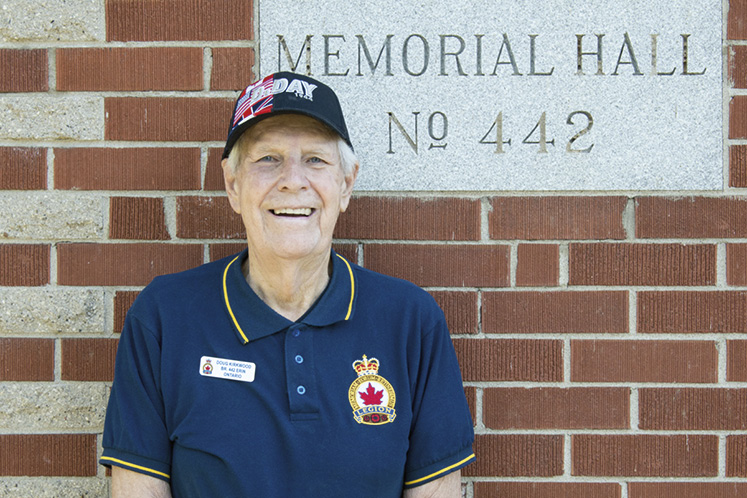
Doug Kirkwood
Why is remembering veterans important? For Kirkwood, it has to do with the next generation understanding the sacrifices that were made.
When Doug Kirkwood was a schoolboy in Erin, World War II was a looming presence in everyday life. Convoys of soldiers from Camp Borden often came through the village, sometimes stopping for lunch.
“They’d set up on Daniel Street near the old public school,” Kirkwood says, “and we’d go there. Troops weren’t allowed to leave, so they’d get us young guys to go to the store and get them chocolate bars and things.”
Schoolchildren also collected milkweed seed pods – for their silk, which was used to fill life preservers. “I still remember the smell of that stuff on my hands,” he says. In school, his teacher turned on the radio at 11:50 every morning so students could hear Gordon Sinclair’s daily broadcast.
When the war ended, Kirkwood recalls, an impromptu parade was staged on Erin’s Main Street. Official homecoming celebrations took place later, and he remembers people speaking solemnly and respectfully of those who did not return. These experiences stayed with him and helped spark his interest in volunteering.
In fact, volunteering has been important throughout his life. He exaggerated his age and joined the Lorne Scots, an infantry reserve regiment, and trained as a signaller, then worked as a signaller in the aftermath of Hurricane Hazel.
He also volunteered with both St. John Ambulance and the Red Cross for 40 years, taking assignments as nearby as the 1979 chlorine car derailment evacuation in Mississauga and as distant as the Slave Lake wildfire in 2011. Over the years, he and his wife, Aletha, a registered nurse, also volunteered with various organizations in Bangladesh and Central and South America.
Next year will mark Kirkwood’s 70th year of membership in the Erin branch of the Royal Canadian Legion. He now focuses on veterans and has researched and written We Will Remember Them: The Men and Women of Erin & District.
The book tells the stories of people from in and around Erin who served in the military and those who supported the war effort at home. Kirkwood arranges layout and printing, and all proceeds from sales go directly to the Legion’s Poppy Fund, which supports veterans and their families.


As the Erin branch’s service officer, Kirkwood is heavily involved in arranging this support. “We’ve arranged for showers and grab bars, for instance, or maybe food is an issue, even housing or help with medical conditions such as PTSD,” he says. But his most visible contribution to remembrance may be his idea of placing veterans’ banners on streetlights in Erin and Hillsburgh. In fact, on the day we met, he had just picked up more banners to install.
His continuing book research has contributed to remembrance in other ways. He has found local veterans’ names to add to cenotaphs and discovered veterans’ gravesites in nearby cemeteries. He has also contributed more than 60 stories to the Ontario Legion’s annual Military Service Recognition Book.
Why is remembering important? For Kirkwood, it has to do with the next generations. “I want the younger people to know the sacrifices that were made overseas and at home … the effort and support that was given to the war effort.”
Related Stories
The War Heroes of Headwaters We Must Not Forget
A new exhibition at the Museum of Dufferin honours the history of service by veterans from Orangeville, Mono, Mulmur and more.
Oscar and Sport, Erin’s War Dog
The true tale of a World War II four-legged soldier who found a forever home in Erin – and a posthumous honour.