Fighting for Food Security
Cringing at grocery prices? You’re not alone. Lisa Needham believes everyone should have access to affordable, nutritious food. She’s spent her career working to help provide it.
Being a nutritionist isn’t just about suggesting ways to sneak spinach into your smoothies and increase your fibre intake. Just ask Lisa Needham, a nutritionist at Wellington-Dufferin-Guelph Public Health. On any given day, she can be found advocating for solutions to food insecurity, working to expand access to healthy, affordable food and briefing high-level public health officials – often all before lunchtime.
Needham graduated from the master of science in applied human nutrition program at the University of Guelph in 2004, and began working for WDGPH the same year. Experience in hospital internships, food service and public health helped her realize she was more passionate about using food to prevent disease rather than about managing its impacts.
Two decades in Orangeville have connected Needham to hobbies, friends and favourite haunts. However, her legacy is her work addressing food insecurity. Provincial and national rates are the highest in two decades, notably among children. According to a September WDGPH Board of Health report, one in four households experienced food insecurity – inadequate access to food due to financial constraints – in 2024.
We caught up with Needham as she works on the Nutritious Food Basket project, which assesses costs for an individual or household to eat healthily in Wellington, Dufferin and Guelph.
5:30 A.M. to 6 A.M. It’s time to wake up and then drive 15 minutes to Island Lake to meet friends for a run. Needham then returns home to eat breakfast and gets ready for work.
8:30 A.M. Needham arrives at the Orangeville office of Wellington-Dufferin-Guelph Public Health on Broadway. Emails await. She meets with the health promotion team to connect about the day’s priorities.
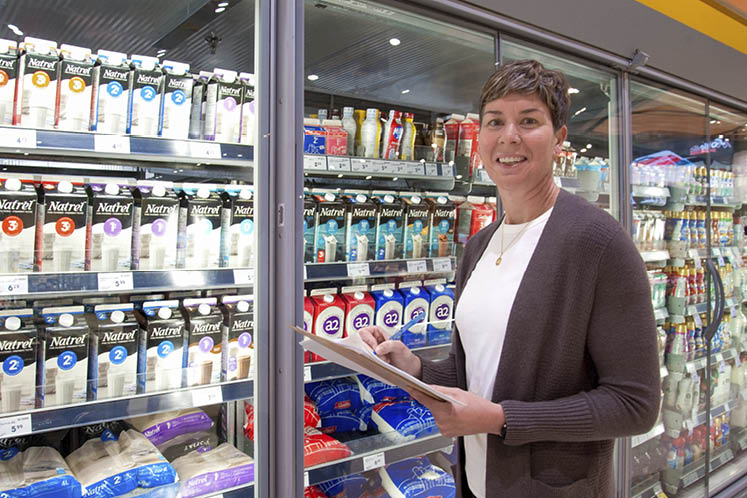
Today Needham will be collecting grocery prices using the Nutritious Food Basket survey tool public health officials use to monitor the cost of a basic healthy diet at local grocery stores. Using annual benchmarks, the results show how affordable and available food is for families at different income levels.
9:30 A.M. Needham and fellow public health nutritionist Karen Wismer meet at the first of two Dufferin-area grocery stores (WDGPH asked that the stores remain unnamed) to collect food prices using a set list provided by the food basket program.
“There is an ongoing need to improve food insecurity,” says Needham. “Change doesn’t happen overnight, but there is more talk about the underlying issues, which is progress. Doing the research and presenting possible solutions developed by an engaged group of community partners and citizens is truly a highlight of my career.”
Armed with the same list, the pair splits up: one wields an iPad, the other a paper spreadsheet and a pen. At the end of the shop, they’ll compare the prices they found for each item, review any differences, and log the data.


In 2025, the cost of the Nutritious Food Basket for a local household of four people was $273.30 per week. The Canadian Consumer Price Index shows that there had already been a 2 per cent increase year over year by June 2026, Needham says.
11 A.M. Needham and Wismer set out for a second grocery store. In total, Needham will visit eight grocery stores in the region over the summer and fall. The compiled data will be used in a report presented to the WDGPH governing body, the Board of Health, in December.
“Our community partners love that report. The data is often used to raise awareness of the issue and is used to inform local actions,” Needham says. “For example, community responses could range from meeting immediate food needs to addressing the root cause of food insecurity. This includes working together to advance solutions to ensure everyone can afford nutritious food.”
12:30 P.M. Lunchtime. Today it’s leftovers from dinner. On other days it can be a treat – such as Pia’s on Broadway in Orangeville.
Needham says she formed an appreciation for both the social and mental aspects of food during her childhood in Lucan, 15 minutes north of London. “My Dutch grandfather owned a grocery store and butcher shop where a lot of my family worked. My grandma cooked a beautiful lunch every day, with homemade buns and soup made with veggies from her garden,” Needham says. “It was her way of expressing joy and love, and she used nutritious food to connect her family.”
1:30 P.M. The Dufferin Food Access Subcommittee holds one of their regular meetings at the public health office. Needham is co-chair. The committee, which focuses on strategies to address food insecurity in the region, includes partner organizations such as the Dufferin Area Family Health Team, Orangeville Food Bank and Shelburne’s Economic Development team, among others.
“We all love in-person collaboration,” Needham says. “We discuss ways to collaborate and strengthen community supports such as community kitchens or gardens, sliding scale food markets, fresh meal offerings in vending machines and addressing the root causes of food insecurity.”
3:30 P.M. Time for some administrative work. Often this involves providing feedback on municipal projects: “For example, I might review municipal plans and consider if transportation routes lead to healthy food retail options. Or do municipal land zoning regulations and bylaws allow for community gardens?” Needham enjoys applying a healthy-food lens to a variety of scenarios. Sometimes she is called on to brief the WDGPH medical officer of health on nutrition-related information.
4:30 P.M. The workday ends – for today. On nights when there are community events, this time is used for preparation. For example, she helped plan and organize regional engagement events as part of the Headwaters Food Charter and Action Plan, launched by the Headwaters Food and Farming Alliance.
Needham then heads home to eat a snack before a strength class at CrossFit Orangeville. “I’m in training for HYROX, a fitness race that blends endurance running and functional strength stations,” she explains. Other nights might see her gravel riding with a crew from Cycling Elements or walking her goldendoodle, Bear, in the Hockley Valley Provincial Park, Mono Cliffs Provincial Park or the village of Alton.
7 P.M. It’s back home for dinner. “I often cook at home after prepping ingredients on the weekend,” Needham says. “But a nice treat out is Greystones, Bluebird Café and Grill, or Mono Cliffs Inn after a hike.”
It’s been a full, yet rewarding day working on a cause near to Needham’s heart.
Related Stories

From Farm to Future: How Women Are Shaping Agriculture
For Fiddle Foot Farm’s Amy Ouchterlony, the modern woman farmer is part grower, part entrepreneur, part caretaker – and often much more.
Northern Connections – Tackling Food Security in Arctic Communities
Two Headwaters residents are working with Indigenous people on innovative programs to enhance food security in the Far North.
Feeding the Soul
Communal gardening helps newcomers nourish the sense of community lost when they were forced to flee their homeland.

Affordable Housing Out of Reach
Owning a home, or even managing rising rental costs, is becoming farther and farther beyond the means of many working people in Headwaters.