A Lake for All Seasons
An ode to a body of water that nurtures life – and soothes the human soul.
The Lake is still, serene and nameless, a boot-shaped, five-acre former quarry flooded 20 feet deep and hidden from the road by a thick screen of trees.
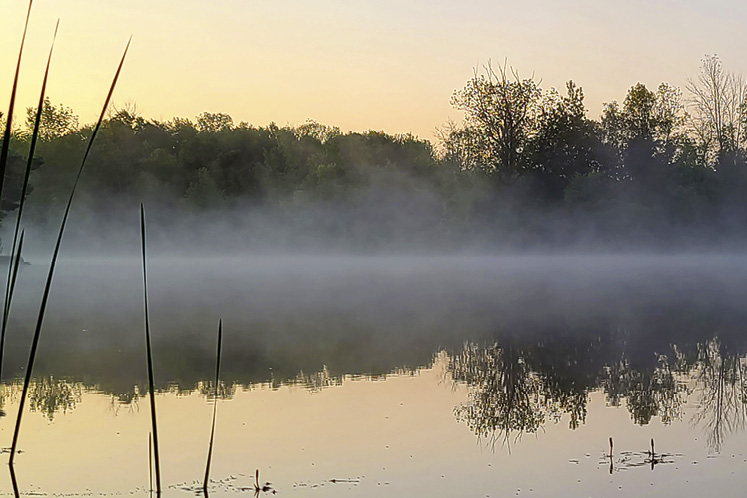
In the mornings, spring and summer and fall, at sunrise, The Lake breathes forth writhing mists an unsubstantial metre high. These hang like a curtain, catching angling early morning sunlight and, depending on the season and the hour, turning translucent shades of rose through amber. They do so whether anyone witnesses this or not.
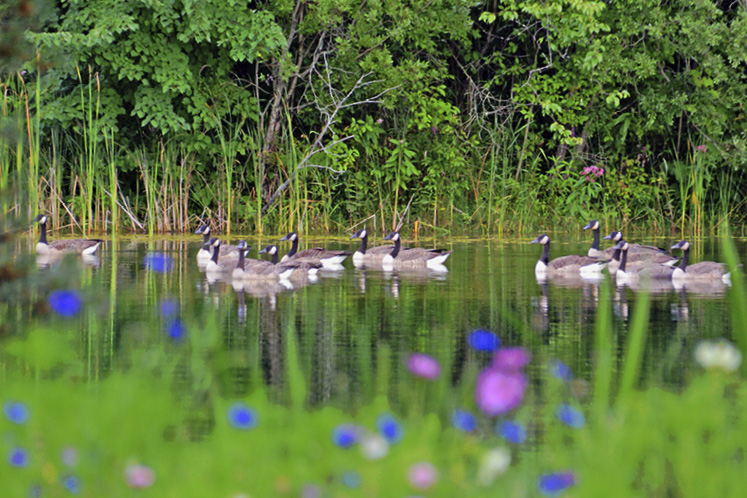
The Lake is filled with many small fish: perch, bass, crappies, bluegills. Frogs abound on its margins, where deer, coyotes, skunks, raccoons, fishers, martens and a bobcat – almost certainly a bobcat – come to drink. Painted turtles sun themselves on its flat, bordering rocks. A grumpy heron sees the nameless lake as his exclusively, sharing its waters grudgingly with a mated pair of cormorants, an odd ménage à trois of mallards, a slovenly muskrat, a rather elegant otter and, from mid-October through early December, large, seemingly endless flotillas of transient Canada geese.
The Lake is a home.
The Lake has a beginning. For those who care to check, it began in our lifetime.
Before becoming a lake, it was an arid expanse of granite, sparsely garnished with topsoil, tough grasses, brush and small, struggling trees. For a few short and greedy decades, the granite was harshly quarried: surveyed, drilled, wedged, cut, jacked, hoisted, washed, weighed and transported elsewhere – occasionally for quite some distance – to become kitchen countertops, fireplace surrounds, mantels and cladding on impressive buildings.
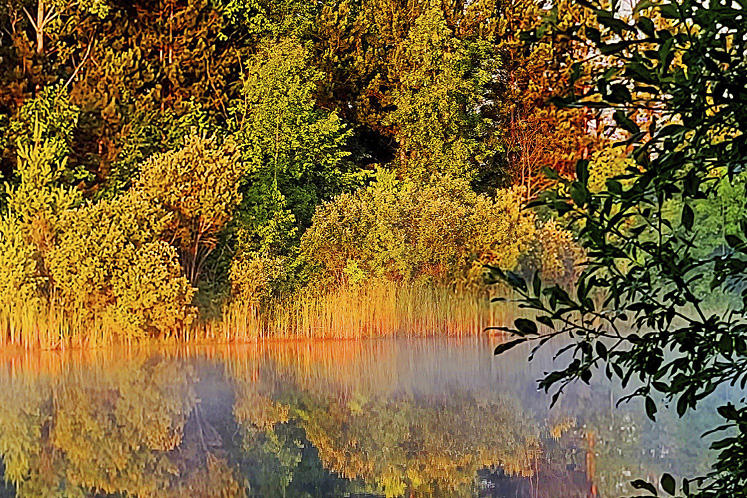
Water from deep in the earth – from five natural springs, it is said – ended the quarrying. Water filled the big slab-sided hole. Cold and clear, the water, over time, nurtured gardens of vegetation beneath and around the lake it would become. Water sometimes overflowed the quarry’s banks, licking at the mounds of the abandoned granite mine’s broken leavings, and moistening the soil, the grasses, and then small trees that accumulated there. Those coniferous and deciduous trees, now grown to maturity, deeply shade and reflect on the surface of what the former quarry has become. A lake. A nameless lake.
Birds nest in many of those trees. Small raptors occasionally perch in the trees’ undulating upper branches, resting, watching, waiting for unwary fish of sufficient size. Fish were surely introduced into The Lake, but when and by whom is uncertain or unknown.
It is difficult to say, but The Lake may be at its most beautiful in summer, its waters warm and its surroundings green. Birdsong carries over it. In summer, the reeds, cattails and water lilies at its margins burgeon and are in full flower. Fish take insects in the shadows of its overhanging trees. The resident cormorant couple dive for fish, alternately and for extended periods, but always surface near their partner. They are bonded after spring meeting and mating.
An osprey, its oversized, sloppy nest housing a brace of ungainly grey chicks, hovers effortlessly over The Lake, swooping down from time to time to seize fish. The appetites of its growing family seem boundless.
The Lake begs for awe in summer. And fishing. And a swim.
Fall, of course, brings crisp air and colour to, and around, The Lake. And it brings geese.
The geese, a great many Canada geese, arrive as Thanksgiving comes and goes, and the trees turn colour, then lose their leaves. The geese arrive en route to somewhere else. They tarry on The Lake’s surface to rest before continuing their annual journey south.
The Lake is not far removed from another lake, a very big one with a well-known name, which the geese must fly over, heading south. The Lake is a very good place to rest beforehand.
The Lake nestles in an area abounding, in fall, with recently shorn cornfields. The hungry travelling flocks of geese graze on the rich stubble. Satiated, they rise into the air, gather into familiar delta formations, and fly high among the clouds over The Lake, whose shape is familiar to them through the genetic memory of generations of their ancestors.
The birds describe a large high circle, then angle downward toward The Lake in V-formation, honking loudly.
Their noise has instruction and meaning. The flock, the conjoined flocks flying together, doesn’t land as one, but touches down in large staggered batches, honking and braking, their big wings outstretched. Momentum carries them to choreographed, waterski-style stops on big webbed feet.
Once landed on The Lake, the geese move to its margins, clearing the watery runway for the next group. Extended family groups or groups from defined locales subtly stick together while becoming part of the gathering greater flotilla.
The Lake provides a resting place and refuge for the geese. Predators cannot reach them. The geese float idly on its surface for a day, with periodic departures and returns for further feeding nearby. Unseen in the darkness of the night, they are intermittently silent, then raucously noisy.
Slicks of small white pinfeathers shed and blown by breezes form a dirty halo caught at the base of the reeds ringing the edges of The Lake. There, a lone, lean coyote sometimes waits, pacing, frustrated. His meal floats out of reach by about 15 metres – sometimes less – on the water. The geese exhibit studied indifference to him. But they carefully maintain that gap, some remaining vigilant while others sleep with long black necks bent back double, head resting in the hollow where wing meets body.

The Lake is even more entertaining and supportive as a staging ground for the Great Goose Departure.
The random alignment of individuals and groups within the floating flock on The Lake becomes, gradually, less so. Geese begin assuming a ragged formation. All face in the same direction, bunch more closely, and head slowly downwind toward the end of The Lake – to the “ankle” of its boot shape. There, they pivot almost as one to face into the wind blowing across the cold expanse of dark water before them. Their honking rises in volume and intensity. Long necks extend upward and bob rhythmically. Wings are furled and unfurled in nervous anticipation. The honking reaches a crescendo.
Necks are then held low and thrust forward, and with the furious flapping of hundreds of wings, The Lake is beaten into an acre of whitecapped waves slapped by running, webbed feet as the transients take off as a vast flock, arcing upward, left, and gone.
They leave churned water, feathers, poop and memories. Then solitude.
With, indeed precipitating, the departure of the Canada geese, small continents of thin ice appear and, undisturbed and unbroken by avian arrivals and departures, thicken, drift, combine and soon carpet The Lake.
For a short while, and comically, this sheath catches unaware, tardy stragglers among the geese. Attempted landings on The Lake while it is in this condition strip late-arriving geese of all grace. Their unprepared landings on ice instead of water are awkward, web-footed skids and slews, transitioning to surprised belly slides that approximate curling using grocery-store Butterballs. With honking.
The Lake’s time as a staging ground ends with the first snow.
The snow may arrive, tentative and delicate, or as emphatic winter all at once. Whichever, snow soon accumulates broad and deep and even over The Lake. The ice beneath the snow is very thick. It is impossibly hard. The water below the ice is clear, dark, still and bitterly cold. Fish barely breathing and hardly moving, huddle near the bottom. Turtles, too, head for the bottom, where they burrow into the mud, while salamanders burrow into the relative warmth of The Lake’s muddy banks. The metabolism of these denizens of the ice-covered lake barely registers. Life slows and endures, but doesn’t cease. Christmas approaches.
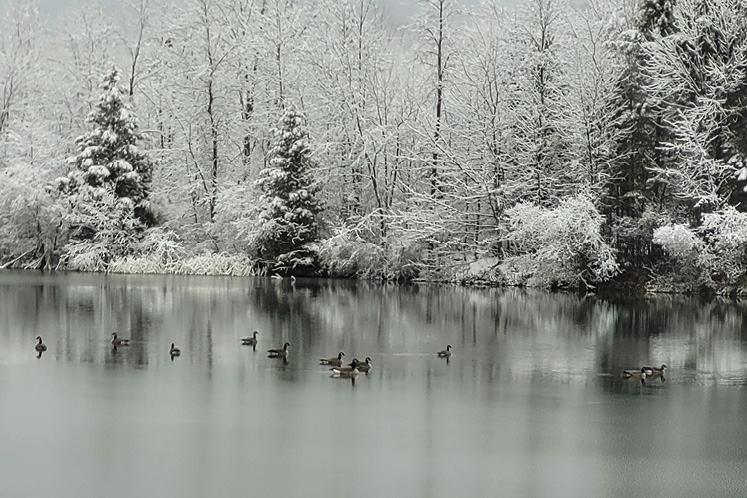
In midday sunshine under snow, The Lake dazzles. The glare hurts the eyes, which seek relief in the Monet-shaded shadows of fir trees. The mauve-, lavender-, heather- and periwinkle-coloured shadows darken and lengthen to deeper greyed violets and purples as the shortened days draw to a close.
Over the long winter months, The Lake may be traversed. It becomes decorated with tracks crisscrossing its surface. It permits the making and following of tracks and the guessing, until knowledgeable, of who or what made which.
Deer tracks, two-pronged and deep, are easy to identify. The tracks of a doe, flanked by the prints of a smaller, sometimes struggling if the snow is deep, fawn are most evident, but never range far from the protective veil of trees. Fisher tracks are vigorous with intent – something is going to die. Coyote tracks, sometimes ragged constellations of them left by a small pack, appear, but particularly evident are the tracks of the loner. Even from afar, he looks bedraggled and seems unhappy. His tracks seem sad: solo, meandering, tangled, stopping and starting, driven by hunger and the lack of a community or group mission.
The resident otter, lately with a partner (kits will appear in late spring), makes and maintains ice-free access holes in The Lake. His is a steady diet of sluggish frogs and fish. He brings them to the surface and guzzles them in the snow, sleek, wet, playful and impervious to the cold.
In spring, The Lake rises and, in places, overflows its perpendicular quarry-defined sides. The nests of red-winged blackbirds, lashed into the dry, dead stalks of last year’s reeds and sometimes cupping a clutch of speckled sky-blue eggs, become awash, swept away or destroyed. From the wavering tops of nearby trees, the parent birds squawk in disappointment and disbelief.
The Lake’s ice extends winter late into spring. Its surroundings are grey and forbidding. The water is bitterly chill. It discourages a dip, but that is not its purpose.
The Lake’s purpose, though its very existence in a disused quarry is an afterthought, is just to be. To provide home, sustenance, refuge, nursery, and a reason to be there for the many animals, fish and fowl who reside, breed, live and die in and around it.
The Lake is both beautiful and functional, but more so, it just is.
The Lake abides.
Related Stories

Bugged!
Insects and their kith are essential to life on earth – but that doesn’t mean we want to share our houses with them. Here’s a closer look at some of our unwanted house guests and how to politely usher them out.

Bird’s-Eye View
For professionals and hobbyists alike, camera drones are revealing a whole new way of seeing and understanding our world.
A Watch on the Wild Side
A trail cam – or several – is an ideal way to delight in the diverse wildlife that visits your country property.

Macro Nature Photography Captures the Secret Lives of Little Things
A close-up look at some of the small critters that inhabit Headwaters and how their lives intersect with ours in crucial ways.