Exploring the Dufferin County Forest
The Dufferin County Forest and other municipally run tracts were created to manage resources and protect the environment. They are also the perfect place for a walk.
Today, it’s difficult to imagine the Headwaters hills bare, without any trees. But for early settlers in the 1800s, the forest was simply in the way. So, in areas like Dufferin County, they cleared trees to plant crops, build their homes and burn for potash – or just burn. However, when the wind and rain washed their fields onto the roads and the rivers flooded, the settlers began to understand the vital roles of the forest.
So the Province of Ontario started to encourage tree planting in the 1870s, even as many settlers were still arriving across the area. Efforts in Dufferin County started in 1914, according to Ministry of Natural Resources records, and over the next 50 years nearly 18 million trees were planted, including those in the Dufferin County Forest, one of the largest collections of forests in Headwaters. Dufferin’s was established in 1930 when the county council purchased 426 hectares (just over 1,000 acres), explains Kevin Predon, county forest manager for Dufferin.
Since then, the managed forest has grown to a total of 1,066 hectares over 14 different tracts, ranging from the 607-hectare Main Tract in Mulmur Township to the four-hectare Levitt Tract in Hockley Valley. In addition, Mono manages its own six-forest tract. Neighbouring municipal forests include the 800-hectare Bolton Resource Management Tract, which follows the Humber River through the town, and the 306-hectare Palgrave Forest that straddles Duffy’s Lane south of the Finnerty Sideroad.
Unlike provincial parks, county forests are private land, not Crown land, and regulations for harvest and recreational use are managed by municipal staff under the direction of the county council.
“The Dufferin County Forest is not a park, preserve or conservation area,” explains Predon. “It is a working forest. Thirty to 40 hectares are sustainably harvested each year to earn revenue for the county, maintain forest health by removing unhealthy trees and assist with forest succession.” The forests are usually planted with evergreen trees – often red pine because it grows well in degraded soil conditions. When the older trees are harvested and sunlight reaches deeper into the forest, there is room for new growth; saplings of oak, maple and others that start growing in the shade begin to flourish.
County forests encourage a diversity of wildlife and vegetation. Trees absorb and retain moisture from rain and melting snow, then mete out the water slowly, which helps preserve streams, rivers and aquifers. Forests also stop – or at least slow down – degradation of the land from erosion and floods.
While the forests help preserve ecosystems in the face of climate change, they are also destinations for fun outdoor pursuits. Most have designated entrances and well-marked trails, and there’s hardly a better place for a walk, particularly with a dog – Predon loves going for a hike with his two dogs. Whether you want to ride a horse or bicycle, walk, birdwatch or just be among the trees – what the Japanese so eloquently call forest bathing – county forests provide ideal settings.


Some tracts of the Dufferin County Forest have parking lots and roadside parking is typically permitted. Individuals can use the forests for free, however larger groups looking to host events require permits with associated fees. The rules are simple, perhaps well summed up in the old saying, “Take nothing but pictures; leave nothing but footprints.” No motorized vehicles are allowed with the exception of snowmobiles on a few trails marked by the Ontario Federation of Snowmobile Clubs. Camping, foraging and fires are also not allowed. Dogs must be on a lead or well controlled. And there are curfews.
From October to May, hunting is allowed in some areas in the south portion of the Amaranth tract as well as the Gara Gore, Melancthon, Randwick, River View and Simmons tracts. These are areas where trails are limited and there are fewer houses. There are strict rules around hunting (the Dufferin County Forest bylaws describe the details online), but visitors to these areas during hunting season should still be cautious and aware – or avoid them entirely.
Since it was established nearly 100 years ago, the Dufferin County Forest has more than doubled in size. The most recent additions include the Levitt Tract in 2010 and the Thomson Tract in Mulmur, south of Honeywood Road on County Road 18, in 2018. Both areas were donated by private landowners.
When you need to go down to the woods, any one of these tracts will welcome you. Locations, maps and bylaws are available at dufferincounty.ca.
Related Stories
The Trees Had to Go!
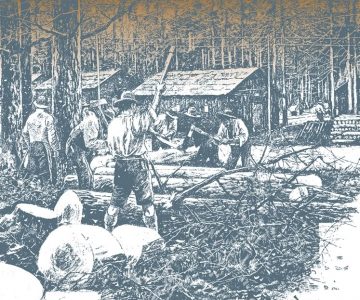
Settlers in the 19th century came here to farm, and to do that they had to clear the trees. Their success with that was thorough and dramatic. So was the impact on the landscape.
Seeing The Forest And The Trees
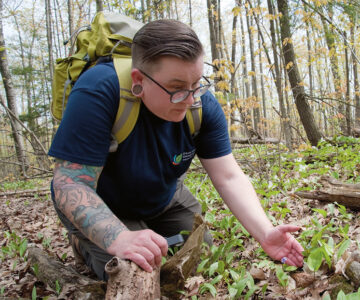
Field botanist Lisa Riederer painstakingly inventories trees, shrubs and groundcover plants for Credit Valley Conservation.

Tree Talk
No matter what your goal – adding shade and beauty to your property, attracting wildlife or fighting climate change – planting more trees is a good idea.
A Magnificent Obsession
Collecting and nurturing remarkable trees has been a 30-year passion for Caledon’s Gary Haslett.