When Cattle Were a Traffic Hazard
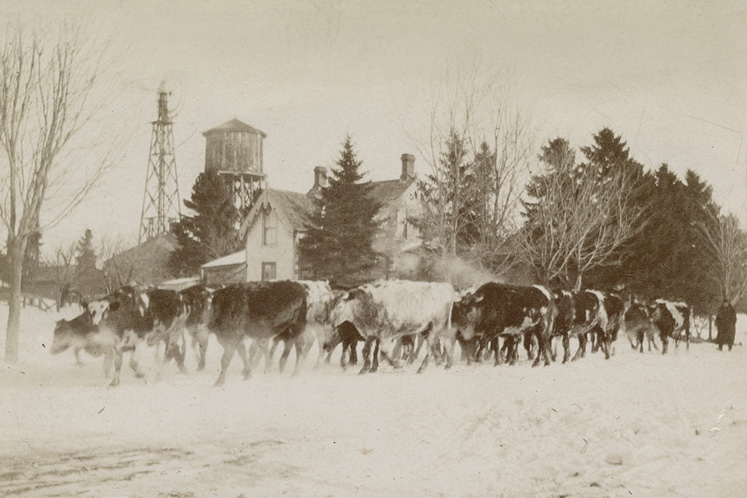
Cattle drives were once a familiar sight on Owen Sound Street in Shelburne – often to the dismay of local residents.
In 1906, when this photo was snapped on snow-covered Owen Sound Street in Shelburne, cattle drives were a familiar sight. These cattle were on their way to the stockyards at the Shelburne CPR station, where they would be prepared for loading onto a train.
For farmers in Headwaters, the coming of the railway in 1873 had brought new opportunities. Suddenly, they were able to ship their cattle, and other livestock, to more distant markets. But first, they had to get the animals to the nearest railway stockyards – and this was usually done on foot, often by a drover specially hired for the job.
At the time, the Shelburne station, now long gone, was located at the end of present-day First Avenue West on what was then the western edge of town. But the stockyards sat on the east side of the tracks, right next to the town’s largest residential neighbourhood.
The prevailing westerly winds ensured that the stench from the yards often blanketed the area. Residents were not pleased. They complained often and bitterly, and in 1898, as the volume of livestock traffic rose and an expansion of the yards was contemplated, the smell became a municipal election issue.
“The accommodation of such a large number of animals within the corporation is a constant menace to the health of the people,” said the Shelburne Free Press. But neither the town nor the railway wanted to end the livestock trade. The answer? “Properly established stockyards, convenient and at the same time isolated enough to save offense or danger,” according to the Free Press.


Unfortunately for the long-suffering neighbours, it was nearly 15 years before the stockyards were actually moved – to the west side of the tracks, where they remained till they closed in the mid-1930s.
By then, roads and highways, as well as motorized vehicles, had evolved. Commercial trucks could transport cattle, and other goods, more nimbly and conveniently, and the sight of cattle herds on Shelburne streets became a thing of the past.
Related Stories
Oscar and Sport, Erin’s War Dog
The true tale of a World War II four-legged soldier who found a forever home in Erin – and a posthumous honour.

When Peepabun Was More Than a Name on Google Maps
Once a thriving centre of Christian revivalism, Peepabun was known for its annual camp meetings in the early 1900s.

The Little Engine That Could
Steam locomotives like the James McKay helped shape and build our communities in the early 1900s.

The Old Fire “Excape” at Shelburne’s Old School on the Hill
Shelburne’s old ‘school on the hill’, built without fire escapes, added in two evacuation slides which students gladly used during fire drills.