Who’s in Charge Here?
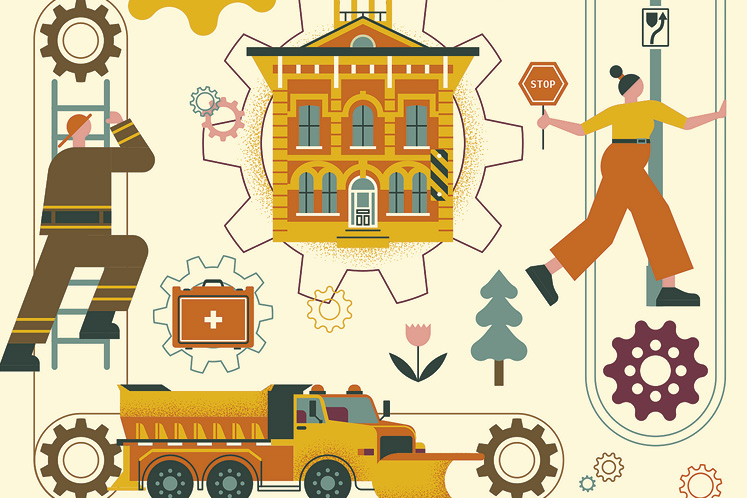
If you’re confused by the two-tier structure of municipal government in Headwaters, you’re not alone. Here’s a primer on how local government works – and who’s responsible for what.
As you schlep your household trash to the curb every week, the structure of municipal government in Headwaters probably isn’t top of mind. You just want your garbage picked up.
But who is responsible for that – and for ensuring the smooth operation of the many other services that keep Headwaters communities functioning? If you have a question to ask, a pat on the back to offer or a bone to pick, who do you call? The answers to these questions aren’t always straightforward.
In Canada, municipalities have traditionally been considered “creatures of the provinces.” This means that Ontario’s 444 municipalities – its regions, counties, districts, cities, towns, townships and villages – exist at the discretion of the provincial government, which can change their status and responsibilities at any time.
This year, for example, the province moved to abolish the ability of Peel Region councillors to select the region’s chair by vote. When the election is held in October, the region’s chair, who also acts as the chief executive officer, will be appointed by the province – and will assume “strong chair” powers similar to the controversial strong mayor powers already granted to the heads of some lower-tier municipalities.
Two-tier municipal structure
Today, the terms upper tier and lower tier describe the two-tier structure of municipal government in Headwaters. Upper tier refers to the regional and county levels, while lower tier refers to the local governments of the towns and townships nestled within an upper-tier municipality.
But as home to the headwaters, or source streams, of four major river systems, Headwaters (with a capital H) is a geographic concept, not a political jurisdiction. Politically, the area encompassed by the moniker includes 10 lower-tier municipalities that are part of three different upper-tier municipalities.
With one exception, the councils of the upper-tier municipalities – Peel Region and Dufferin and Wellington counties – are made up of elected representatives drawn from the lower-tier councils. The exception is Erin, where the mayor serves on both the town and Wellington County councils, but Erin’s county councillor sits only on the county council.
Representatives of the lower tiers meet as the upper-tier council and collaborate to make decisions and shape policies that affect their entire region or county.
Dufferin County
Dufferin is the only upper-tier municipality whose lower-tier municipalities lie completely within Headwaters. The county’s eight lower-tier municipalities are the towns of Orangeville, Mono, Grand Valley and Shelburne, as well as the townships of Amaranth, East Garafraxa, Melancthon and Mulmur. Each has its own council.
The mayor and deputy mayor of seven of the lower-tier municipalities, as well as the mayor only of East Garafraxa, also serve on Dufferin County council.
Town of Caledon
Though geographically part of Headwaters, Caledon is a lower-tier municipality whose upper-tier affiliation, Peel Region, also includes Brampton and Mississauga. Neither is part of Headwaters.


Caledon’s mayor also serves on Peel Region council. Eight councillors make up the balance of Caledon council: each of the town’s six wards is represented by one local councillor, and two regional councillors represent three wards apiece at Peel Region council.
Town of Erin
Like Caledon, the town of Erin is considered part of Headwaters, but it, too, is a lower-tier municipality, one of nine in Wellington County. Erin town council consists of a mayor and four councillors. The mayor and one county councillor represent the town on Wellington council.
Division of responsibilities
When you have questions about a municipal issue or service, it helps to know which tier manages what, so you can voice your concern to the right level. But in Headwaters, the tiers that look after specific services may vary from municipality to municipality.
The upper-tier governments usually manage region- or county-wide services such as regional and county roads, social services, public health and garbage collection (except recycling, which is no longer a municipal responsibility).
Lower-tier governments collect property taxes on behalf of both tiers and for education. And lower tiers are usually responsible for managing services such as policing, local roads and sidewalks, snow removal, libraries, arenas and some parks and trails, as well as drinking water and fire services.
When things go wrong, the elected officials and staff of both municipal tiers are closest to hand. They know your community at the street level. So if your garbage is sitting uncollected – or you have another concern about a municipal service – they’re the ones to reach out to. A phone call or online search is usually all it takes to find the help you need.
Related Stories

Meet the Candidates: Municipal Election 2026
Find out who’s running for local government in Headwaters.
Are You Ready to Vote?
Voting in this October’s election may look a little different in some municipalities depending on where you live. Here’s our guide to make sure your voice is heard.
2026 Municipal Election Events
Want to ask a question or find out more about the candidates running for election in your town or township? Here are the panel and Q&A events currently planned for the Headwaters communities.
Municipal Election 2026: Who’s Running in the Town of Orangeville
Here are the candidates running for mayor, deputy mayor, councillor and school board trustee in Orangeville.