Northern Impressions
Caledon may be home for Bridget Cauthery, but the Far North has left an indelible impression on her heart.
My fascination with the North began when I was a child. My father was a water and plastics engineer, and in addition to working in the Middle East and the Caribbean, he also consulted on projects in the Far North. For several years during my childhood in the late 1970s, he spent time in Nanisivik on the northern edge of Baffin Island in what is now Nunavut, building a sewage treatment system for the newly created mining community.
At 73 degrees north latitude just inland from Strathcona Sound, 20 kilometres east of the community of Ikpiarjuk, or Arctic Bay, Nanisivik is remote. Mechanical wastewater treatment in the Far North is a significant challenge due to the freezing ground and air temperatures. My father often complained that certain materials purchased for the water treatment operation in Nanisivik, having taken many weeks or even months to travel by boat to the site, frequently cracked or failed in the extreme cold. Establishing and maintaining a basic service such as wastewater treatment in the North is a challenge.
Born in London, England, in 1930, my father was captivated in his own way by the North. In the 1950s, years before his work in Nanisivik, he had spent time in Churchill, Manitoba, working as an office clerk for a shipping company. Having paid his way across the Atlantic by working on a cargo vessel, my father was waiting out the winter to make the return journey home to England once the sea ice melted.
Years later he told my brothers and me about how, on his days off, he would walk along the rocky shore of Hudson Bay, past massive sun- and wind-bleached whale skeletons and stone inuksuik that pointed travellers to nearby communities. He told us about how, on one of those walks, he had met a large timber wolf as he rounded a bend in the shoreline. The wolf, he said, was just as surprised to see my father as my father was to see him, and sensibly, they both decided to turn around and go back the way they had come.
Returning to our family home in Caledon after time spent in Nanisivik, my father used to bring us whole Arctic chars, fished from holes made in the sea ice. He also brought home beautiful hand-carved, soapstone necklaces, made by local Qikiqtani craftspeople, each of a different Arctic animal. Mine was a two-headed seal, flat on one side and carved in relief on the other. It was bigger than my palm and hung on a string made from caribou hide.
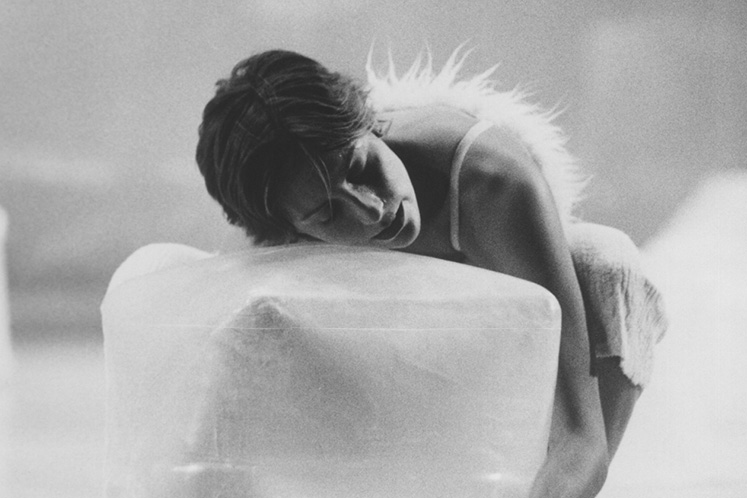
The influx of people passing through Ikpiarjuk and Nanisivik to do business at the mine resulted in a growing market for local carvers. Local Inuit recall that the mine also brought more frequent deliveries of supplies from the South as well as the establishment of a year-round elementary school. Alcohol came to the previously dry community, too, and bylaws that prevented sled dogs from roaming. Such laws inevitably curtailed the traditional Qikiqtani means of hunting and made them more reliant on non-traditional foods and clothing from the South.
During the summer of 2017, my family and I spent a week at a cottage in the Kawartha Lakes region of central Ontario. We stopped one afternoon at a small vintage store in the village of Buckhorn, where my sons went looking for keepsakes from their holiday. My eldest son chose a large dusty conch shell, my youngest son chose a vintage diecast police car, and my middle son chose an Inuit soapstone carving of an owl. The conch shell cost $7, the toy car $9 and the hand- carved owl $2.50. Although only four inches tall, it is incomparably beautiful and, among the bric-à-brac and mass-produced toys, it was utterly forsaken.
I have visited the North on four occasions: a cruise up the inside passage from Vancouver to Skagway, Alaska, when I was 11 years old, two trips to the Yukon in 2001 and 2003, and one to the Northwest Territories in 2008. From 2000 to 2009, I was company manager for Toronto Dance Theatre, a contemporary dance company under the artistic direction of Christopher House. I was responsible for the safe transport, provision of meals and general care of 12 dancers, two apprentices and the production stage manager, assistant stage manager, rehearsal director and artistic director.
In January and February 2001, I managed Toronto Dance Theatre’s tour to British Columbia, the Yukon and Alberta for the premiere of Christopher House’s Severe Clear, a work based on his participation in the Yukon Journey Project the previous year. An initiative spearheaded by the Yukon Arts Centre, the project saw a group of Canadian artists from multiple disciplines travel to the Yukon and Nunavut in order to experience the North. In exchange, each artist was commissioned to create a work in their métier that would have its premiere in Whitehorse. In response to his journey, House created Severe Clear, my first encounter with choreographing the North.
TDT’s tour to the Yukon reintroduced me to the North as an adult. After a seven-hour drive along an ice-covered Highway 2, we arrived at Dawson City. Dawson stunned me. It was breathtaking – both figuratively and literally. The sky was crystal blue, and the sun sparkled off the tiny beads of ice that formed on my eyelashes as we trudged from the bed and breakfast where we were staying on 5th Avenue to the hardware store on 2nd Avenue to buy hockey tape to cover up the deep crevices in the floor of the former Mechanics’ Hall (the dancers performed in bare feet).
At night, the northern lights encircled the dome of the sky in rippling trails of absinthe green. On our way to Dawson, we had stopped at Carmacks, one of only three gas stations along the highway, for a washroom break. While stretching my legs, I met a very large Samoyed-type dog waiting for its owner in the back of an open pickup truck with the engine running. The dog’s saliva froze as it dribbled onto the truck’s fenders, and when he offered me his paw to shake, the fur on the underside was so dense, I could not feel his pads.


On subsequent trips to the Yukon and Northwest Territories, I continued to add to my scrapbook of ideas of the North: a congregation of furry-legged ptarmigans pecking in the snow-filled side yard of a home in Yellowknife; a mother grizzly bear and her two cubs ambling across the road on my way to hike in Kluane National Park; stopping on the trail through the park to test the relative warmth of piles of blueberry-laden bear droppings to determine how recently the animal had crossed our path; listening to morning broadcasts of Mr. Dressup on CBC Radio for children without televisions while ferrying dancers between the hotel and the theatre, then to late afternoon broadcasts of introductory Gwich’in lessons for a people without language; the German couple in thick wool socks and Birkenstocks who baked dense loaves of bread made of spelt to eat with thick lentil-based soups in a yellow cottage straight out of Heidi’s Alps across from the Westmark Hotel in Whitehorse; the desk in the lobby of the hotel staffed by a Japanese-speaking tour guide who welcomed her countrymen and women on their honeymoons and answered their questions about the daily forecasts before offering tips for conceiving beneath the northern lights; the fresh-from-the-frozen-lake, weather permitting, fish ’n’ chips served with the creamiest coleslaw and a dose of attitude at Bullock’s Bistro in Yellowknife; the strong smell of wood smoke arising from sheets, dried before the fire, that covered the massage table I lay on, face down, with my face poking through my own seal-sized breathing hole; the pearlescent sheen of sealskin coats worn by members of the public mingling in the foyer before a show; the Turkish woman working for the Northern Arts and Culture Centre who had reluctantly immigrated to Yellowknife with her husband only to find that, after six months, her husband had returned to Ankara and she had decided to stay; wolfing down exquisitely fresh and painstakingly prepared salmon sashimi in a second-floor sushi restaurant minutes before the hour call; climbing, white-knuckled, down the steps from a plane onto the tarmac in Yellowknife in a blinding snow squall and watching First Nations and Inuit teenagers trudge, heads down, undeterred, toward a waiting military plane bound for the Arctic Games in Nuuk, Greenland; a radio personality announcing a “high of 43 degrees today,” dropping the superfluous “minus” of ordinary January weather; the glare and Technicolor din of the Walmart in Whitehorse after only five days spent farther north; and driving across Great Slave Lake along the ice road marked with cut fir trees on the way to Hay River on the far shore to deliver dance classes at the local public school where even the principal joined in. (The school did not have a gymnasium so classes were taught in the hallway decorated with the posters warning against the dangers of huffing and what to do if you think a friend might be suicidal.)
All these postcards of the North I encountered speak to my unquestionable privilege, my culture shock and the brevity of my stays, but they also speak to the admiration I feel for the diversity and complexity of lives lived in the North.
Related Stories
Northern Connections – Tackling Food Security in Arctic Communities
Two Headwaters residents are working with Indigenous people on innovative programs to enhance food security in the Far North.
Land Acknowledgments Decoded
A primer on the history and the reconciliation goals behind the statements read out before municipal, arts and sports events.
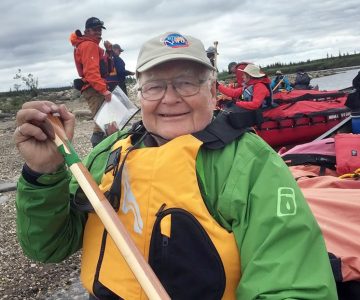
John Wheelwright
John Wheelwright, 89, paddled 300 kilometres on the Upper Horton River north of the Arctic Circle this past summer.

Canoe North Adventures
Taylor Pace, Al Pace and Lin Ward of Hockley Valley operate Canoe North Adventures and have led 90 expeditions on 21 rivers in the NWT, Yukon and Nunavut.