
The Wonders of Moth Antennae
From helping with navigation to filtering out pheromones, these delicate but powerful sensory organs are crucial tools for moth survival.
You’d be hard-pressed to find structures in nature as wondrous as moth antennae.
Moths are utterly dependent on these feathery organs for survival. Deprived of antennae, moths can’t find mates and can’t fly properly. It also appears that moth antennae can influence gender expression.
Among the multi-faceted functions of moth antennae is their ability to detect odors wafting through the air – the “come-hither” pheromones released by females to summon males.


The air is filled with thousands of different insect pheromones in the spring. Male moths filter out this multitudinous “noise” and respond only to the scent meant for them.
The sensitivity of their antennae is mind-boggling. Male moths can detect one female pheromone molecule per billion molecules of air. This allows them, according to some estimates, to detect females from distances of 7 km or more.
Human engineers at the University of Washington are capitalizing on this stunning odor sensitivity by attaching sphinx moth antennae to tiny drones. In a scenario straight out of science fiction, the robotic drones have been guided by the moth antennae to the specific floral scents that the moths find appealing!
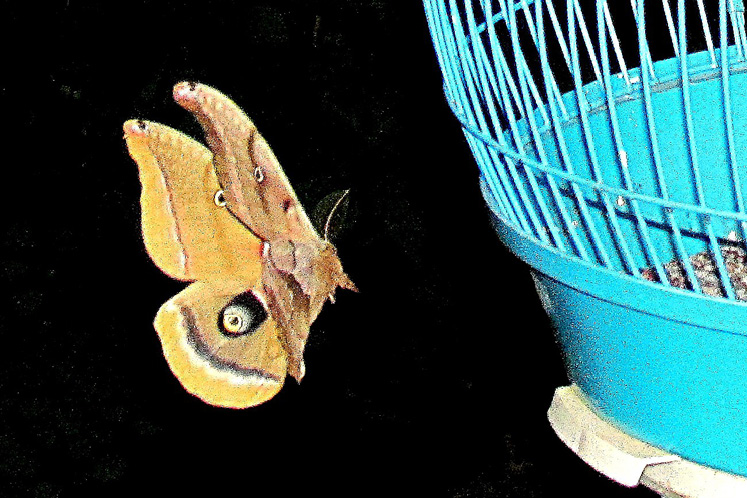

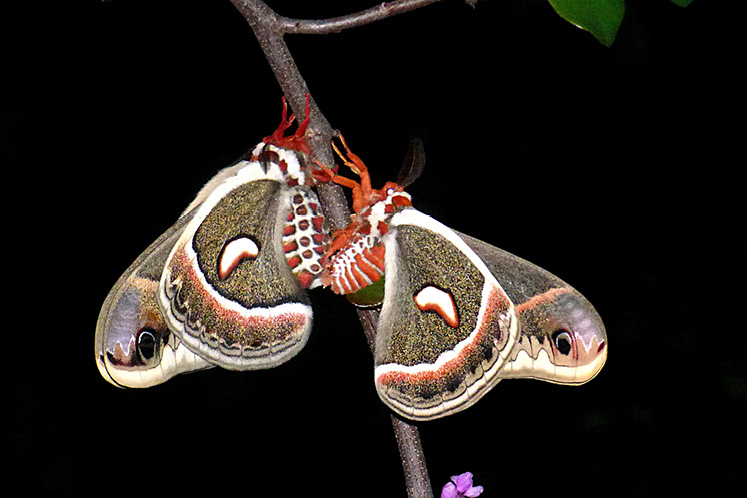
But moth antennae are more than pheromone detectors. They also serve as organic gyroscopes, helping moths to stabilize their flight. In moths, controlled flight is only possible via a link between antennae, brain and wings.
Want more moth antennae wonders? They appear, at least in some species, to be crucial to the expression of gender. In one experiment the antennae of male moths were replaced with antennae of female moths. The males then switched gender roles. Instead of pursuing females they began looking for plants to lay (non-existent) eggs on!
Moth antennae are stunningly complex and over-the-top fascinating. My guess is that they will reveal even more of their secrets in the years ahead.
Related Stories
Moths of the Limberlost
These furry little moths sporting tiny faces with big eyes are delightful companions in the garden.
If the Greenbelt Gives Way to Sprawl, Seven Headwaters Species Will Suffer
You may not know some of these magnificent species but they are our precious, fragile neighbours that cannot survive in a subdivision.

Transforming Turf into a Meadow Ecosystem
From a swath of turf grass came a thriving meadow ecosystem full of wild flowers, pollinators and biodiversity.
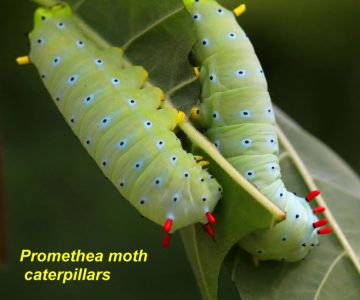
Promethea Moths
While most moths release their pheromones after dusk, promethea moth females are an exception.