Pop’s Recipe for Well-Being: Swiss Chalet, Vodka Tonics and Good Company
Dan Needles on how eating together and enjoying life’s simple pleasures helped his father live to the ripe old age of 97.
My father died about 10 years ago at the age of 97. There was never anything wrong with him until he had a heart attack the week before Christmas and ended up in the hospital. When I drove down to visit him in Stratford, I brought him a quarter chicken dinner, but the nurse brought me up short.
“He’s on a salt-free diet,” she informed me.
“Really?” I said. “He’s been eating at Swiss Chalet since it opened in 1954.”
The nurse put a weary hand to her brow. “I can’t believe I said that. Give him the chicken.”
By this point, Pop had outlived quite a few doctors and several rewrites of Canada’s food guide. Not that he would have read it. He smoked into his 60s and the last time he broke into a trot was sometime during the Second World War. His favourite beverage was a vodka tonic.
But he was fascinated by his own health. He came down with Spanish flu as a baby in 1919 and never felt entirely well again his whole life. He listened to every pop and gurgle his body made, and the only hobby he ever took an interest in, besides his tropical birds, was seeking out specialists to find out what was wrong with him. His ailments moved like the news cycle for healthy eating. He would give up each prescription within a few days as some new ailment captured his attention. As a stage actor for 65 years, he had played many death scenes, and he could be quite convincing.
When I pointed out to him that he had done very well to make 97, he said, “It’s because I’ve been vigilant. You never know what can happen!”
He was right. Another heart attack snuck up on him a couple of weeks later after Christmas and he was gone. At his funeral, the secret to long life was a popular subject. A number of people were talking about the latest news from the U.S. government suggesting saturated fats are not the problem and that cholesterol levels, good, bad or indifferent, are not a predictor of anything. It seems everything we’ve been told by the experts for the last 35 years is suspect. Well, not really. A careful sifting of the literature says that the food writer Michael Pollan probably got it right years ago when he told us to eat stuff your grandmother would recognize as food, from around the outside edges of a supermarket … not too much and mostly plants.
In spite of his constant state of vigilance, Pop ate pretty much what he liked and had no political views on food. Local, organic, sustainable, fair trade … it was all white noise to him, like the hum of the air conditioner. He didn’t send away for herbal tonics or watch Dr. Oz. The only two adjectives he ever used in connection with food were complaints that it was slow arriving or expensive.
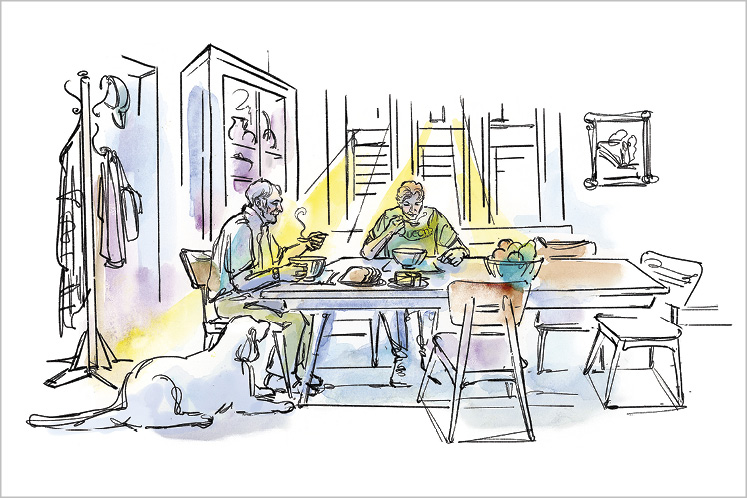
I think one of his secrets, apart from his sturdy genetics and the long walks he took every day with his dog, was that he hated to eat alone. He didn’t cook anything himself, but he always had a house guest who could at least boil soup. And soup, according to the experts, is better for you than a carload of miracle supplements from a shady Kansas City mail-order house.


Here at Larkspur Farm, we gather around a table laden with the fruits of the season, a lot of it from our own garden or the orchard. There is always a platter of beef, pork, chicken or lamb from the barnyard. But the key ingredient is good company, something that the ancients insisted was essential to good health.
Pop once told me a war story about supervising a crew of Kanaks, the original inhabitants of the Pacific island of New Caledonia, as they moved logs through a swamp. At the end of each day, they would take him back to their village and sit him down to a meal of fish, rice and taro root. His hosts laughed when he threw his K-rations into the centre. He remembered the laughter and the stories and the songs of those tropical evenings and realized it was one of the few times during the war that he wasn’t homesick or scared.
By now it should be obvious that all this effort we expend in the search for healthy food serves us best when we share it with others. It may not make us live any longer, but it certainly helps us feel better about the fact we are alive.
Related Stories
A Sudden and Tragic Loss
The death of a parent forces a profound life shift as grief, gratitude and memory intertwine, and the sense of loss lingers.
Marking Time through Tradition and Ceremony
By honouring our customs, we celebrate continuity and remember a shared history.
On a Short Leash
Slowing down doesn’t come naturally for active sheepdogs, or their reluctantly aging owners.

Staying Useful and Relevant
Experts agree the best defence against aging is to maintain a sense of purpose after retirement.