The Mayor of Mono Centre
A stonemason by trade and Freemason by association, Archie McQuilkin stepped into the realm of local politics and left his mark on the local community.
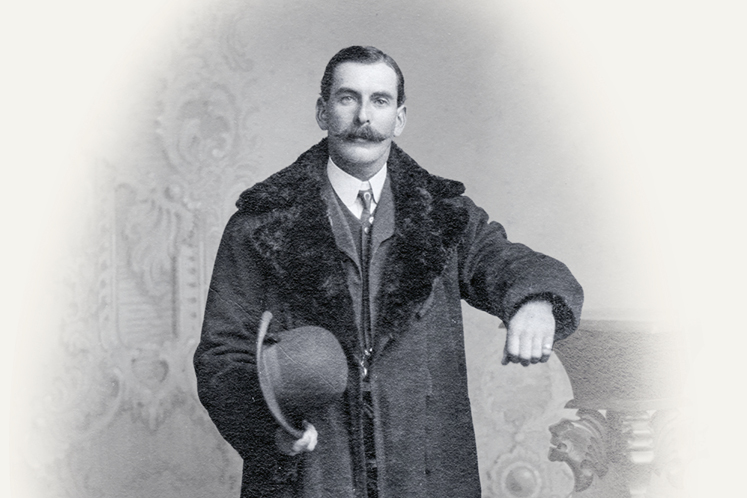
When Archie McQuilkin posed for this photo in about 1910, he was in his mid-30s and clearly wished to portray himself as a gentleman of substance. Wearing a three-piece suit, a white shirt with a starched collar, and a carefully knotted tie, he also carried a bowler hat, a symbol of sartorial sophistication. But the pièce de résistance was the long, elegant coat, with its ample fur collar.
At the time, Archie, a stonemason by trade, was already a force in Mono Centre, the Dufferin County village where he was born and grew up. By his late 20s, he had joined the Freemasons, becoming a member of Orangeville’s Harris Lodge No. 216. Acceptance into this fraternal organization was often considered a mark of status in the community.
Freemasons are expected to behave ethically, though not all, of course, live up to this standard. They are also dedicated to self-improvement and to honouring the organization’s long history and secret rituals, as well as to supporting one another and their community, often through charitable works.
Archie took these commitments seriously. Throwing his hat into the political ring, he was elected deputy reeve of Mono Township in 1922. After taking a break from politics, he was persuaded to return in 1931 and served on the township council till he retired in 1939, perhaps because he was already suffering from the illness that caused his death in 1940.

By then, he was known affectionately as “the mayor of Mono Centre,” and his fulsome obituary in the Orangeville Banner noted “his faculty of making friends and holding them.” These friendships “extended far beyond the confines of his home community and his township.”
Not surprisingly, then, Archie’s funeral was attended by luminaries from Mono and farther afield. His interment in the Burns Cemetery was conducted with full Masonic honours, and as a final tribute, his many friends made sure a headstone – proudly inscribed with Freemasonry’s traditional symbols – commemorated this man whose life had left an indelible mark on his community.
Related Stories
Forgotten Factories: Remembering Bolton’s King Street Ashery
Discover the history of potash production in Headwaters, and the rise and fall of entrepreneur Edward Porritt’s ashery in the late 1800s.
A Good Friday Donnybrook Fair
Prohibition laws of the late 1800s often led to hotels functioning as underground drinking holes that even local constables had trouble breaking up.
When Cattle Were a Traffic Hazard
Cattle drives were once a familiar sight on Owen Sound Street in Shelburne – often to the dismay of local residents.
Oscar and Sport, Erin’s War Dog
The true tale of a World War II four-legged soldier who found a forever home in Erin – and a posthumous honour.