The Turtle Protectors
Habitat loss, traffic and growth are pushing Ontario’s turtles toward local extinction, but grassroots rescue efforts offer hope.
The antediluvian creature emerged from the Grand River and walked, resolutely, up a slope toward Dufferin Road 25 near Grand Valley in June 2025. The road hummed with morning traffic. Driving in that steady stream of vehicles was Alexis Wright who, every June, is primed to look for turtles. When her peripheral vision registered the lumbering snapping turtle, she edged her car to the shoulder, turned on her hazard lights and, as a biblical torrent of rain fell, pondered her next move.
Wright is the founder of Headwaters Turtle Protectors, a volunteer group dedicated to making the area’s increasingly urbanized world safer for turtles. The snapping turtle heading toward Dufferin Road 25 – and almost certain oblivion on that rainy morning – was lucky. Wright, experienced in handling turtles safely, picked it up, carried it across the road and set it down in the direction it was heading. It was a female, with nesting on her mind.

Then, as transport trucks thundered past and the rain continued to fall, Wright watched the turtle enter a soy field and begin to dig her nest. Wright names special turtles and called this one Maizey after she misidentified the soy sprouts as corn. Agriculture isn’t Wright’s forte. Turtles are.
Then the waiting began. Along with volunteers Michele Blanchard-Seidel and Mandy Park, Wright took turns watching Maizey from a respectful distance. The protectors didn’t want to spook her, but they did want to make sure she got safely back to the Grand River after nesting. At that point, her duties would be over. Turtle eggs and hatchlings must fend for themselves, with no parental care.
The protectors’ vigil lasted more than eight hours. At 7:30 p.m., Park was on watch when Maizey began trudging back to the river. Park texted Wright, who soon arrived to carry Maizey back across the road.
Maizey was safe, but what about her eggs? Later, the protectors searched the approximate location of the nest, but came up empty. The precise site was disguised by the saturated soil, the uniformity of the soy sprouts and Maizey’s fine job of covering her eggs. The unsuccessful attempt to find the eggs probably led to a regrettable outcome. In late summer, as the hatchlings trundled across the road toward the river, they were likely run over.
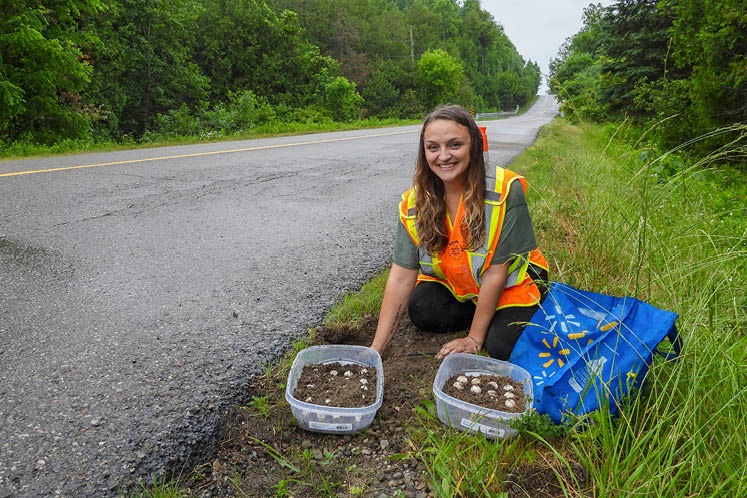
As a mother of a young boy and with a job as an environmental and human rights reporter for The Pointer, an online media platform serving the regions of Peel and Niagara, Wright doesn’t have lots of free time. But she is usually able to work from home and, importantly, has an understanding mom who can take care of her son, Joey, when she is away on rescue missions.
For Wright, driving in the warm months is more than a way to get from one place to another. It is an opportunity to watch for turtles and, if necessary, carry them across roads in the direction they were travelling. She emphasizes doing this safely. This is not an idle concern. In May 2024, two sisters were struck by a vehicle and killed as they attempted to help a turtle cross a road near Chatham. “Now that I’m a mom, I’m especially wary,” says Wright.
Why is she so passionate about the welfare of turtles? “As an environmentalist, I feel I’m screaming into the void much of the time,” she says. “So it feels good to do something that has undeniable positive outcomes. I’d feel pretty bleak if I didn’t do anything.”
Turtles at risk
Of the eight species of native turtles found in Ontario, all except the painted turtles are considered at risk by the province’s Committee on the Status of Species at Risk.
In Headwaters, midland painted turtles are the most common species. Though snapping turtles are also reasonably common, they are listed as a species of “special concern,” which means they may become “threatened” if adverse factors affecting their populations are not dealt with.

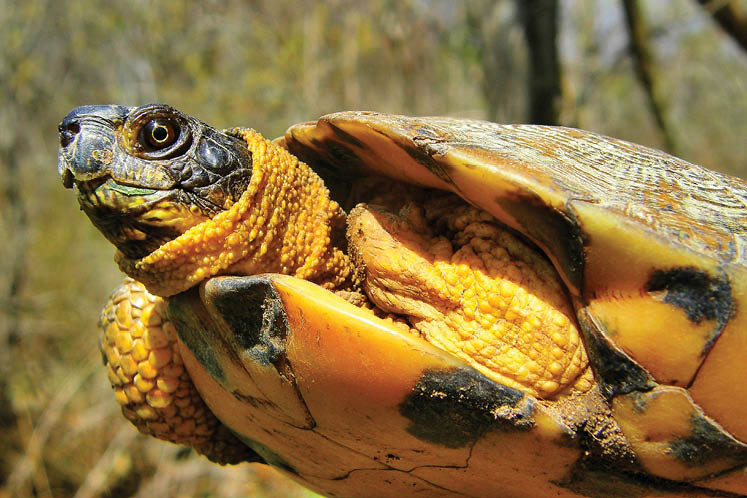
Blanding’s turtles, a third Headwaters species, are already considered “threatened.” This means they are likely to become “endangered” if nothing is done to reverse the factors leading to their extirpation (local extinction) or extinction.
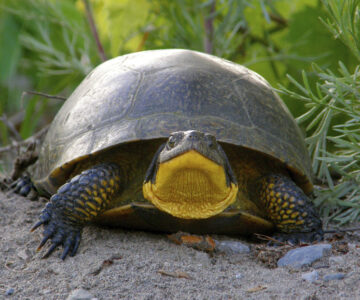
And sadly, Blanding’s turtles do appear to be on the verge of extirpation in these hills, though some of these beautiful animals, with banana-yellow throats and army-helmet-like shells, probably still inhabit the Luther Marsh.
But interestingly, a female Blanding’s turtle was found wandering in south Caledon a couple of years ago. The surprising presence of a female Blanding’s in south Caledon is undeniably positive. But her prospects for survival are fraught. This area of Caledon will soon experience explosive growth.
This growth will take a heavy toll on the area’s already compromised natural environment. Buildings, highways, parking lots and agriculture have eliminated much of the turtle habitat in Headwaters and beyond – and habitat loss will, regrettably, continue apace. It is the overarching reason turtles are in crisis today. Humans have drained wetlands and largely eliminated the natural corridors that connect the wetlands that remain.
This makes it imperative to protect surviving bits of nature – as refuges for turtles and myriad other life forms. “Swan Lake,” for example, a blue jewel in a landscape restored from a former quarry, is worth protecting. Located in Caledon north of the village of Cataract, this body of water has been reclaimed by swans, frogs and, yes, turtles.
Spearheaded by advocacy groups, local residents and environmental activists, the fight against a developer’s proposal to fill the lake with debris and excess soil from construction projects has been long and bitter. But last December, Caledon council voted unanimously to nix the idea.
For now, the proposal is dormant. “Swan Lake” and its turtles are safe, though there is no guarantee that the proposal won’t be revived. My hope is that turtles can be granted this small, but important, wetland as recognition of human complicity in their decline and as a gift to their future.
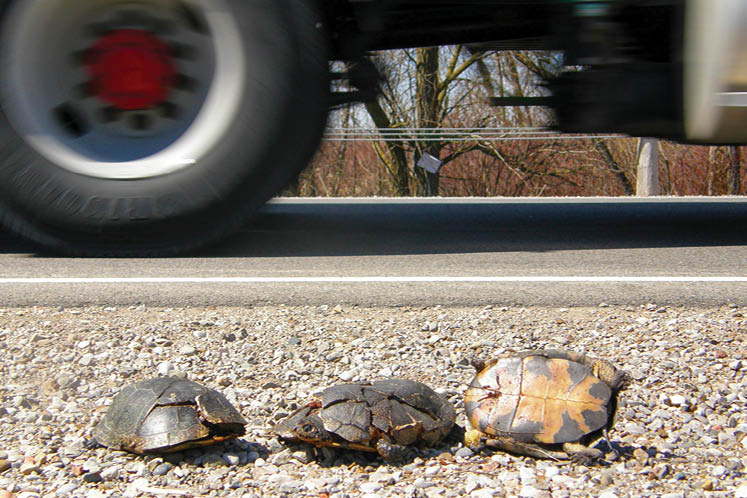
Growth, of course, is supported by more and bigger roads, and by ever-increasing traffic. For millions of years, turtles have moved, largely unencumbered, through expansive home ranges – females on egg-laying missions and many others simply moving from one wetland to another. These overland journeys have always carried risk. In deep time, wandering turtles probably fell prey to velociraptors, and in pre-colonial times, to hungry wolves or cougars. But their epoch-spanning wanderlust now puts them at much greater risk.
Wright’s intervention last June near Grand Valley ensured a happy ending for the snapping turtle mother. But every year, in thousands of other instances across Ontario, the endings are tragic. Crossing busy roads is like playing Russian roulette with five of the gun’s six chambers loaded.
Victims of growth
In Headwaters, the tremendous growth planned for Caledon will add thousands of vehicles to the town’s roads. This is a given. And more cars will mean higher turtle mortality. Then, predictably, that mortality will decline – not because turtles have learned to avoid roads, but simply because they have been locally exterminated.
The gory reality of the toll that road mortality exacts on turtles was brought home to me on the first warm spring day of April 2008, when I found several Blanding’s turtles smashed on the pavement of Highway 24 south of Brantford. I pulled over to find three additional Blanding’s turtles about to cross the road from east to west. I carried them across to the extensive marshland they were seeking.


I pondered my options on that sad morning. I called Bob Johnson, who was, at the time, curator of amphibians and reptiles at the Toronto Zoo (since retired). He was concerned and suggested I contact the Ministry of Transportation in London, as the highway is under provincial jurisdiction. MTO and the Toronto Zoo acted quickly. That summer, temporary fencing was erected on both sides of the highway, and in 2009, permanent chain-link fencing was installed.
A subsequent study by the Toronto Zoo discovered that the remaining Blanding’s turtles in that local population were using an existing culvert under the highway to get from one side to the other. Crucial habitat connectivity was documented.
Most important, however, was the almost complete cessation of Blanding’s turtle road mortality after the fencing was installed at this hot spot. This project has been a clear win for turtle conservation and is unambiguous proof that road barriers can work. It also demonstrates that collaborations between concerned citizens and government organizations to save turtles can be successful. But barriers cost money. So here’s the question: Do we humans value the lives of turtles enough to pay the price?
Hope for survival
In mid-August last year, I met Wright on the Caledon Trailway. It was an overcast morning, threatening rain. Gathered around her was a group of fellow turtle lovers, cameras at the ready. She opened three plastic trays partially filled with water and revealed 90 very small, very active hatchling snapping turtles. The response of the humans was predictable: oohs and ahs and other expressions of delight. The little reptiles reached their improbably long necks upwards, eager for release, eager for freedom.
These baby turtles had emerged from their eggs five days earlier at Scales Nature Park, an educational facility that showcases native Ontario reptiles. In 2025, says Wright, 1,179 Headwaters turtles, incubated at the park, were released into their haunts in these hills.
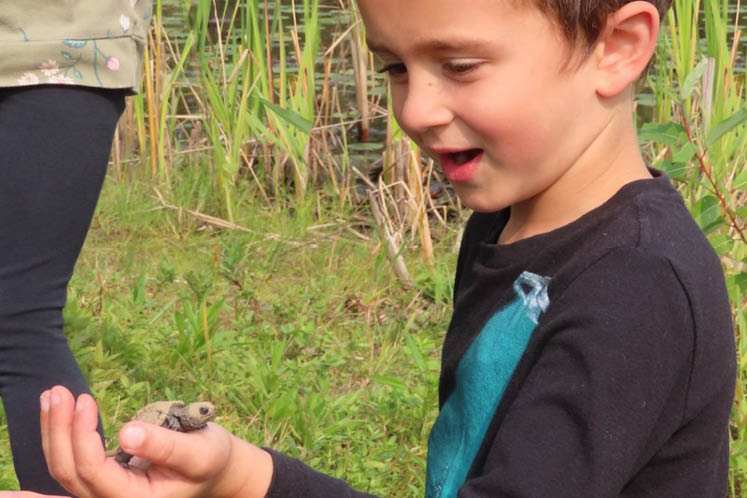
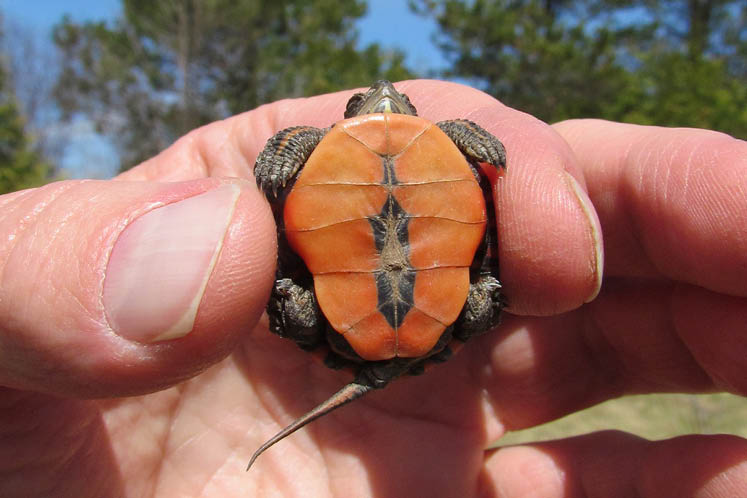
Scales Nature Park also incubates thousands of turtle eggs from other areas of the province – 13,810 in 2025. These are recovered from nests in vulnerable locations such as roadsides and heavily used trails.
To ensure the eggs’ continued viability, it is important that they be handled carefully according to precise guidelines. Egg recovery can be carried out only by individuals who have taken part in training approved by the Ministry of Natural Resources and Forestry and who have the required permits.
A Scales’ “headstarting” program enables young turtles to grow larger in a safe environment and enhances their chances of survival when they are released back into the wild. As required by the MNRF, that release will take place near where their mother was found.
Worryingly, however, Scales Nature Park has lost significant funding over the past few years and may not be able to continue its crucial egg incubation work this year. If this happens, turtle conservation in Ontario will suffer a major setback.
At the trailway, Wright took the hatchlings to the edge of the nearby wetland and gently released each, dispersing them to improve their chances of evading predators.
Most of these tiny turtles will not survive the decade or more needed to achieve sexual maturity. Small turtles are consumed by herons, mink, racoons and large fish. But with every passing year, and every increment of growth, their vulnerability will decline and a small percentage will live long enough to breed.
A few of the 90-plus released turtles could even be alive at the end of this century, after most of the human observers present on that August day have passed away. Some Ontario turtles, including snapping turtles, have the potential to live as long as humans.
Foiling predators
Along with collecting eggs from vulnerable nests, Headwaters Turtle Protectors and other turtle conservation organizations throughout Ontario protect nests from egg predators with wooden frames topped with hardware cloth. Small openings are cut into the bottom of the frames to allow baby turtles to leave the enclosures when they hatch.
Why protect nests? After all, turtles have survived on Earth for millions of years, and throughout that time, their nests have always been predated. Consider, however, that humans have dramatically changed the calculus for turtle survival through road mortality and habitat loss. Adding to those massive threats is another, not often recognized: “subsidized predators.” In our modern human-centric world “meso-predators” (mid-sized predators) such as foxes, skunks and raccoons are thriving. All of them enjoy eating turtle eggs.
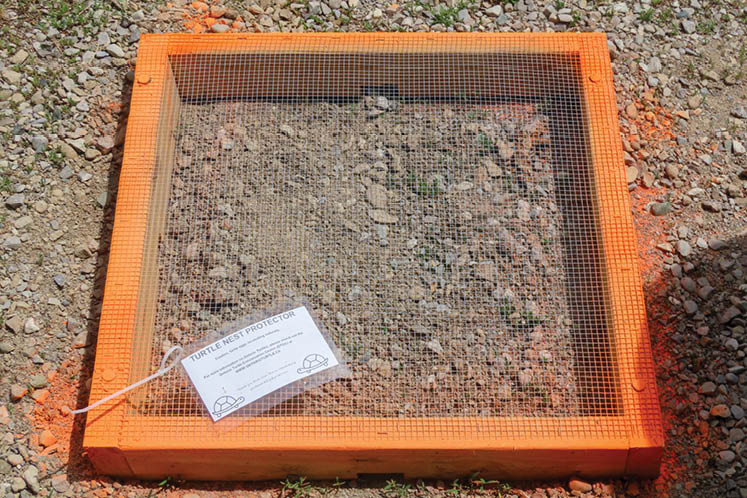
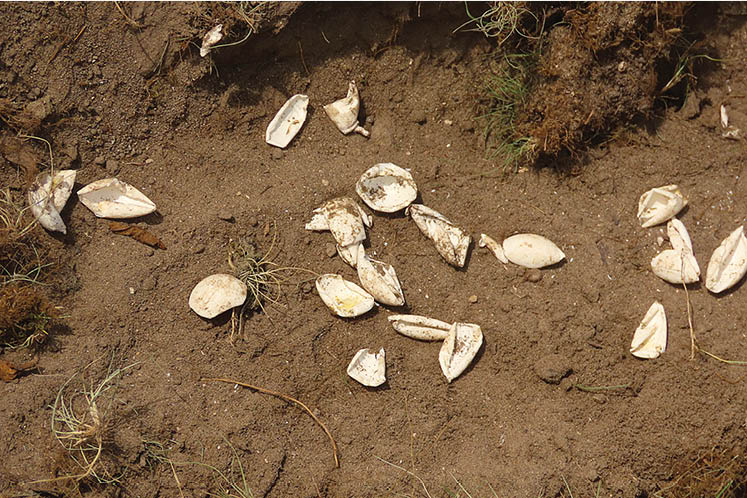
A reason for this abundance is likely the absence of large predators, such as the wolves and cougars that once inhabited southern Ontario and preyed on meso-predators. There is also a phenomenon that biologists call “the ecology of fear”: the simple presence of big predators can change the behaviour of prey animals and their reproductive potential.
The absence of large predators means that meso-predators are no longer constrained by the ecology of fear. They can wander, eat and reproduce freely. Studies at Rondeau Provincial Park and elsewhere have found that the egg mortality of unprotected turtle nests approaches 100 per cent.
Meso-predators are a real problem. These mid-sized predators also maim turtles they encounter on land, gnawing on their legs and heads. Wood turtles, endangered in Ontario, are particularly vulnerable to these land-based assaults because they spend much of their time foraging in woodlands and meadows.
Helpers and care givers
Along with protecting nests and recovering vulnerable eggs, Headwaters Turtle Protectors take injured turtles to local animal care facilities, including the Dufferin Veterinary Hospital in Orangeville and the National Wildlife Centre in Caledon. DVH staff assess the turtles’ needs, offer preliminary treatment and then, if necessary, send the turtles to the Ontario Turtle Conservation Centre in Peterborough, the premier hub for complex turtle care in the province.
Kearsten Allen, a client service representative and animal care attendant at DVH says that last year, the practice took in more than 100 live and dead turtles. Most had been hit by cars, but others – a small minority – were the victims of animal attacks, lawn mower incidents or ingested fishhooks. The hospital’s acceptance of dead turtles might surprise you, but if these turtles are females and carrying eggs, the eggs can be recovered and incubated.
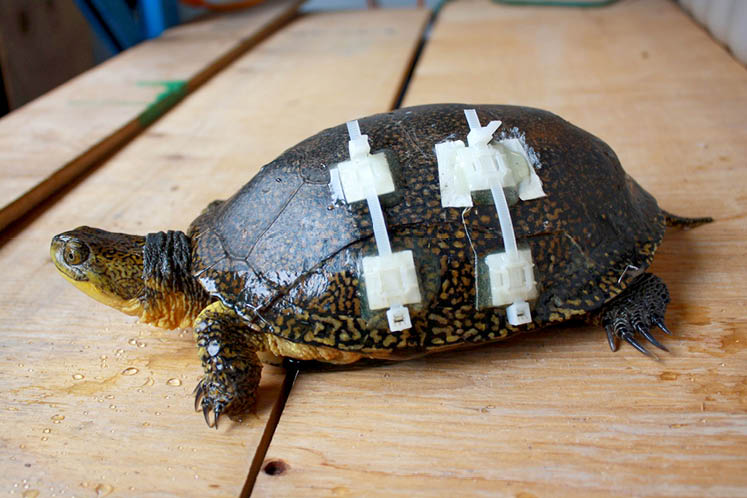
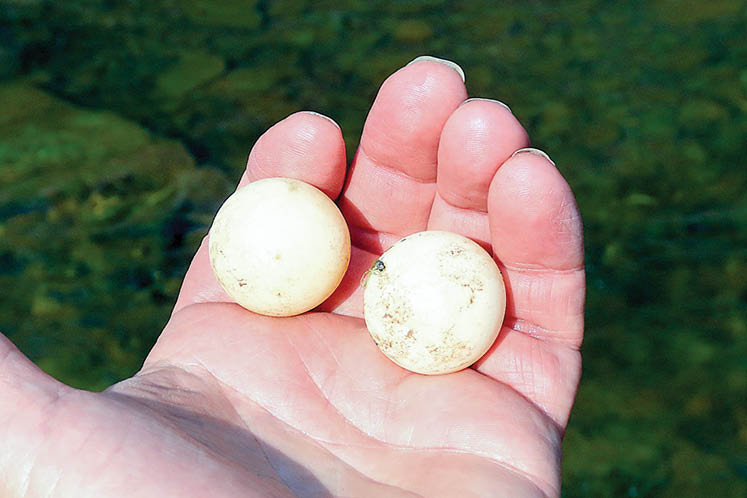
“We serve as a triage centre for turtles,” says Allen, who credits Rachel Kulbacki, a registered veterinary technician at DVH, with teaching her the ins and outs of the crucial triage process. This process, says Allen, involves providing “pain management and temporary shell repair while they wait to be transferred to the OTCC for surgical intervention and rehabilitation.”
When injured turtles admitted to the OTCC recover sufficiently from their injuries, they are released at or near where they were rescued. This is why, says Allen, “one of the most important parts of our job as first responders is getting as much information as possible regarding the rescue location from the transporter.”
Some of the injured turtles that arrive at the National Wildlife Centre are also triaged and sent on to the OTCC for intensive care. But, says wildlife veterinarian Dr. Sherri Cox, the NWC’s co-founder and medical director, the centre also treats and rehabilitates many injured turtles on-site. “Our team of five veterinarians is trained to perform surgery to repair shells, and we have a dedicated rehabilitation team that cares for the turtles while in care.”
Cox adds that the NWC hopes to begin incubating turtle eggs this year, but for now, this will be a small-scale initiative. The centre will care only for eggs recovered from deceased females.
The OTCC receives injured turtles from all over the province. Lisa Browning, the centre’s education co-ordinator, lauds the contributions of a cadre of dedicated “turtle taxi” drivers. “We have an incredible network of 1,600 turtle taxi volunteers who can help transport them to our facility,” she says. “Long-distance trips often involve multiple drivers and ‘turtle relays,’ and in some cases, we’ve even had volunteer pilots fly injured turtles to us from northwestern Ontario!”
The OTCC’s work is truly impressive. In 2025, the centre admitted 2,260 injured and sick turtles and incubated more than 9,000 eggs collected from recovering patients, dead females and disturbed nests. And crucially, they returned more than 4,000 rehabilitated patients and hatchlings to the wild.
Browning explains that the OTCC does more than rehabilitate turtles. “Our veterinary team also holds Turtle Trauma workshops and helps to train other vets and rehabilitators from a variety of clinics and organizations across Ontario,” she says. “We currently have over 40 of these ‘first responders,’ who help provide initial treatment and pain medication to injured turtles.”
Turtle conservation in Ontario is becoming a very big deal. Headwaters Turtle Protectors is but one of a growing number of local turtle conservation organizations spanning the province. In Headwaters and the surrounding area alone, groups fighting for turtles include Halton Hills Turtle Guardians, Heart Lake Turtle Troopers and Wellington Turtle Guardians.
Collectively these organizations represent a remarkable grassroots conservation effort. These ordinary people doing extraordinary things to help these imperilled animals are a cause for optimism and celebration in these dark times for biodiversity and the environment.
The importance of turtles
If you Google the environmental value of turtles, you’ll find lots of references to their role as scavengers. Cleansing wetland waters by eating dead fish and recycling the nutrients contained in those fish, turtles are the maintenance crews of these ecologically important areas. But turtles’ ecological contributions undoubtedly extend well beyond this role through their interactions with other organisms including insects, crustaceans, mollusks, fish, amphibians and plants.
Though more research is needed to better understand turtles’ contributions to wetland health, their value extends far beyond their utility in the environment. Beloved by people, they serve as ambassadors for the preservation of the wild. Saving turtles and their habitats will save myriad other life forms.
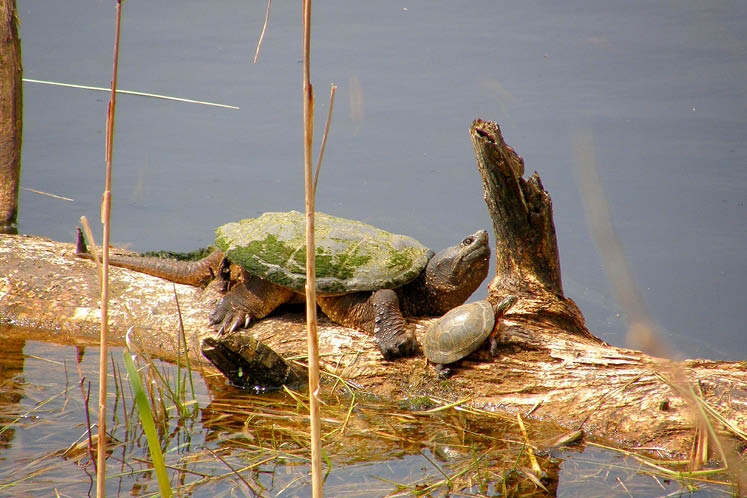
Turtles are ancient beings deserving of a future on our human-dominated planet. They have intrinsic value and they nourish human souls. Imagine wetlands once graced with basking painted turtles and massive cruising snappers, and then emptied of those wondrous beings. A tragedy for the turtles, but also for people who value biodiversity and discovery. Wetlands bereft of turtles would be lonely places.
The soy field near Grand Valley that Maizey, the snapping turtle Wright and her Headwaters Turtle Protector colleagues rescued last June, will soon be developed. The next time Maizey emerges from the Grand River to lay her eggs, she will need to navigate not only a busy road crossing, but likely a new landscape covered by houses. Her days are almost certainly numbered. The sombre beat goes on.
“This too shall pass” is a sentiment tattooed on Wright’s right forearm. One interpretation is that no matter how bad things are now, the situation will improve. I hope, sometimes with scant confidence, that things will get better for turtles. Humanity has hurt them grievously. But people can reflect on this hurt and become invested, as Wright and so many other concerned Ontarians have, in taking action to secure their future. Protecting turtles and other non-human beings is one of the highest orders of goodness: for them, for us, for our children and for generations not yet born.
MORE INFO
What to do if you find an injured turtle anywhere in Ontario
- Take note of the exact location of the turtle so it can be returned after rehabilitation.
- If you’ve found a snapping turtle, know that they require careful handling. This video shows how: vimeo.com/94872148.
- Kearsten Allen of the Dufferin Veterinary Hospital explains the next step: “Call the Ontario Turtle Conservation Centre at 705-741-5000, located in Peterborough. They have a map of all first responder clinics within Ontario and can direct you to the closest clinic. The OTCC can also guide you on the safest ways to properly move or retrieve an injured turtle.” If you find an injured turtle, phone rather than send an e-mail as injured turtles require prompt attention. If you can’t drive the turtle to Peterborough, the OTCC will arrange a turtle taxi and may advise you to take the turtle to a clinic such as the DVH for initial treatment.
- If you are unable to get the turtle to a clinic immediately or you are waiting for a turtle taxi driver, place the turtle in a well-ventilated plastic container with a secure lid and no water. Do not offer the turtle any food or water, and do not treat it in any way. If you must keep the turtle overnight, keep it in the well-ventilated container at room temperature in a dark, quiet place away from pets (information via OTCC).
What to do if you find an injured turtle in Headwaters
- As above, start by calling the OTCC so that, if necessary, they can arrange a turtle taxi relay to Peterborough.
- Then call Dufferin Veterinary Hospital at 519-941-7690. If the clinic is open, you can deliver the turtle to 24 Armstrong Street in Orangeville. Alternatively, contact the National Wildlife Centre near Caledon East at 416-577-4372.
- If those facilities are closed, contact Alexis Wright of Headwaters Turtle Protectors at [email protected] or 519-598-0591. Use these HTP contacts only for injured turtle emergencies or if a turtle is nesting in a dangerous location, such as a roadside.
If you have a general query for Headwaters Turtle Protectors or have found a nesting turtle, connect with them via their Facebook page.
Turtle conservation organizations
ONTARIO TURTLE CONSERVATION CENTRE
2785 Television Rd, Peterborough, 705-741-5000 ontarioturtle.ca
The OTCC is the premier turtle rehabilitation centre in the province. Their website is a rich source of information about turtles and turtle conservation.
More “turtle taxi” drivers are always needed. Volunteer by contacting ontarioturtle.ca/get-involved/volunteer or [email protected]. And if you’d like to donate to the OTCC, visit ontarioturtle.ca/donation-options.
HEADWATERS TURTLE PROTECTORS
Not surprisingly, as newcomers on the conservation scene, Headwaters Turtle Protectors needs volunteers, and stepping up to help doesn’t require a big commitment. “Offer what you can. Do what you can. Just let us know when you are available,” says founder Alexis Wright.
Possible volunteering duties include patrolling your area of Headwaters in the busy turtle nesting season (primarily June), monitoring turtle moms as they nest and helping turtles cross roads — always keeping your safety uppermost in mind. Wright identifies the Palgrave area as especially needful of volunteers as it is one of the epicentres of turtle activity in Headwaters.
To volunteer or make inquiries, contact Headwaters Turtle Protectors through their Facebook page. Donate to Headwaters Turtle Protectors at [email protected]. Donations will be directed to Scales Nature Park to support their egg incubation program.
SCALES NATURE PARK
82 Line 15 South, Oro-Medonte scalesnaturepark.ca
Scales Nature Park, a reptile conservation centre south of Orillia, is open to the public for much of the year. Visit their website to learn more about their multi-faceted education and conservation programs.
As mentioned, their egg incubation program is at risk due to lack of funding. To support this critical program, you can donate directly to Scales. But if you require a tax receipt, you can donate through Amphibian and Reptile Conservation Canada, a main partner with Scales in the Saving Turtles at Risk Today program. Go to the ARCC website (arcc-carc.ca/donate) and earmark the donation for Scales Nature Park.
Related Stories
Three Species That Ontario Has Lost
As habitats shrink, these three animals have become ‘extirpated herptiles’ — reptiles and amphibians that are now regionally extinct in Ontario.
Brief Encounters
A fleeting glimpse of one of these five rare Headwaters species can feel like magic – and like a warning we can’t ignore.
Healing Powers
“How could I not help those animals that don’t have a voice?”

It’s Baby Season at the Wildlife Centre
The spring rush of young, orphaned or injured animals marks the start of another busy year at Procyon Wildlife and Rehabilitation Centre.