
Could a Caledon Health-care Hub Ease the Pressure on Our Strained Rural Hospital System?
Proponents of a collaborative care model say it will improve access to health providers and ease pressure on overburdened hospitals and emergency rooms – all in one place.
When medical problems arise after hours, Katherine, a mother of three under the age of seven, visits the emergency room at the Headwaters Health Care Centre. “We’ve been to the ER so many times, we know exactly what to do,” says the Orangeville resident, joking that she knows the intricacies of the system so well, she could volunteer at the hospital. “We take food, drinks, toys, a blanket because we know once we walk in there, we could be there for up to eight hours.”
Katherine, who asked that her surname be kept private, has also taken her kids to Peel Memorial Centre for Integrated Health & Wellness in Brampton, a 45-minute drive from Orangeville. She’d prefer not to go to the ER for non-emergency issues, such as allergic reactions, fevers and earaches, she says, but sometimes there’s no choice. If she visits a clinic outside her family practice, she risks being dropped as a client. “They’ll call and say, ‘Next time please use the ER,’ because it’s a billing problem,” Katherine says.
Health-care providers – family doctors, ER staff and social workers say they want patients to avoid this tension. However, it’s often inevitable as providers’ services are stretched thin or unavailable.
But short of adding new hospitals, what can be done? Integrated health-care hubs, which bring together a range of non-emergency health care services, are a solution proponents say is already transforming one community in Ontario – and could work here. A 20-acre land donation to Caledon, made by local farmers Bryon and Catherine Wilson in October 2020, is earmarked by the town for such a build.
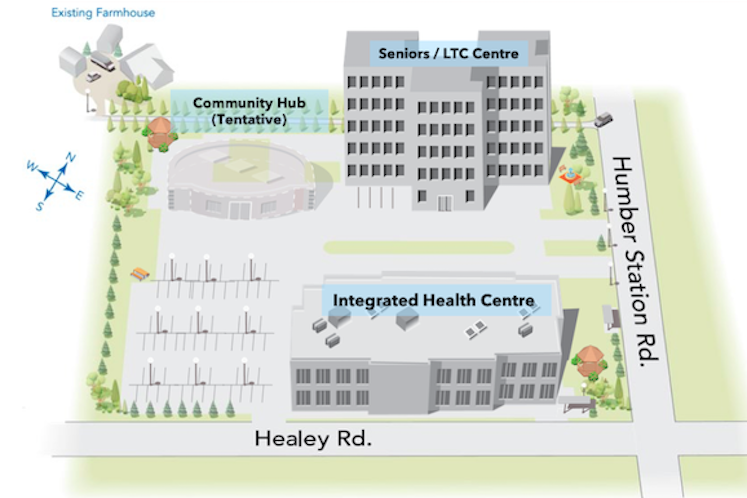
This artist’s drawing of a proposed health care centre just west of Bolton was presented at the Caledon Health Summit in April 2025. It shows plans for an integrated health centre, a seniors centre and a community hub. Click on the image for more information.
Meanwhile, health teams in Dufferin and Caledon are joining forces and pooling resources to help get people the care they need at makeshift hubs – easily, quickly and in their own community.
A scarcity of care
Orangeville’s Headwaters Health Care Centre is the only hospital serving Dufferin County, Caledon and Erin (population: approximately 160,000). Its ER was built in 1997 to accommodate 23,000 annual visits but currently sees over 36,000. There are also long waitlists for doctors in the area. For example, a recent survey found 11 per cent of Caledon residents do not have a physician. Orangeville has five walk-in clinics with limited weekend availability. Bolton has three, while Caledon Village has one and Erin has none. Brampton, the closest large city (population: 800,000), has just one 24-hour hospital and an urgent care centre that also offers non-urgent outpatient care.
Health care in Ontario is chronically underfunded. A 2024 report from the Financial Accountability Office found that since 2008, Ontario’s health spending per capita has consistently ranked near or at the lowest in Canada, a situation some fear will lead to more health care privatization. Public hospitals often receive insufficient government funding to purchase or replace equipment.
For example, nearly 100 per cent of funding for equipment at the Headwaters Health Care Centre comes from private donations. Recently, the Headwaters Health Care Foundation, which raises funds for the hospital, generated $18 million through the Smart Headwaters campaign to expand the centre’s emergency and diagnostic imaging departments, including a new MRI suite.
Rural areas are disproportionately affected by Ontario’s health-care crisis. According to a 2024 report from the Rural Ontario Municipal Association, rural Ontarians are losing primary care providers at a rate of 12 per cent a year – four times the rate in urban centres. Some of the other issues impacting rural communities include a lack of walk-in clinics, frequent emergency department closures, acute shortages in health-care workers and long travel times to access health services.
Delivering care differently
Dave Pearson, executive director of the Hills of Headwaters Collaborative Ontario Health Team, has been advocating for health-care hubs as a practical way to fill the gaps in the system. He describes a hub model as being a “one-stop shop” where a variety of health-care providers, specialists and social workers all work together, ideally in one location. The goal is to increase access for patients and make it easier for providers to give referrals, do follow-ups and ensure patients get long-term continuity of care, all within their community. “A hub should be designed around the needs of the residents, rather than the needs of the providers,” he explains.
At the Caledon Health Summit earlier this year, Pearson discussed the hub model in light of projections that Caledon’s population is expected to grow from approximately 76,000 to 300,000 by 2051. In particular, the over-65 population is rising, which is why a senior’s wellness centre is a key focus, he says. “We’re trying to bring the care providers together to create the type of future that we want for the community and think about how we use space differently,” Pearson says.
Pearson cites the Rexdale CHC Community Hub as an example to watch. In 2013, the Rexdale Community Health Centre, located in north Etobicoke, transformed a former high school into the Rexdale CHC Community Hub, and relocated all its health services there – alongside other offices, meeting rooms and community kitchen space.
So in addition to health care, the residents can also seek help with what Pearson calls “the social determinants of health,” including settlement and employment services, legal aid, youth and senior services, housing support and diet guidance among its dozens of services.
Executive Director Safia Ahmed says she appreciates how the Rexdale hub fosters teamwork. “It’s not just about sharing a physical building – it’s also about working together and communicating with each other,” she explains. “If someone comes in with diabetes, we’ll walk with them to the specialist and introduce them.” The centre is operating at full capacity, offering dozens of health and social services that continually adapt as the community demographics evolve, says Ahmed.
Baby steps in Orangeville and Caledon
Pearson says local providers are positioning the W&M Edelbrock Centre municipal building in Orangeville as a hub. The Dufferin County Community Paramedic Program, TeleCheck and the north office of the Bethell Hospice are currently co-located at the facility, and Dufferin Child & Family Services operates a youth wellness and health program there. In the coming months the HOHC OHT partners plan to relocate more programs there. And in November, Pearson says the HOHC OHT will be applying to the Ministry of Health for a primary care team that includes doctors and nurses.
Building any kind of new large-scale publicly funded health facility – such as the one proposed in Caledon on donated land – will take time. Meanwhile, the HOHC OHT has also begun setting up smaller “spokes” that draw specialized or targeted health services directly into communities.
One example is a series of one-off Care Days at the Caledon East Community Complex. These offer access to a range of non-urgent services in one location. A seniors’ event held in September focused on falls prevention, cognitive assessments, future planning, caregiver support and medication information. Previous events offered services around crisis support, foot care, mental health, addictions, housing support, menopause and women’s preventative cancer screening, smoking reduction and diabetes. More than 200 people have attended the Care Days so far, Pearson says, and staff have found that attendees access at least five services during their visit.
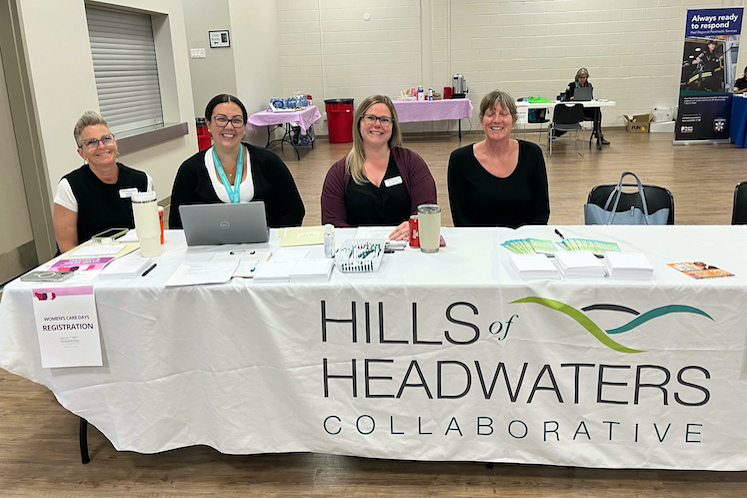
“Pretty soon, we’ll be coming up with a model where we can have Care Days occurring simultaneously in Caledon and Dufferin,” he explains, adding that, like the Rexdale centre, they plan to add a mobile component that can travel to harder-to-reach rural geographies. Upcoming events include a Youth Care Day on November 19 at the Edelbrock Centre, and a Care Day at the Honeywood Arena on November 20.
A bonus: wooing more health care professionals to Headwaters
Frustrating. Disjointed. Difficult to navigate. This is how Dr. Mike Gagnon, who has practised family medicine in Bolton for almost two decades, describes the current state of the health-care system. Having also worked with the Headwaters Health Care Centre in Orangeville and the Bethell Hospice in Inglewood, he has seen the challenges community members and practitioners face when trying to navigate the system.
Gagnon sits on the HOHC OHT’s committee, advising on the plan and design of the team-based care models. He believes that the collaborative approach of a health-care hub must be the future of health care, not only for patients, but also to attract and retain desperately needed doctors and health-care workers.
Some Bolton-based family doctors over the age of 70 have delayed retirement because there are no successors, he says. At the same time, fewer new doctors are choosing to go into family medicine due to the difficulties of managing a practice.


“If you’re a family doctor, you have to also run a business. It’s not just practising medicine,” Gagnon says, adding that new graduates are more attracted to working in a hospital with easier access to other health team members and referral systems. With health-care hubs, however, physicians can walk in, bring their stethoscopes, practise medicine and walk out at the end of the day, Gagnon says. “It’s going to be a case of ‘if you build it, they will come.’”
But there’s a long road ahead. The Strategic Roadmap for the Caledon hub, presented to Peel Council in May by Peel Region Health Services, outlines plans for an integrated health centre that provides team-based primary care and specialist care, as well as mental health and addictions support, allied care services – including physiotherapy, diagnostic and pharmacy – and urgent care. A seniors’ wellness village with long-term care and adult day services, respite care and drop-in wellness programs are also part of the plan.
Eight experts, including Pearson, are serving on a project advisory committee to provide guidance in areas such as site components, timelines and resources. In 2026, pending budget approval, the next steps in the roadmap include conducting a feasibility assessment, as well as performing “community engagement” and “partnership development.”
Communicating change
Once the hub is up and functioning – which could be as early as 2030, according to the strategic plan – the challenge will be alerting the public, Pearson says. Drawing attention to new health-care services, such as Care Days and mobile clinics, can be difficult.
Orangeville mom Katherine says she welcomes any plans that make seeing a doctor easier and faster. For the hubs and spokes to be successful, the information should be easily accessible, and the locations should be nearby, she says. “We need more opportunities to not use the hospital because there are so many non-emergencies sitting in there.”
Pearson ultimately envisages a day when, instead of looking for the blue “H” road sign that leads you to a hospital, people will look for a “C” sign – the “C” signifying care – that leads to a centralized medical facility open seven days a week.
“What we want is for you to be able to walk in the door and no matter what your needs are, you’ll be taken care of.” In Caledon you’re never more than 15 minutes away from a library, Pearson says. “That’s the way that we need to start thinking about the delivery of health and social care as well.”
Related Stories

Explainer: Why Is Controversy Swirling Around Caledon’s ‘Swan Lake’?
While activists and their allies fight to protect a body of water at a rehabilitated gravel pit, the Town of Caledon is considering new bylaws that could alter future land use regulations.

Beyond the Trade War
A Q&A with writer and pollster Michael Adams on tariffs, Canada’s recent election, and our strained relations with our neighbour to the south.

Building the Case Against Illegal Trucking Yards
How the rise of truck depots on Caledon land zoned for agricultural use has galvanized local governments and activists to work together to turn back the tide – if it isn’t already too late.

Still Waiting for the Bus
Rural communities are built for drivers – but what about everyone else? As new transit efforts gain ground, riders are hoping for more than a lift.